

What Is the Difference Between Premenopause and Perimenopause?

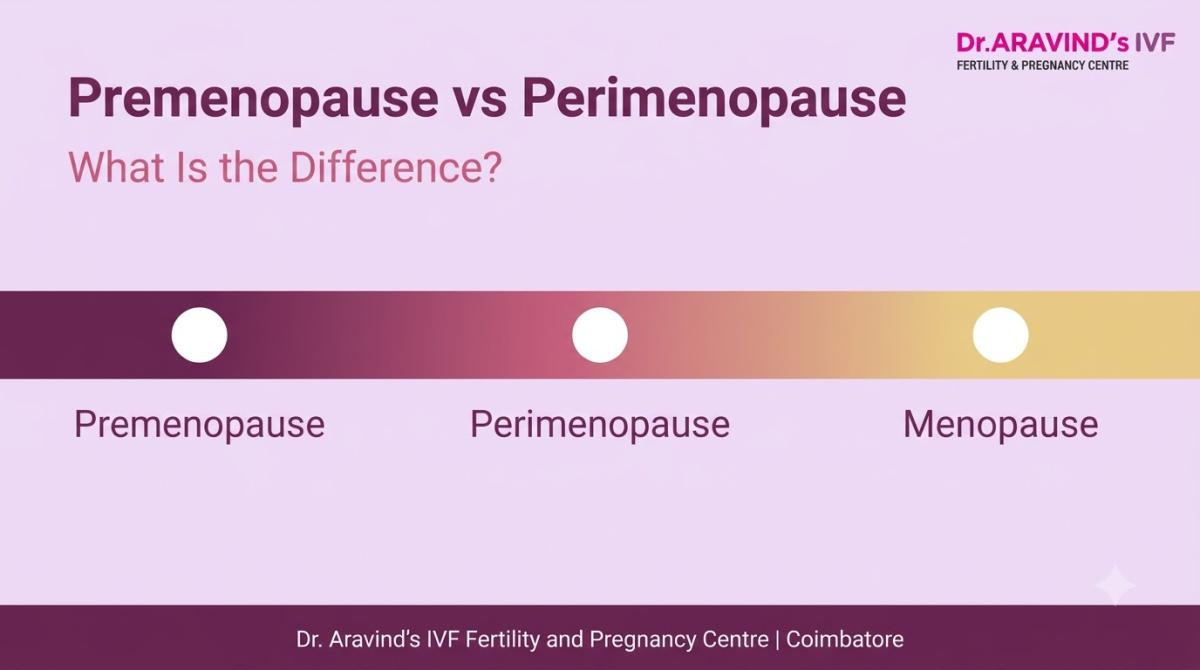
A woman in her early forties notices her period arriving a few days late. Then early. Then heavier than usual. She searches online and finds two words that look almost identical: premenopause and perimenopause.
Are they the same thing? Not quite. And knowing which stage you are in changes what you expect, what you test and when you ask for help.
At the best IVF hospital in Coimbatore, women often arrive with exactly this question, especially when they are also trying to conceive. Here is the clear answer.
What Is the Difference Between Premenopause and Perimenopause?
Difference Between Premenopause and Perimenopause in Simple Words
The short answer: premenopause is the long stretch of reproductive years before any menopause-related change begins. Perimenopause is the transition phase when hormones start to shift and cycles begin to change.
| Premenopause | Perimenopause | |
|---|---|---|
| Meaning | Reproductive years before the transition | The transition towards menopause |
| Periods | Usually regular | Often irregular |
| Hormones | Stable pattern | Oestrogen and progesterone fluctuate |
| Typical symptoms | None related to menopause | Hot flushes, sleep changes, mood changes |
| Pregnancy possible | Yes | Yes, but less likely |
Some doctors also use “premenopause” loosely to mean the years just before perimenopause. This is why the terms get mixed up. If a report uses either word, ask your doctor exactly what is meant.
What Is Premenopause?
Premenopause Meaning: The Fertile Years Before the Change
Premenopause covers the years from your first period until the first signs of transition. Cycles are generally regular, ovulation happens most months, and hormone levels follow a predictable pattern.
There are no menopause symptoms at this stage. Fertility is at its highest in the twenties and begins to decline gradually from the early thirties, even though periods still look normal.
What Is Perimenopause?
Perimenopause Symptoms and Age: When the Transition Begins
Perimenopause is the phase leading up to menopause. For many women it begins in the mid-forties, though it can start in the late thirties or earlier. It usually lasts several years.
Common signs include:
- Periods that become shorter, longer, heavier or lighter
- Skipped periods
- Hot flushes and night sweats
- Poor sleep and mood changes
- Vaginal dryness
During this phase, ovulation becomes less predictable and ovarian reserve falls. FSH levels may rise and AMH usually drops. Menopause is confirmed only after 12 months without a period.
Can You Get Pregnant in Perimenopause?
Perimenopause and Fertility: What Women Should Know
Yes. Pregnancy is still possible because ovulation still happens, only less regularly. But the chance falls year by year, and egg quality declines with age.
This is why a woman over 40 who is trying to conceive should not wait to see if her cycle “settles”. Earlier assessment keeps more options open. Do not rely on an irregular cycle as contraception either, if pregnancy is not wanted.
For a fuller breakdown of the two stages, read our guide on the difference between premenopause and perimenopause.
Best IVF Hospital in Coimbatore: When to See a Specialist
Fertility Evaluation in Coimbatore for Women Over 35
Seek an assessment if you are over 35 and have tried for six months without success, if your periods have become irregular, or if you are under 40 with very irregular or absent cycles.
A fertility evaluation looks at AMH, FSH, antral follicle count and ovulation, along with your partner’s semen analysis. At Dr. Aravind’s IVF Fertility and Pregnancy Centre, the best IVF hospital in Coimbatore, both partners are assessed together so the plan is built on the full picture.
An irregular cycle is not always perimenopause, and it does not always mean fertility has ended. The right tests tell you where you stand.
Dr. Aravind’s IVF Fertility and Pregnancy Centre, the best IVF hospital in Coimbatore, can assess your hormones, ovarian reserve and options in one consultation.
📞 +91 90 2012 2012
📧 [email protected]
🌐 www.draravindsivf.com












Comments (0)