

What Is an AI Voice Agent? A Practical Guide for Sales
An AI voice agent is software that holds a spoken, two-way conversation with a person over a phone call or voice channel, understands what they say, and responds in natural speech.
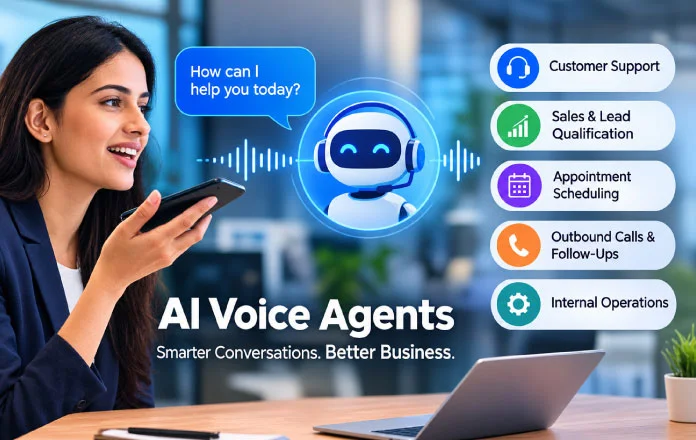
An AI voice agent is software that holds a spoken, two-way conversation with a person over a phone call or voice channel, understands what they say, and responds in natural speech. For sales teams, it means calls like first-touch outreach, lead qualification and appointment booking can be handled at any hour without a person dialling every number.
This guide explains how voice agents work, where they fit in a sales process, and how to start without hurting your customer experience.
What is an AI voice agent, and how does it work?
A voice agent chains together a few technologies that run in a fraction of a second:
- Speech recognition turns the caller's words into text.
- A language model works out what the caller means and decides what to say or do next, guided by your script, product details and rules.
- Speech synthesis turns the reply into a natural-sounding voice.
- Integrations let the agent act: check a calendar, update the CRM, send a text or transfer the call to a human.
Unlike a recorded message, the agent can handle interruptions, follow-up questions and answers you did not script word for word.
AI voice agent vs IVR vs chatbot
People often confuse these three. The difference is how much freedom the system has to understand and respond.
|
Traditional IVR |
Chatbot |
AI voice agent |
|
|---|---|---|---|
|
Channel |
Phone |
Text (web, app, messaging) |
Phone and voice channels |
|
How the caller interacts |
Presses keys or says set phrases |
Types messages |
Speaks naturally |
|
Handles unscripted questions |
No |
Partly |
Yes, within its instructions |
|
Takes actions (book, update CRM) |
Limited |
Yes, if integrated |
Yes, if integrated |
|
Best for |
Routing calls to a menu |
Website and chat support |
Outbound and inbound sales and service calls |
An AI voice agent is not a replacement for your best salespeople. Think of it as the first conversation that decides who should reach them.
Where AI voice agents fit in a sales process
The best use cases share one trait: they are repetitive, time-sensitive and follow a clear structure.
- Instant lead response. The agent calls a new web or ad lead within a minute, while interest is still high, and asks the first few qualifying questions.
- Lead qualification. It checks budget, timeline, need and decision-maker, then passes warm leads to a rep with a call summary.
- Appointment setting. It offers time slots, books the meeting on a live calendar and sends a confirmation.
- Follow-up and no-show recovery. It chases leads who went quiet, missed a demo or abandoned a quote.
- Database reactivation. It works through old leads and customers to find who is ready to talk again.
- After-hours inbound calls. It answers missed calls at night and weekends, so enquiries are not lost.
CloudTalk's roundup of industry data notes that about 40% of B2B web traffic arrives outside business hours, which is where an always-on agent helps most.
Benefits and limits
Benefits
- Speed. Leads get a call in minutes, not days. Speed to lead is one of the strongest predictors of whether a prospect is ever reached.
- Coverage. Every lead gets called, including at 9 pm and on weekends.
- Cost. One vendor-reported benchmark puts an AI-handled call at roughly $0.30-$0.50 against $6-$12 for a human-handled call. Treat such figures as directional until you test them on your own data.
- Better use of your reps. People spend their time on conversations that are already qualified.
- Clean data. Every call is transcribed and logged, so nothing depends on a rep remembering to update the CRM.
Limits
- Conversion on live conversations is lower. The same source reports AI agents turning conversations with decision-makers into a next step at 12-18%, against 22-31% for human reps. Use the agent to open the door, not to close the deal.
- Complex or emotional conversations need a person. Set clear rules for when the agent transfers the call.
- Trust and compliance matter. Be upfront that the caller is speaking with an AI, follow local rules on outbound calling and consent, and honour do-not-call requests.
- Quality depends on setup. A weak script or poor CRM data leads to poor calls.
The figures above are vendor-reported, Clouducaasso check them against your own pilot results before building a business case.
How to get started in five steps
- Pick one use case. Instant lead response or appointment setting is a good first choice: clear goal, easy to measure.
- Write the conversation. Define the opening line, the three to five qualifying questions, the objections you expect and the point at which the call goes to a person.
- Connect your tools. Link the agent to your CRM, calendar and phone system so it can act, not just talk.
- Pilot on a small slice. Start with one lead source or one region. Listen to recordings every week and fix what sounds off.
- Measure against a baseline. Track contact rate, qualified leads, meetings booked and cost per meeting, and compare with your current process before you scale.
FAQs
Will an AI voice agent replace my sales team? No. It handles first contact and follow-up so your reps can focus on conversations that need judgment and relationship-building.
Do callers know they are talking to an AI? They should. Disclose it at the start of the call. Honesty builds trust and, in many places, is a legal requirement.
Can it work with my CRM? Most platforms connect to popular CRMs and calendars. Confirm that yours is supported before you commit.
How long does setup take? A focused pilot with one use case can often go live in a few weeks, depending on integrations and how clear your script is.
Want to see how an AI voice agent could work for your sales process? Book a demo and we'll map out a pilot for your team.

Cloud Ucaas provides voice broadcasting software that helps businesses deliver automated voice messages to thousands of contacts within minutes. Upload your contact list, record or convert text to speech, and schedule campaigns for the right time. Use it for promotions, appointment reminders, payment alerts, event invitations, and emergency notifications. The platform supports personalized messages, call scheduling, and real-time reporting, so you can see answered calls, responses, and delivery results at a glance. Built for speed and reliability, our solution lowers outreach costs, saves your team time, and helps you reach customers directly through the channel they trust most: a simple phone call.






Comments (0)