

Low Calorie Snacks Market Gains Momentum with Demand for Healthier Food Choices
The global low-calorie snacks market size was valued at USD 13.52 billion in 2025

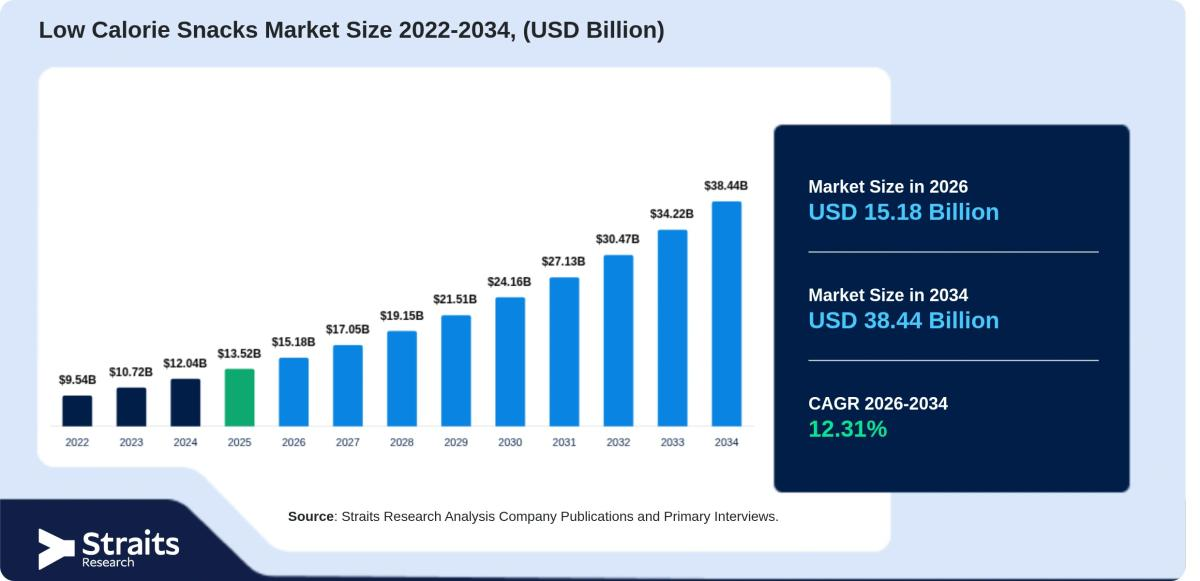
Low-Calorie Snacks Market Size, Forecast to 2034
Low-calorie snacks are food products formulated to provide fewer calories than conventional snack options while offering convenience, taste, and nutritional value. These products include baked snacks, fruit-based snacks, low-calorie confectionery, protein bars, popcorn, and other portion-controlled foods. Their popularity is supported by changing dietary habits, growing interest in weight management, and demand for convenient food options that align with health-conscious lifestyles.
The global low-calorie snacks market size was valued at USD 13.52 billion in 2025 and is projected to grow from USD 15.18 billion in 2026 to USD 38.44 billion by 2034, registering a CAGR of 12.31% during the forecast period from 2026 to 2034.
Market Drivers
Growing Health and Weight Management Awareness
Increasing awareness of balanced diets and calorie consumption is encouraging consumers to choose snacks with lower energy content. Weight management goals and interest in healthier eating habits are supporting demand for products with reduced sugar, fat, and portion sizes. Food manufacturers are responding with baked snacks, low-calorie confectionery, fruit-based products, and other alternatives that offer convenience without compromising taste.
Rising Demand for Convenient and Healthy Snacking
Busy lifestyles and changing meal patterns have increased the consumption of snacks between regular meals. Consumers are seeking portable food options that combine convenience with nutritional value. Low-calorie snack bars, packaged fruit products, baked crisps, and portion-controlled snacks are gaining attention among working professionals, students, and health-conscious consumers.
Product Innovation and Clean-Label Formulations
Food manufacturers are introducing new flavors, natural ingredients, plant-based formulations, and reduced-sugar alternatives to attract health-conscious buyers. Improvements in food processing and ingredient technology are also helping companies maintain taste and texture while lowering calorie content. These product innovations are expanding the availability of low-calorie snacks across mainstream retail channels.
Market Challenges
Taste and Texture Limitations
Reducing sugar and fat can affect the taste, texture, and overall eating experience of snack products. Consumers may hesitate to purchase low-calorie alternatives if they do not provide the same satisfaction as conventional snacks. Manufacturers must balance nutritional objectives with flavor, freshness, and product quality to encourage repeat purchases.
Higher Production and Ingredient Costs
Low-calorie snack production may require specialized ingredients, alternative sweeteners, natural additives, and additional formulation processes. These requirements can increase manufacturing expenses, particularly for premium and organic products. Higher production costs may translate into elevated retail prices, limiting adoption among price-sensitive consumers.
Regulatory and Product Labeling Requirements
Food manufacturers must comply with food safety regulations, nutritional labeling standards, and permitted health and nutrition claims across different markets. Differences in regulatory requirements can complicate product launches and international distribution. Accurate calorie declarations and transparent ingredient information are essential for maintaining consumer trust and avoiding compliance issues.
Market Segmentation
The low-calorie snacks market is segmented by type, nature, packaging, and distribution channel.
- By Type: Sweet Snacks, Savory Snacks, Others
- By Nature: Organic, Conventional
- By Packaging: Pouches, Cans, Jars, Others
- By Distribution Channel: Business to Business, Business to Customer
Regional Insights
Europe Low-Calorie Snacks Market Analysis
Europe dominated the low-calorie snacks market with a 35.8% share in 2025. Strong consumer interest in healthier food choices, established packaged food industries, and widespread availability of reduced-calorie products support regional demand. The presence of established food manufacturers and well-developed retail networks also encourages product innovation and wider distribution across the region.
North America Low-Calorie Snacks Market Analysis
North America is projected to register the fastest growth, with a CAGR of 7.86% during the forecast period. Rising interest in weight management, demand for convenient food options, and expanding availability of low-sugar and reduced-fat snacks support regional development. Product launches across protein snacks, baked alternatives, and portion-controlled formats are also creating new opportunities for manufacturers.
Asia Pacific Low-Calorie Snacks Market Analysis
Asia Pacific offers significant growth opportunities due to urbanization, changing dietary habits, and expanding demand for packaged food products. Consumers in China, India, Japan, and other regional markets are showing greater interest in convenient snacks with nutritional benefits. Expanding modern retail networks and e-commerce platforms are also improving product accessibility.
Middle East and Africa Low-Calorie Snacks Market Analysis
The Middle East and Africa market is supported by changing food preferences, urban population growth, and increasing availability of packaged snack products. Demand for healthier alternatives is creating opportunities for manufacturers to introduce reduced-sugar, baked, and portion-controlled snacks. Retail expansion and the development of modern food distribution channels are expected to support further market adoption.
Latin America Low-Calorie Snacks Market Analysis
Latin America is witnessing demand for healthier packaged food options as consumers become more attentive to nutritional content and ingredient quality. Brazil and Mexico offer opportunities through their established snack food industries and expanding retail networks. Product innovation, competitive pricing, and wider distribution are likely to influence regional market development.
Key Players Analysis
The global low-calorie snacks market includes established food and beverage companies alongside specialized health-focused snack manufacturers. Competition is shaped by product innovation, ingredient quality, pricing, brand recognition, and distribution reach. Companies are expanding their portfolios through reduced-sugar products, baked snack alternatives, organic formulations, and convenient packaging to address changing consumer preferences.
Key players operating in the market include:
- Conagra Brands, Inc.
- Danone S.A.
- General Mills, Inc.
- The Hain Celestial Group, Inc.
- The Hershey Company
- The Kraft Heinz Company
- Mondelez International, Inc.
- Nestlé S.A.
- PepsiCo, Inc.
- Simply Good Foods Co.
For Detailed Insights, Visit: https://straitsresearch.com/report/low-calorie-snacks-market
About Us
Straits Research is a research and intelligence organization specializing in research, analytics, and advisory services, providing business insights and market research reports across diverse industries.
Contact Us
- Email: [email protected]
- U.S.: +1 646 905 0080
- U.K.: +44 203 695 0070








Comments (0)