

Sodium Silicate Market 2034 Outlook: A Steady Growth Path at 3.7% CAGR
The global sodium silicate market size was valued at USD 8.58 billion in 2025

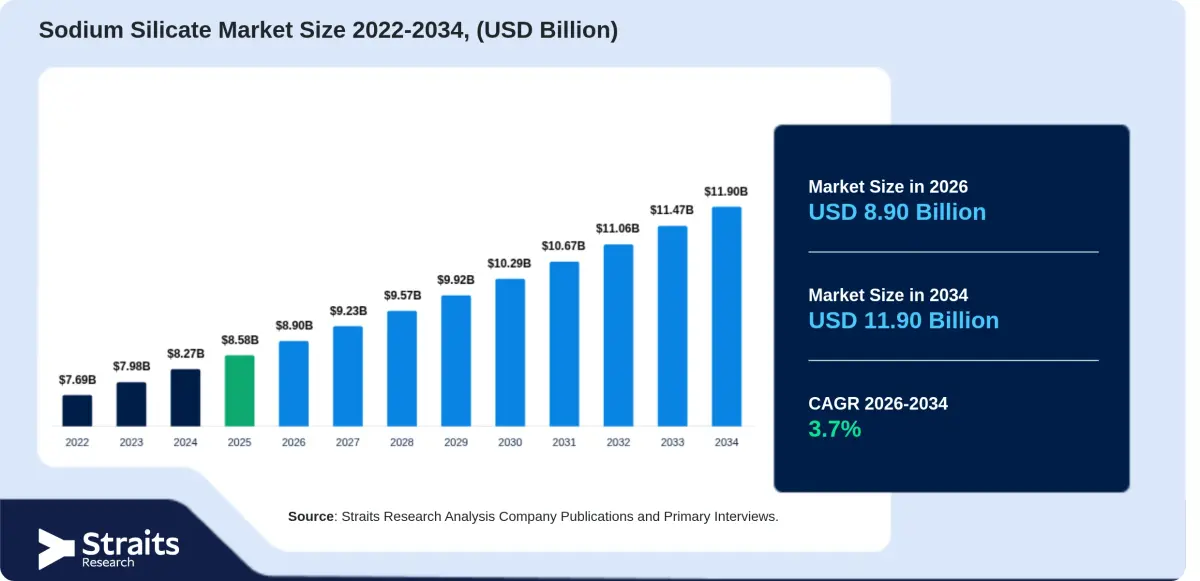
Sodium Silicate Market Size, Forecast to 2034
Sodium silicate, commonly known as water glass, is an inorganic chemical compound produced by combining sodium oxide and silica. It is available in liquid and solid forms and serves as an important raw material in detergents, adhesives, paints, refractories, construction materials, and pulp and paper processing. Its binding, cleaning, corrosion-inhibiting, and chemical-stabilizing properties make it valuable across several industrial applications.
The global sodium silicate market size was valued at USD 8.58 billion in 2025 and is projected to grow from USD 8.90 billion in 2026 to USD 11.90 billion by 2034, registering a CAGR of 3.7% during the forecast period (2026–2034). Asia Pacific dominated the market in 2025, accounting for 42.6% of global revenue.
Market Drivers
Rising Demand for Detergents and Cleaning Products
The extensive use of sodium silicate in household and industrial detergents supports market demand. Its alkalinity, buffering capacity, and corrosion-inhibiting properties improve cleaning performance and help protect metal components in washing equipment. Expanding consumption of cleaning products across residential, commercial, and industrial settings continues to create demand for sodium silicate-based formulations.
Expanding Construction and Infrastructure Activities
Sodium silicate plays an important role in construction materials, including concrete treatments, cement formulations, waterproofing compounds, adhesives, and fire-resistant products. Its binding and sealing properties improve material durability and performance. Infrastructure development, urban construction, and demand for longer-lasting building materials are supporting its adoption across the construction industry.
Increasing Use in Chemical and Industrial Manufacturing
Sodium silicate serves as a raw material in silica gel, zeolite, catalyst, and other specialty chemical production. Its chemical versatility allows manufacturers to develop products for applications such as coatings, purification, and industrial processing. Expanding downstream chemical production and demand for application-specific silicate formulations are strengthening its industrial importance.
Market Challenges
High Energy Consumption in Manufacturing
Conventional sodium silicate production involves high-temperature furnace operations that require substantial energy. Fluctuations in electricity and fuel prices can increase manufacturing expenses and reduce profit margins. These cost pressures create challenges for producers operating in regions with high industrial energy costs.
Raw Material Price and Supply Volatility
The production process depends on inputs such as silica sand, sodium carbonate, and sodium hydroxide. Changes in the availability and prices of these materials can affect production costs and supply consistency. Dependence on concentrated raw material supply sources also exposes manufacturers to procurement risks and potential production disruptions.
Transportation and Handling Costs
Liquid sodium silicate contains a significant proportion of water, which increases transportation weight and delivered costs. Long-distance distribution can therefore become less economical, particularly for suppliers serving customers located far from manufacturing facilities. These logistics challenges encourage regional production and localized supply arrangements.
Market Segmentation
The sodium silicate market is segmented by form, type, grade, application, and end-user.
- By Form: Crystalline, Anhydrous
- By Type: Liquid, Solid
- By Grade: Neutral, Alkaline
- By Application: Paints, Adhesives, Refractories, Tube Winding, Detergent, Catalyst
- By End-User: Pulp and Paper, Construction, Automotive
Regional Insights
Asia Pacific Sodium Silicate Market Analysis
Asia Pacific dominated the sodium silicate market with a 42.6% share in 2025. Strong chemical manufacturing capabilities, expanding construction activities, and substantial detergent and pulp and paper production support regional demand. China, India, and Japan remain important consumption and manufacturing centers due to their established industrial bases and demand for sodium silicate-based products.
North America Sodium Silicate Market Analysis
North America is projected to register the fastest growth, with a CAGR of 6.71% during 2026–2034. Demand from construction, detergents, automotive manufacturing, and water treatment applications supports regional expansion. Investments in domestic chemical production and demand for industrial-grade silicates also contribute to market development.
Europe Sodium Silicate Market Analysis
Europe benefits from established chemical manufacturing, automotive production, construction activities, and detergent industries. Demand for specialized silicate grades and efficient industrial formulations supports market development. Manufacturers are also focusing on production efficiency and product customization to serve diverse industrial applications.
Middle East and Africa Sodium Silicate Market Analysis
The Middle East and Africa market benefits from infrastructure development, construction investment, and expanding industrial activities. Water treatment requirements and demand for construction chemicals provide additional applications for sodium silicate. Industrial diversification and investments in regional manufacturing capabilities are expected to support market development.
Latin America Sodium Silicate Market Analysis
Latin America experiences demand from construction, detergent manufacturing, pulp and paper processing, and industrial chemical production. Brazil represents an important market due to its manufacturing base and infrastructure activities. Improvements in industrial capacity and demand for construction materials are expected to create further opportunities.
Key Players Analysis
The global sodium silicate market comprises established chemical manufacturers and specialized silicate producers competing through production capacity, product quality, distribution networks, and application-specific formulations. Companies are focusing on manufacturing efficiency, product diversification, and the development of high-purity silicates to serve detergents, construction, automotive, pulp and paper, and specialty chemical applications.
Key players operating in the market include:
- BASF SE
- CIECH S.A.
- Evonik Industries AG
- Kiran Global Chem Limited
- Merck KGaA
- Nippon Chemical Industrial Co., Ltd.
- Occidental Petroleum Corporation
- PPG Industries
- PQ Corporation
- Shanti Chemical Works
- Tokuyama Corporation
- W. R. Grace & Co.
For Detailed Insights, Visit: https://straitsresearch.com/report/sodium-silicate-market
About Us
Straits Research is a research and intelligence organization specializing in research, analytics, and advisory services, providing business insights and market research reports across diverse industries.
Contact Us
- Email: [email protected]
- U.S.: +1 646 905 0080
- U.K.: +44 203 695 0070






Comments (0)