

Automotive Polymer Composites Market Size, Share and Growth Forecast 2026-2034
Global automotive polymer composites market size reached USD 10.6 Billion in 2025. Looking forward, IMARC Group expects the market to reach USD 17.8 Billion by 2034, exhibiting a growth rate (CAGR) of 5.73% during 2026-2034

Market Overview:
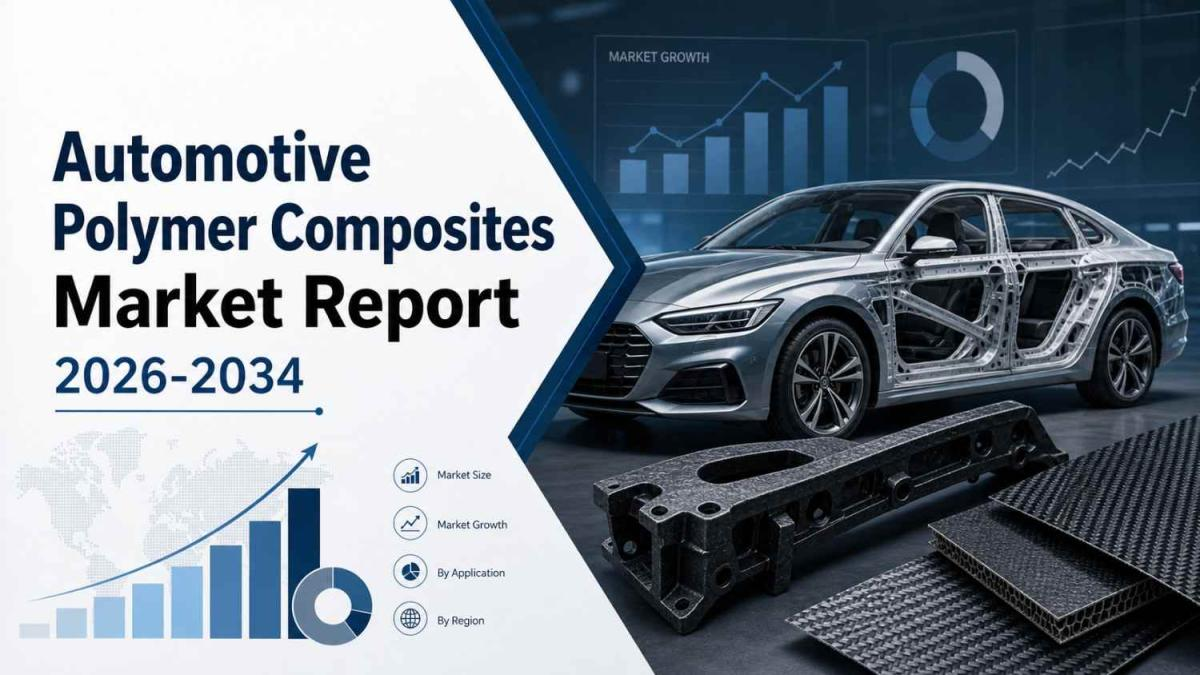
According to IMARC Group’s latest research publication, “Automotive Polymer Composites Market Size, Share, Trends and Forecast by Resin Type, Product, Manufacturing Process, Application, End Use, and Region”, the global automotive polymer composites market size reached USD 10.6 Billion in 2025. Looking forward, IMARC Group expects the market to reach USD 17.8 Billion by 2034, exhibiting a growth rate (CAGR) of 5.73% during 2026-2034, with market fundamentals remaining highly favorable. Asia Pacific currently dominates the market, driven by the expanding automotive industry, surging sales of electric vehicles, and rising adoption of eco-friendly materials.
This detailed analysis primarily encompasses industry size, business trends, market share, key growth factors, and regional forecasts. The report integrates research findings, market assessments, and data from different sources. It covers market dynamics such as drivers and challenges, and highlights growth opportunities, technological improvements, emerging trends, and innovations. It also provides a regional evaluation and a competitive landscape analysis.
How Lightweighting and Emission Regulations Are Reshaping the Automotive Polymer Composites Market
-
The automotive industry is increasingly focused on reducing vehicle weight to improve fuel efficiency and reduce emissions, with polymer composites being lighter than traditional materials such as steel or aluminum and making them an attractive option for automakers.
-
Governments of numerous countries are imposing more stringent emissions and fuel efficiency regulations on automakers, driving the adoption of lightweight materials such as polymer composites.
-
The increasing adoption of eco-friendly materials in the automotive industry that involve less energy and fewer greenhouse gas emissions during production is positively influencing market growth.
-
Technological advancements in the manufacturing process have decreased the cost of producing polymer composites, making them more cost-effective compared to traditional materials.
-
Polymer composites offer design flexibility and corrosion resistance, alongside high strength-to-weight ratio, stiffness, and toughness, enabling their use in body panels, structural components, and interior parts.
Grab a sample copy of this report: https://www.imarcgroup.com/automotive-polymer-composites-market/requestsample
Key Trends in the Automotive Polymer Composites Market
-
Escalating Demand for Lightweight Vehicles: The primary driver of the market, as automakers seek to reduce vehicle weight to improve fuel efficiency and reduce emissions, with polymer composites offering a lighter alternative to steel or aluminum.
-
Technological Advancements in Manufacturing: The cost of producing polymer composites has decreased over the years, making them more cost-effective compared to traditional materials and supporting broader adoption across vehicle segments.
-
Stringent Emissions and Fuel Efficiency Regulations: Governments worldwide are imposing stricter regulations on automakers, driving the adoption of lightweight materials such as polymer composites, which help meet safety and performance requirements while reducing emissions.
-
Growing Consumer Preference for Electric Cars: The shift toward electric vehicles is creating new demand for lightweight materials that extend driving range, with polymer composites supporting battery efficiency and overall vehicle performance.
-
Competitive Strategies Among Key Players: Capacity expansion, partnerships, and mergers and acquisitions (M&As) adopted by key players are creating a favorable market outlook across the globe.
Growth Factors in the Automotive Polymer Composites Market
-
Weight Reduction for Fuel Efficiency: The escalating demand for lightweight and fuel-efficient vehicles is driving adoption, as polymer composites help reduce vehicle weight while maintaining strength and safety standards.
-
Improved Mechanical Properties: Automotive polymer composites exhibit high strength-to-weight ratio, stiffness, toughness, fatigue resistance, corrosion resistance, and thermal stability compared to the polymer matrix alone, enabling their use in demanding applications.
-
Eco-Friendly Material Adoption: The increasing adoption of eco-friendly materials in the automotive industry, which involve less energy and fewer greenhouse gas emissions during production, is positively influencing market growth.
-
Design Flexibility and Corrosion Resistance: Various benefits provided by polymer composites, including design flexibility and corrosion resistance, are supporting their use in body panels, structural components, and interior parts.
-
Government Regulations on Emissions: More stringent emissions and fuel efficiency regulations imposed by governments of numerous countries are driving the adoption of lightweight materials, creating favorable market conditions for polymer composites.
Leading Companies Operating in the Global Automotive Polymer Composites Industry:
-
BASF SE
-
Covestro AG
-
DuPont de Nemours Inc.
-
SGL Carbon SE
-
Teijin Carbon Europe GmbH (Teijin Limited)
-
Toray Advanced Composites
Automotive Polymer Composites Market Report Segmentation:
Breakup By Resin Type:
-
Epoxy
-
Polyurethane
-
Polyamide
-
Polypropylene
-
Polyethylene
-
Polyester
-
Vinyl Ester
-
Others
Epoxy represented the largest segment, owing to its strong adhesion, chemical resistance, and mechanical properties that make it well-suited for structural and exterior applications in automotive manufacturing.
Breakup By Product:
-
Glass Fiber Composites
-
Natural Fiber Composites
-
Carbon Fiber Composites
The report provides a detailed breakup and analysis of the market based on product, covering glass fiber composites, natural fiber composites, and carbon fiber composites, each offering distinct performance characteristics for different automotive applications.
Breakup By Manufacturing Process:
-
Compression Molding
-
Injection Molding
-
Resin Transfer Molding
-
Sheet Molding
The report provides a detailed breakup and analysis of the market based on manufacturing process, covering compression, injection, resin transfer, and sheet molding, each enabling different production volumes and part complexities.
Breakup By Application:
-
Interior Components
-
Exterior Components
-
Structural Components
-
Powertrain Components
Exterior components accounted for the largest market share, driven by demand for lightweight body panels and parts that improve fuel efficiency while meeting safety and performance requirements.
Breakup By End Use:
-
Conventional Vehicles
-
Electric Vehicles
-
Trucks and Buses
The report provides a detailed breakup and analysis of the market based on end use, covering conventional vehicles, electric vehicles, and trucks and buses, with electric vehicles gaining traction as automakers seek lightweight materials to extend driving range.
Breakup By Region:
-
North America (United States, Canada)
-
Europe (Germany, France, United Kingdom, Italy, Spain, Russia, Others)
-
Asia Pacific (China, Japan, India, South Korea, Australia, Indonesia, Others)
-
Latin America (Brazil, Mexico, Others)
-
Middle East and Africa
Asia Pacific was the largest market for automotive polymer composites, driven by the expanding automotive industry, the surging sales of electric vehicles, and the rising adoption of eco-friendly materials. The region’s growing manufacturing base and increasing vehicle production further support market expansion.
Recent News and Developments in the Automotive Polymer Composites Market
-
Key players are pursuing capacity expansion, partnerships, and mergers and acquisitions to strengthen their market positions and meet growing demand for lightweight automotive materials.
-
Manufacturers are investing in technological advancements in manufacturing processes to reduce production costs and improve the cost-effectiveness of polymer composites compared to traditional materials.
-
Growing consumer preferences toward electric cars are prompting automakers to explore polymer composites that support vehicle lightweighting and extend driving range.
-
The increasing adoption of eco-friendly materials in automotive production, involving less energy and fewer greenhouse gas emissions, is creating favorable conditions for sustainable composite solutions.
Note: If you require specific details, data, or insights that are not currently included in the scope of this report, we are happy to accommodate your request. As part of our customization service, we will gather and provide the additional information you need, tailored to your specific requirements. Please let us know your exact needs, and we will ensure the report is updated accordingly to meet your expectations.
About Us:
IMARC Group is a global management consulting firm that helps the world’s most ambitious changemakers to create a lasting impact. The company provide a comprehensive suite of market entry and expansion services. IMARC offerings include thorough market assessment, feasibility studies, company incorporation assistance, factory setup support, regulatory approvals and licensing navigation, branding, marketing and sales strategies, competitive landscape and benchmarking analyses, pricing and cost research, and procurement research.
Contact Us:
IMARC Group
134 N 4th St. Brooklyn, NY 11249, USA
Email: [email protected]
Tel No:(D) +91 120 433 0800
United States: +1-201-971-6302








Comments (0)