

C_HAMOD Exam Guide: Understanding SAP HANA Data Access & Modelling
The C_HAMOD Exam Guide explains SAP HANA data access, provisioning, calculation views, SQL, and practical data engineering scenarios for the system-based Data Engineer certification.
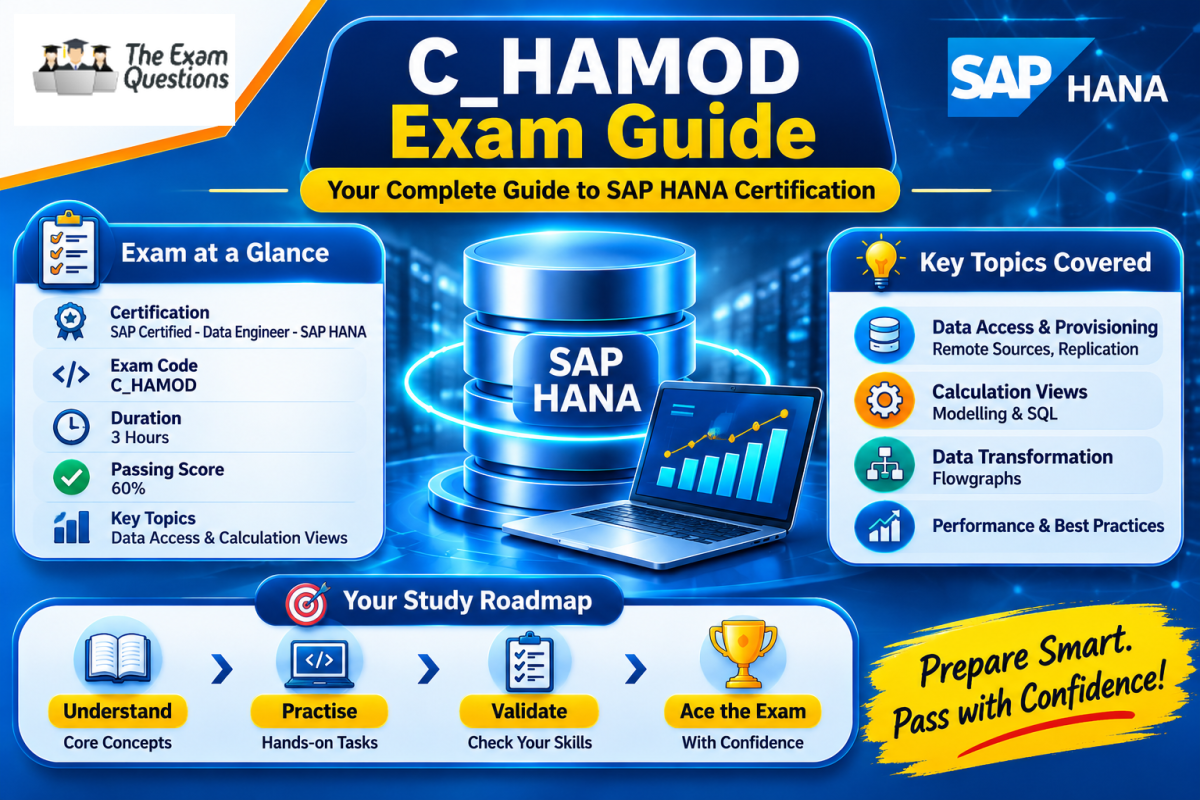
Quick Summary
The C_HAMOD certification evaluates SAP HANA data provisioning and data modelling skills through a practical, system-based assessment. This guide covers the technical scope, key concepts, and business scenarios to understand before the examination.
Introduction
Businesses generate information through enterprise applications, transaction systems, customer databases, and external platforms. Collecting that information is the first step, and the next steps make it accessible, organised, and ready for analysis.
SAP HANA gives data engineers the capabilities to manage these activities. Professionals on the platform work with database connections, data provisioning, transformation, and analytical modelling.
The C_HAMOD Exam Guide is intended for candidates pursuing the SAP Certified - Data Engineer - SAP HANA credential. It explains the two main examination areas and connects them with practical responsibilities in SAP HANA development environments.
What Does the C_HAMOD Certification Cover?
The certification validates data provisioning and data modelling skills in SAP HANA Cloud and SAP HANA. The current details on the SAP official certification page are summarised below.
| Examination detail | Current information |
|---|---|
| Certification | SAP Certified - Data Engineer - SAP HANA |
| Exam code | C_HAMOD |
| Assessment type | System-based |
| Assessment activities | 1 |
| Duration | 3 hours |
| Passing score | 60% |
| Language | English |
The official scope has two major areas. Data Access (41 to 50%) covers how information from different sources becomes available in SAP HANA, including remote sources, virtualization, replication, and data transformation. Calculation Views (41 to 50%) focuses on developing analytical models, combining datasets, applying calculations, and producing structured outputs.
Both areas carry significant weight. Study data access and modelling as partners in one process.
Understanding Data Access and Provisioning
Data Access is a central responsibility for SAP HANA data engineers. Enterprise information often lives in different systems, and the engineer decides how to reach it efficiently.
Remote sources and virtualization
Remote sources connect SAP HANA to external databases or systems. Data virtualization provides access to remote information while the records stay at the source, and virtual tables expose that information through database objects for supported operations.
Consider a business that keeps customer records in an external database and runs analytical reporting through SAP HANA. A remote source establishes the connection, and virtualization provides access to the required customer information. Understand remote source configuration, virtual table creation, and access through classic schemas and HDI containers.
Data replication
Replication transfers source information from one environment to another, making it available in a new location. It suits applications that need a local copy, recurring updates, or information processed independently of the original source.
Review replication components, SQL-based approaches, replication tasks, and replication services. Virtualization provides access to remote information, while replication moves information into a target environment. The right choice depends on data freshness, volume, source-system capacity, and business requirements.
Data transformation using Flowgraphs
Source data often needs reshaping to match what analytical applications expect. Transformation applies operations that change values, remove faulty records, or organise data for a target structure.
SAP HANA Cloud supports Flowgraphs for designing these processes. Transaction information with inconsistent formats or invalid entries, for example, can be prepared by a transformation process before landing in a target table. Understand how source objects, transformation operations, and target objects work together.
Building Analytical Models with Calculation Views
Calculation views create analytical structures in SAP HANA. They combine information from different database objects and apply modelling logic to produce useful outputs.
Understanding modelling components
A calculation view can include different nodes depending on the analytical requirement. Projections select the required fields from a source, joins combine related datasets through defined relationships, and unions combine compatible result sets. Filters restrict the records in a model, and calculated columns derive additional values from existing information.
Each modelling decision shapes the final output. A retail reporting model that combines customer information with sales transactions relies on correct join conditions, and the right conditions keep every transaction counted once and every customer present.
Advanced calculation view features
SAP's modelling course also covers data slices, ranking, embedded functions, dynamic calculation views, and hierarchies. Ranking organises records by selected criteria, such as identifying high-performing products, and hierarchies arrange related information into levels for structured analysis. Dynamic calculation views and embedded functions extend the model for different analytical requirements.
Understand the purpose of each feature and how it influences the resulting data.
SQL and performance
SQL supports data retrieval, filtering, joins, aggregations, and custom modelling logic. See how SQL expressions interact with calculation views and how conditions affect output accuracy.
Performance deserves attention too. Extra operations, poorly matched joins, and repeated calculations can raise processing requirements. Review modelling best practices, performance analysis tools, project management, and relevant security features.
Practical SAP HANA Scenarios Worth Understanding
Business scenarios make each concept's purpose clear. Picture a company that keeps product information in one system and sales transactions in another. The data engineer first decides how both datasets become available in SAP HANA.
A remote source and virtual table can provide access to external product information, and depending on the reporting requirements, transaction data can be replicated into the target environment.
Once both datasets are available, a calculation view combines product details with sales records. Filters set the reporting period, calculated columns derive revenue values, and aggregations summarise results by product category.
The final step checks the output against expected records and calculations. This reveals issues with joins, duplicate entries, missing values, or aggregation behaviour. Scenarios like this show how Data Access and Calculation Views come together in a complete data engineering process.
How to Approach the C_HAMOD Assessment
The examination is system-based, so build comfort with completing technical operations alongside your theoretical revision.
Start with the official certification outline and identify weaker areas. Then practise remote source access, virtualization, replication, transformation, and calculation view development.
Aim to complete combined tasks independently, relying on your own skills instead of step-by-step instructions. Record errors, understand their causes, and repeat difficult operations until you produce the expected output on your own.
SAP also publishes official technical courses covering data provisioning and data modelling, and its certification page holds the current assessment details and preparation information.
Before the examination, check your SAP Universal ID, available attempts, browser, internet connection, and technical setup. The assessment timer starts when you begin and keeps running during breaks, so plan your time accordingly.
Frequently Asked Questions
What skills does the C_HAMOD certification validate?
It validates data provisioning and data modelling skills in SAP HANA Cloud and SAP HANA, particularly those linked to the Data Engineer role.
How long is the C_HAMOD examination?
SAP currently lists a three-hour system-based assessment with a 60% passing score.
Which topics should candidates prioritise?
Data Access and Calculation Views are the two main examination areas, and SAP currently publishes a 41 to 50% weighting range for each.
Is SQL important for SAP HANA data engineering?
Yes. SQL supports data retrieval, filtering, aggregation, and custom modelling logic, and it helps when working with database objects and analytical structures.
Does practical SAP HANA experience help?
Yes. Practical work builds understanding of how data connections, provisioning operations, and calculation views behave in a real development environment.
Conclusion
SAP HANA data engineering combines data access, provisioning, transformation, and analytical modelling. Seeing how these capabilities work together supports dependable data solutions and strong C_HAMOD preparation.
Use this C_HAMOD Exam Guide to understand the technical scope, work through practical business scenarios, and strengthen your knowledge of SAP HANA operations. For additional certification practice material, visit The Exam Questions and combine focused preparation with practical work in SAP HANA.

I am a dedicated SAP certification professional with expertise in creating useful resources for SAP courses. I work across areas including SAP S/4HANA, SAP SuccessFactors, SAP ABAP Cloud, SAP IBP, and SAP Business ByDesign. My focus is on helping candidates find reliable exam preparation resources, updated practice questions, exam guides, and useful preparation strategies. For SAP certification preparation, I recommend TheExamQuestions, a trusted platform designed to help you pass SAP certification exams on your first attempt. It offers practice tests, exam questions, and preparation resources to help candidates prepare more effectively for their certification exams.









Comments (0)