

From Rough Draft to Journal Pages: A Scopus Publication Timeline
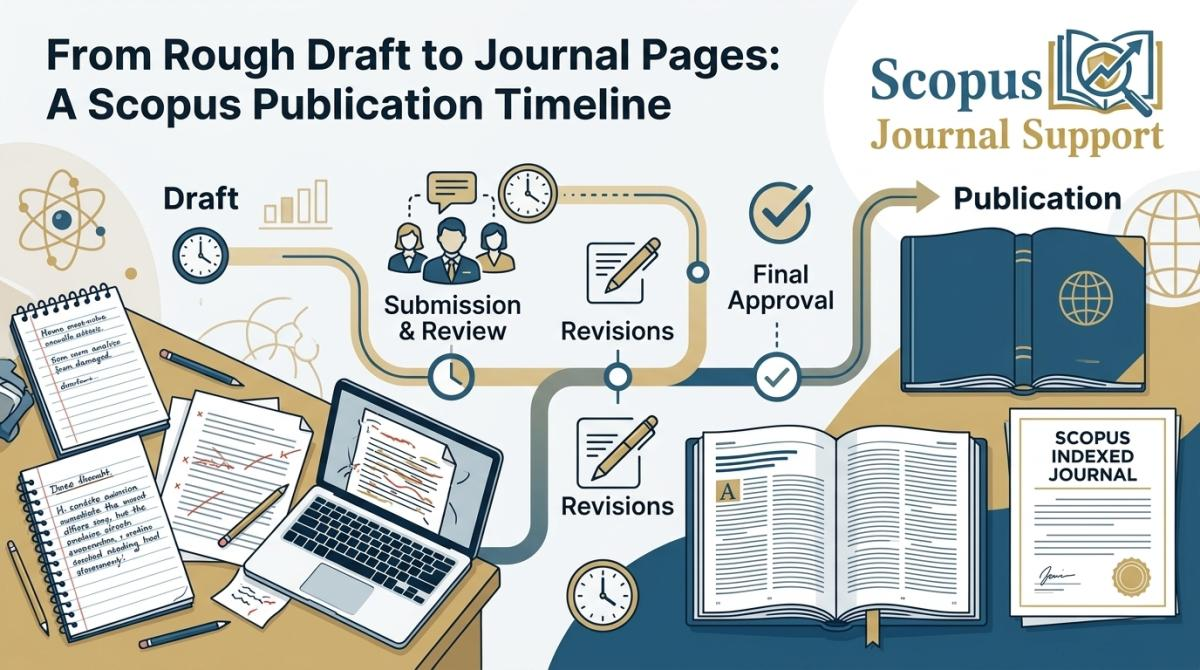
Most authors can tell you the date they started writing, but few can tell you how long each stage of publishing will take them. Without a realistic picture, deadlines slip, motivation drops and papers sit half-finished on a hard drive.Understanding the whole route is the first step toward steady Scopus journal publication support, because every stage has its own tasks and its own risks.This article follows one paper through the full timeline, from the first idea to the day it appears online, and shows what to do at each point.
Stage one: shaping the idea into a paper
Every publication starts as a topic, and a topic is not yet a study. The first job is to turn interest into a question that a single paper can answer.Spend time reading recent work in your field and note what is still unresolved.Then write your question in one sentence.
Compare these research question examples from a different field:
-
Too broad: “How do farmers deal with climate change?”
-
Workable: “Which water-saving practices do smallholder vegetable growers adopt after two consecutive seasons of irregular rainfall?”
The second version names the group, the behaviour and the time frame. A question at this level tells you what data you need and what the paper will not cover.
Stage two: planning the study and the publication together
Many scholars plan the research first and think about publishing later. Reverse that habit where possible. Decide early which type of journal you are aiming for, since its article length, preferred methods and reporting standards will shape how you collect and present data.This is a good moment for research and consultancy services, which can help check whether the design can answer the question, whether the sample is suitable, and whether the planned analysis matches the aim. Fixing a design problem at this stage costs days. Fixing it after data collection may cost the whole study.
Stage three: writing the first full draft
Write the draft without worrying about polish. Aim to get the argument down in the order a reader will meet it: introduction, method, results, discussion, then the abstract and title last.
A few habits keep this stage productive:
-
Set a weekly word target instead of waiting for inspiration
-
Draft the methods and results while the work is fresh
-
Keep a running list of references in the style your target journal uses
-
Leave comments for yourself where evidence is missing rather than stopping to chase it
-
Share an early version with one trusted reader before it grows too long
Stage four: revising, editing and formatting
Once the draft exists, work from large problems to small ones. Fix the argument first, then the structure, then the language, and only then the formatting.At this point, Scopus manuscript editing services help authors whose findings are strong but whose prose obscures them, while Scopus journal formatting services take care of heading levels, table layouts, figure quality and reference style. Doing formatting last matters, because every later rewrite can break it. Ask whoever helps you to show their changes, so that you can approve each one and learn from the pattern. The final text should still say what you mean.
Stage five: choosing the journal and checking its status
Choosing a journal is a decision that deserves its own time. Read recent issues of two or three candidates, look at the kinds of studies they publish, and compare their aims and scope with your paper.For Scopus indexed journal assistance, the key step is to check the journal’s current entry in the Scopus source list yourself, rather than relying on an old list.Then read the journal’s own policies on review model, article length and prior publication. A journal that suits your topic but not your method is a poor match, however respected it may be.
Stage six: preparing and sending the submission
Submission is a procedure with its own pitfalls. Portals commonly ask for an anonymised manuscript, a separate title page, a cover letter, declarations on ethics and funding, a data availability statement and sometimes a list of suggested reviewers.Scopus Journal Support helps authors who want this stage handled carefully, with the researcher approving every document before it is sent. Scopus journal submission assistance of this kind does not change the science. It makes sure that what reaches the editorial office is complete and in the right order.Gather all files into one folder before you open the portal so that nothing is rushed to the final screen.
Stage seven: waiting, and what the first decision means
After submission comes the quietest and most frustrating period. The paper is checked by the editorial office, then sent to reviewers if it passes. Timelines vary widely between journals, so check the stated average on the journal’s website instead of guessing. Decisions usually fall into a few groups: rejection, rejection with encouragement to resubmit, revision, or acceptance with small changes. Immediate acceptance is rare. A request for revision is a positive sign, since the editor sees potential in the paper.
Stage eight: responding to reviewers
When revisions arrive, sort comments into those that must be fixed, those that should improve the paper and those that need a polite explanation. Answer every point in a separate response letter, quote each comment, and say exactly what you changed and where.If you disagree with a suggestion, say so respectfully and support your view with evidence. Editors accept reasoned disagreement far more readily than silence.Co-authors should read the revised version before it goes back. Everyone named on the paper shares responsibility for it.
Stage nine: acceptance, proofs and publication
After acceptance, the journal sends proofs, which are typeset versions of your paper. Read them slowly. Check author names, affiliations, figure labels, table values, equations and references, because errors at this point tend to remain permanently.Reply within the stated deadline, since late answers can push your paper into a later issue. Once the paper is online, share it through your institutional profile and professional networks, and keep a record of the final citation details for your records.
How the timeline changes with different outputs
Not every project follows the same calendar, and the same stages stretch or shrink depending on the goal.For journal publication, expect the review stage to be the least predictable part. Plan your next paper while waiting, so the time is used well.Book publication has a longer rhythm. Publishers usually ask for a proposal, a chapter outline, a defined readership and sample chapters before they consider a full manuscript, so the early stages take much longer than a single article requires.Dissertation writing is its own long timeline, and it connects directly to publishing. A thesis whose chapters each have a clear question and a clean methods section can later produce several papers with far less rewriting.Scholars who want broader planning can turn to academic publication consultancy for PhD scholars, which is most effective when it starts while the study can still be adjusted.
Building a personal schedule
A rough schedule helps more than a perfect one. Work backward from the date you need the paper submitted, then assign time to each stage, leaving extra room for revision and for the co-author review that always takes longer than planned.Remember that review time is outside your control. Do not build a plan that depends on a particular decision date. Build one that keeps you productive whichever way the decision falls.
Frequently asked questions
Should I write the abstract before or after the paper?
Write a rough abstract early to test whether your argument holds together, then rewrite it after the results and discussion are final. The first version guides you, and the second version reports what you actually found.
How do I know when a paper is ready to submit?
A paper is ready when a colleague outside your project can summarise its contribution correctly after reading only the abstract and introduction, and when every item in the author guidelines has been ticked off.
Is it acceptable to contact the journal about a delayed decision?
Yes, after the journal’s stated review period has passed. Write a short, polite message with your manuscript number, and avoid repeated reminders in quick succession.
What happens if my paper is accepted but I find an error in the proofs?
Report it to the production team at once and mark the correction clearly. Minor corrections are usually allowed at the proof stage, but major changes to content may need the editor’s approval.
Can I post a preprint while the paper is under review?
Policies differ. Many journals allow preprints, while others restrict them or require specific wording. Read the journal’s preprint policy before posting anything publicly.
Closing thoughts
Publishing is easier to manage when it is broken into stages with clear tasks. If you would like help placing your own manuscript on this timeline, or steady Scopus journal publication support from the first draft to the final proof, you are welcome to reach out to Scopus Journal Support and talk through your next step.

Moving from a research idea to a completed academic manuscript takes careful organization and attention to detail. Authors must present their findings logically, use references correctly, and follow the specific instructions provided by their chosen journal. Scopus journal publication support helps researchers navigate manuscript preparation, formatting checks, and submission requirements. Depending on individual goals, assistance may also be relevant for dissertation writing, academic book publication, journal publication, and research and consultancy services. Researchers can review their documents, identify areas that need improvement, and prepare materials that communicate their work more effectively. Every publication journey is different, so guidance should suit the research topic, academic level, and intended audience. Contact the team to discuss your requirements and explore practical options for your project












Comments (0)