

Global Optical Coherence Tomography Market: Revenue Growth, Competitive Landscape and Industry Outlook 2034
Optical coherence tomography market grew from USD 2.6 Billion in 2025 to USD 3.0 Billion in 2026. Looking forward, IMARC Group estimates the market to reach USD 7.0 Billion by 2034, exhibiting a CAGR of 11.13% from 2026-2034

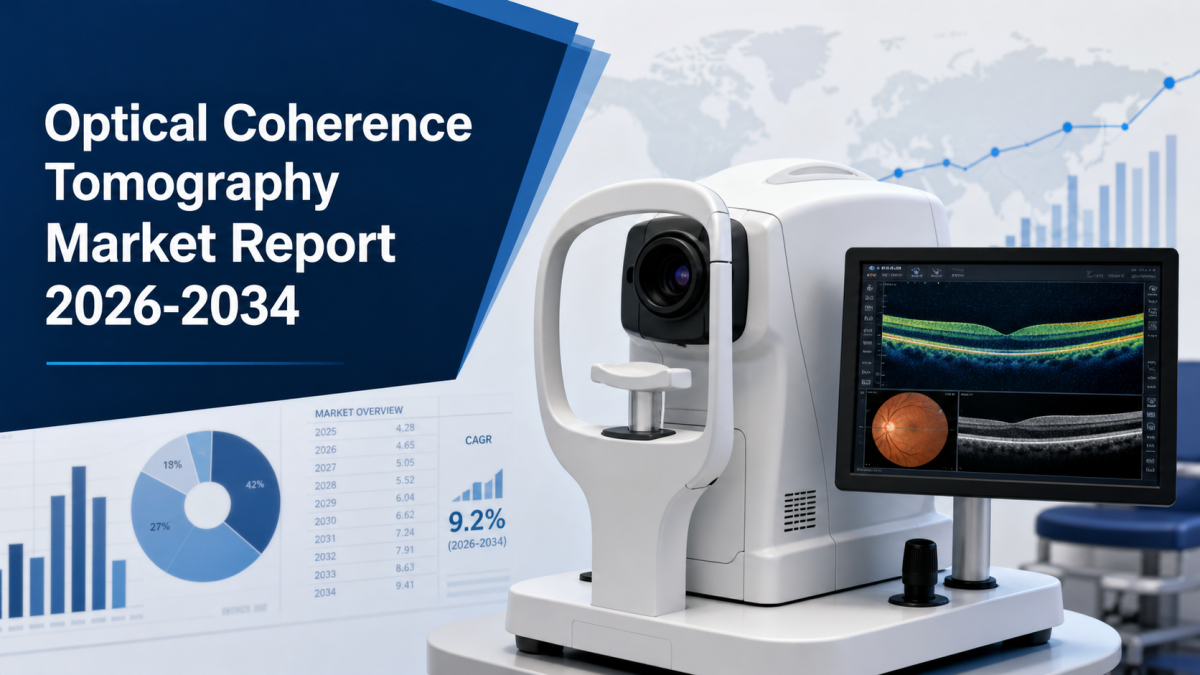
Market Overview:
According to IMARC Group's latest research publication, "Optical Coherence Tomography Market Size, Share, Trends and Forecast by Type, Technology, Application, and Region", the global optical coherence tomography market grew from USD 2.6 Billion in 2025 to USD 3.0 Billion in 2026. Looking forward, IMARC Group estimates the market to reach USD 7.0 Billion by 2034, exhibiting a CAGR of 11.13% from 2026-2034. North America currently dominates the market, holding a share of 38.7%.
This detailed analysis primarily encompasses industry size, business trends, market share, key growth factors, and regional forecasts. The report integrates research findings, market assessments, and data from different sources. It covers market dynamics such as drivers and challenges, and highlights growth opportunities, technological improvements, emerging trends, and innovations. It also provides a regional evaluation and a competitive landscape analysis.
How AI Is Reshaping the Future of Optical Coherence Tomography Market
-
Deep learning algorithms are being embedded into imaging platforms to automate image analysis, enabling rapid detection of pathological features such as fluid accumulation, drusen deposits, and retinal layer disruptions with precision comparable to experienced clinicians.
-
Intelligent systems reduce interpretation variability across practitioners while supporting real-time clinical decision-making during patient examinations, a meaningful shift for high-volume screening environments.
-
Volumetric scan data processing and quantitative biomarker extraction are enhancing longitudinal disease monitoring for conditions like glaucoma and diabetic retinopathy, where subtle change over time drives treatment decisions.
-
Altris Inc. launched its Altris Sync application, which connects imaging devices from multiple manufacturers including Carl Zeiss, Topcon, and Heidelberg Engineering to provide artificial intelligence-powered analysis and longitudinal data insights for retinal disease management.
-
NIDEK Co. Ltd. launched the RS-1 Glauvas system featuring a 250 kHz scan speed with deep learning-based analytics for wide-area high-quality imaging, reflecting how AI and hardware advances are converging.
Grab a sample copy of this report: https://www.imarcgroup.com/optical-coherence-tomography-market/requestsample
Key Trends in the Optical Coherence Tomography Market
-
Portable and Handheld Devices Expand Access: Handheld systems equipped with microelectromechanical components enable point-of-care imaging in remote locations, community health centers, and neonatal intensive care units where conventional tabletop equipment cannot operate effectively.
-
Cardiovascular Diagnostics Open New Revenue Streams: Cardiologists increasingly rely on high-resolution cross-sectional imaging to guide percutaneous coronary interventions, assess stent deployment accuracy, and evaluate plaque morphology with superior precision compared to conventional angiography alone.
-
Multimodal Imaging Gains Clinical Adoption: Platforms combining structural imaging with functional assessments such as fractional flow ratio measurements are being adopted for their comprehensive diagnostic capabilities.
-
Telemedicine and Underserved Populations: Portability is particularly relevant for reducing diagnostic disparities, allowing bedside screening for retinopathy of prematurity in neonates and age-related macular degeneration in elderly patients with limited mobility.
-
Miniaturization Improves Image Quality: The miniaturization of optical components and improved battery technologies are enabling higher imaging quality in increasingly compact form factors, attracting interest from both developed and emerging healthcare markets.
Growth Factors in the Optical Coherence Tomography Market
-
Rising Chronic Eye Conditions: Increasing occurrence of age-related macular degeneration, diabetic retinopathy, and glaucoma is the major factor contributing to market growth worldwide, with non-invasive imaging providing high-resolution views of eye structures.
-
Aging Population Base: The increasing geriatric population is driving demand for advanced diagnostic imaging tools, as older adults face higher rates of retinal and choroidal disorders requiring accurate diagnosis.
-
Technological Advancements in Swept Source and Spectral Domain Systems: Improvements in imaging speed, depth, and precision are enabling usage of optical coherence tomography systems across various medical fields beyond ophthalmology.
-
AI Integration Streamlines Workflows: The ability to detect biomarkers and monitor disease progression is improving, allowing systems to streamline clinical workflows and facilitate early intervention techniques.
-
Rising Healthcare Expenditure in Emerging Markets: Expanding healthcare budgets are broadening access to sophisticated medical equipment, supporting adoption across Asia-Pacific, Latin America, and the Middle East.
Leading Companies Operating in the Global Optical Coherence Tomography Industry:
-
Abbott Laboratories
-
Agfa-Gevaert N.V.
-
Agiltron Inc.
-
Carl Zeiss AG
-
Haag-Streit Group
-
Heidelberg Engineering Inc.
-
Leica Microsystems GmbH (Danaher Corporation)
-
Novacam Technologies Inc.
-
OPTOPOL Technology Sp. z o.o.
-
Terumo Corporation
-
Thorlabs Inc.
-
Topcon Corporation
Leading manufacturers invest substantially in research and development to enhance imaging resolution, scan speed, and AI integration, while pursuing partnerships with academic institutions and healthcare networks to validate new clinical applications. Strategic mergers and acquisitions have intensified as larger conglomerates seek to strengthen diagnostic portfolios, and emerging players from Asia are introducing cost-competitive multimodal imaging platforms.
Optical Coherence Tomography Market Report Segmentation:
Breakup By Type:
-
Handheld OCT Devices
-
Tabletop OCT Devices
-
Others
Handheld OCT devices hold 38.1% of the market share. These compact instruments utilize microelectromechanical systems integrated with advanced optical components to deliver high-resolution cross-sectional images at the point of care. Their lightweight design enables use in neonatal intensive care units, emergency departments, and remote healthcare facilities, with growing demand for accessible retinal screening tools accelerating adoption across developed and developing markets.
Breakup By Technology:
-
Time Domain OCT (TDOCT)
-
Frequency Domain OCT (FD-OCT)
Time domain systems represent established and foundational technology, utilizing a reference mirror mechanism and low-coherence interferometry to generate cross-sectional tissue images. Their relatively lower acquisition costs make them accessible for smaller practices and resource-constrained settings. Frequency domain systems have emerged as the preferred technology for advanced clinical and research applications, offering significantly faster scan speeds and superior image resolution, with enhanced depth penetration and signal-to-noise ratio facilitating detailed visualization of deeper biological structures.
Breakup By Application:
-
Dermatology
-
Ophthalmology
-
Cardiovascular
-
Oncology
-
Others
Ophthalmology leads the market with a share of 57.8%. Clinicians rely extensively on cross-sectional imaging to evaluate macular degeneration, diabetic retinopathy, glaucoma progression, and macular edema, enabling timely therapeutic interventions that preserve patient vision. The technology provides precise quantitative measurements of retinal layer thickness, nerve fiber integrity, and choroidal structures essential for treatment planning and longitudinal disease tracking.
Breakup By Region:
-
North America (United States, Canada)
-
Asia Pacific (China, Japan, India, South Korea, Australia, Indonesia, Others)
-
Europe (Germany, France, United Kingdom, Italy, Spain, Russia, Others)
-
Latin America (Brazil, Mexico, Others)
-
Middle East and Africa
North America, accounting for 38.7% of the share, enjoys the leading position in the market. The region benefits from an advanced healthcare ecosystem characterized by widespread adoption of innovative diagnostic technologies, a well-established network of ophthalmic specialty clinics, and substantial investments in medical research and development. A highly favorable reimbursement environment supports routine utilization of advanced imaging procedures, while the presence of major medical device manufacturers fosters continuous technological innovation.
Recent News and Developments in Optical Coherence Tomography Market
-
Optos launched its next-generation MonacoPro system combining ultra-widefield scanning laser ophthalmoscopy with spectral-domain imaging, boosting the optical coherence tomography market outlook.
-
RSUD Al-Ihsan Hospital in Bandung, Indonesia, successfully executed two intricate coronary interventions with the Vivolight OCT-Cornaris P80, emphasizing its vital function in directing interventional procedures and enhancing patient results.
-
Johnson & Johnson MedTech revealed the U.S. introduction of the SOUNDSTAR CRYSTAL™ Ultrasound Catheter for intracardiac echocardiography visualization in cardiac ablation treatments, showcasing a sophisticated 2D ICE catheter with AI-driven mapping capabilities.
-
EssilorLuxottica acquired an approximately 80% stake in Heidelberg Engineering, a leading developer of ophthalmic diagnostic devices including advanced imaging systems, signaling continued consolidation and investment in the European diagnostic imaging sector.
-
Anusandhan National Research Foundation, in partnership with the Indian Council of Medical Research and the Gates Foundation, initiated the Mission for Advancement in High-Impact Areas (MAHA)-Medical Technology to enhance innovation in India's medical tech industry.
Note: If you require specific details, data, or insights that are not currently included in the scope of this report, we are happy to accommodate your request. As part of our customization service, we will gather and provide the additional information you need, tailored to your specific requirements. Please let us know your exact needs, and we will ensure the report is updated accordingly to meet your expectations.
About Us:
IMARC Group is a global management consulting firm that helps the world's most ambitious changemakers to create a lasting impact. The company provide a comprehensive suite of market entry and expansion services. IMARC offerings include thorough market assessment, feasibility studies, company incorporation assistance, factory setup support, regulatory approvals and licensing navigation, branding, marketing and sales strategies, competitive landscape and benchmarking analyses, pricing and cost research, and procurement research.
Contact Us:
IMARC Group
134 N 4th St. Brooklyn, NY 11249, USA
Email: [email protected]
Tel No:(D) +91 120 433 0800
United States: +1-201-971-6302










Comments (0)