

Global Urban Air Mobility Market Outlook: Revenue, Regional Share, Air Taxi Demand and Emerging Opportunities 2034
Urban air mobility market size was valued at USD 6.2 Billion in 2025. Looking forward, IMARC Group estimates the market to reach USD 101.0 Billion by 2034, exhibiting a CAGR of 35.24% from 2026-2034

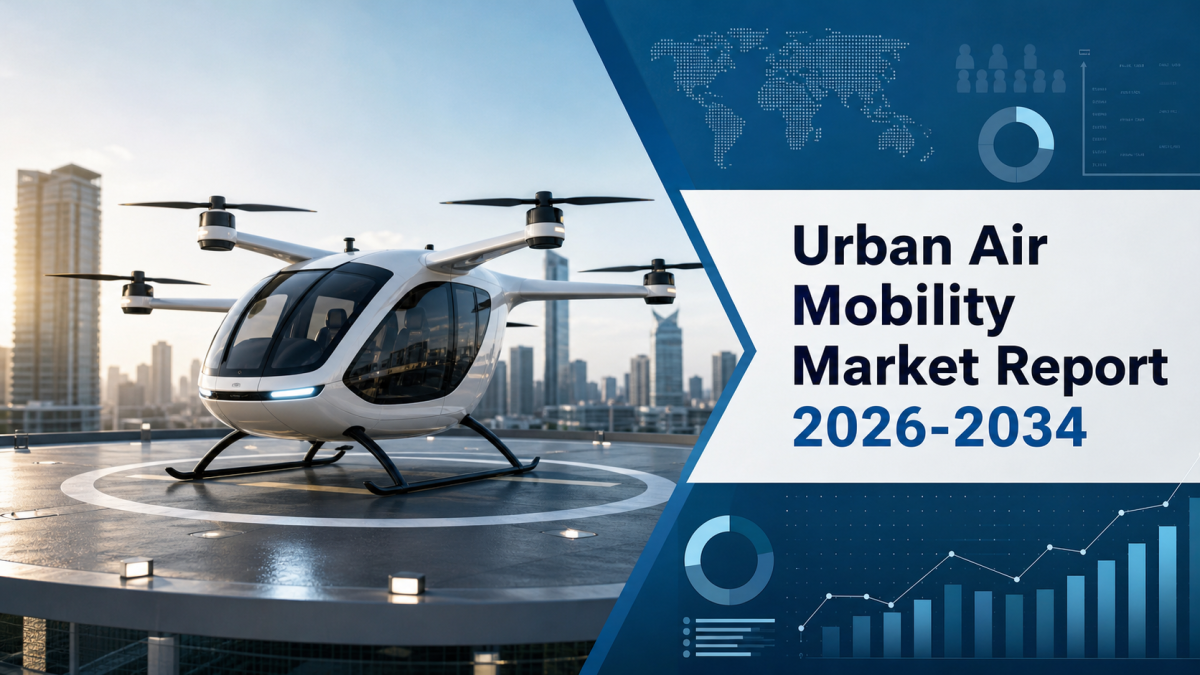
Market Overview:
According to IMARC Group's latest research publication, "Urban Air Mobility Market Size, Share, Trends and Forecast by Type, Operation, Range, Platform Architecture, End Use, and Region", the global urban air mobility market size currently stands at USD 6.2 Billion. Looking forward, IMARC Group estimates the market to reach USD 101.0 Billion, exhibiting a growth rate (CAGR) of 35.24% during the forecast period. North America currently dominates the market, holding a share of over 42.5%, with advances in electric vertical takeoff and landing (eVTOL) aircraft and heavy public and private sector investments spurring development and integration of UAM services across the region.
This detailed analysis primarily encompasses industry size, business trends, market share, key growth factors, and regional forecasts. The report integrates research findings, market assessments, and data from different sources. It covers market dynamics such as drivers and challenges, and highlights growth opportunities, technological improvements, emerging trends, and innovations. It also provides a regional evaluation and a competitive landscape analysis.
The Forces Lifting the Urban Air Mobility Market
The industry is undergoing rapid transformation, driven by eVTOL development, stepped-up investment, and increasing demand for efficient urban transportation. Trends of note include lightweight, energy-efficient aircraft designed to minimize emissions and operate efficiently in city settings, while large aerospace and automotive firms collaborate with startups to speed innovation and deliver scalable UAM solutions. Regulatory agencies are defining safety standards, air traffic control infrastructure, and certification processes to enable commercial operations, and infrastructure development—including vertiports and charging stations—is picking up pace in major metropolitan regions.
-
eVTOL Aircraft Maturity: Quiet, efficient machines without the carbon footprint of conventional helicopters are being developed for both passenger and cargo transport, with advances in battery technology, propulsion systems, and safety components making commercial applications increasingly feasible.
-
Infrastructure Takes Shape: Vertiports integrated into rooftops, parking garages, and transport hubs are being engineered to support charging, boarding, safety processes, and rapid vehicle turnaround.
-
Air Traffic Management: Strong systems capable of monitoring and directing large numbers of low-altitude aircraft safely are emerging as a critical enabler of scaled operations.
-
Public-Private Collaboration: Partnerships between public and private sectors are creating a sustainable environment for passenger and cargo transportation, positioning UAM within the broader smart city and transportation ecosystem.
-
Consumer and Cargo Use Cases Multiply: From on-demand short-range air travel to last-mile delivery, applications are expanding as the technology proves out.
Grab a sample copy of this report: https://www.imarcgroup.com/urban-air-mobility-market/requestsample
Urban Air Mobility Market Report Segmentation:
Breakup By Type:
-
Air Taxis
-
Air Metros & Air Shuttles
-
Personal Air Vehicles
-
Cargo Air Vehicles
-
Air Ambulances & Medical Emergency Vehicles
-
Last-Mile Delivery Vehicles
Air taxis lead the market with around 44.0% of market share. These eVTOL machines are designed for short-range, on-demand commuting, offering a futuristic alternative to ground-based travel with the potential to cut through traffic and provide direct, point-to-point transport for business and recreational travelers.
Breakup By Operation:
-
Remotely Piloted
-
Fully Autonomous
-
Hybrid
Remotely piloted leads the market with around 55.7% of market share. Trained pilots operate eVTOL aircraft from centralized command centers, maintaining accurate route management and rapid response to changing conditions. This model provides increased safety oversight in urban areas where regulatory needs are still developing, while minimizing the need for an onboard pilot and maximizing passenger or cargo capacity.
Breakup By Range:
-
Intracity
-
Intercity
Intracity leads the market with around 53.6% of market share. It targets short-distance, point-to-point transportation within a single city, moving people between business districts, airports, and residential neighborhoods—directly addressing congestion and time wastage in high-density urban areas.
Breakup By Platform Architecture:
-
Fixed Wing
-
Rotary Blade
-
Hybrid
Rotary blade stands as the largest component, holding around 70.0% of the market. Its technological maturity, established design, and versatility in vertical takeoff and landing make it the most advanced platform segment, offering better maneuverability, stability, and control critical for navigating complicated urban environments without runways.
Breakup By End Use:
-
E-Commerce
-
Commercial Ridesharing Operators
-
Private Operators
-
Medical Emergency Organizations
-
Others
Private operators lead the market share, driven by their potential to innovate rapidly, make significant investments, and respond to changing market requirements. Startups, airlines, and technology-enabled mobility companies are leading development and deployment, with the leeway to enter strategic partnerships and establish scalable business models suited to urban mobility.
Breakup By Region:
-
North America (United States, Canada)
-
Asia Pacific (China, Japan, India, South Korea, Australia, Indonesia, Others)
-
Europe (Germany, France, United Kingdom, Italy, Spain, Others)
-
Latin America (Brazil, Mexico, Others)
-
Middle East and Africa
North America accounted for the largest market share of over 42.5%, fueled by a robust ecosystem of technological innovation, regulatory support, and engaged industry participation. Within the region, the United States accounted for over 83.70% of the North American market, home to pioneering UAM firms and proactive bodies such as the Federal Aviation Administration facilitating pilot schemes and rapid aircraft certification.
Who Is Leading the Urban Air Mobility Market?
-
Airbus
-
Archer Aviation Inc.
-
BETA Technologies, Inc.
-
Embraer Group
-
Eve Holding, Inc.
-
Guangzhou EHang Intelligent Technology Co. Ltd
-
Hyundai Motor Company
-
Joby Aero, Inc.
-
Lilium GmbH
-
Safran Group
-
Textron Inc.
-
The AIRO Group, Inc.
-
Uber Technologies, Inc.
-
Vertical Aerospace
-
Volocopter GmbH
-
Wingcopter GmbH
Major players are investing heavily in research, design, and testing of eVTOL aircraft, focusing on advancing safety, increasing range, minimizing noise, and gaining regulatory certification. Partnerships with aerospace and automotive companies, airlines, and ride-hailing services are assisting in scaling operations and integrating with current transportation systems, while pilot schemes in major cities test real-world operations and build public confidence.
Real-World Applications: Where Urban Air Mobility Is Taking Off
-
Air Taxi Commuting: On-demand, short-range flights connect business districts, airports, and residential neighborhoods, dramatically shortening commute times and enhancing productivity in congested cities.
-
Emergency Medical Response: Air ambulances and medical emergency vehicles use eVTOL platforms to bypass ground traffic, speeding critical patient transport.
-
Last-Mile Delivery: Cargo air vehicles and delivery drones support e-commerce logistics, reaching locations where ground transport is slow or impractical.
-
Airport Shuttles and Metros: Air metros and shuttles offer high-end substitutes for ground travel, feeding into existing transport hubs.
-
Tourism and Regional Connectivity: Latin American and Middle Eastern markets are exploring UAM to connect distant places with cities, leveraging tourism and geography as demand drivers.
Policy and Regulatory Tailwinds
-
FAA Implementation Planning: The Advanced Air Mobility implementation plan, Innovate28, aims to facilitate large-scale AAM operations in the US, coinciding with the LA Olympics.
-
US Certification Progress: The FAA issued Archer Aviation its Part 135 Air Carrier and Operator Certificate, a major milestone toward commercial operations, and provided new regulations enabling electric air taxi commercialization.
-
European ATM Roadmap: The latest edition of the European ATM Masterplan outlines the roadmap for digitization and integration of air traffic management, with U-space and eVTOL traffic oversight as essential components.
-
Asia-Pacific Regulatory Collaboration: Twenty-four Asia-Pacific nations and administrations collaboratively created reference documents on advanced air mobility for civil aviation regulators, the first occasion regulators have jointly developed resources to support commercial eVTOL and UAS operations.
-
National Strategies: Saudi Arabia's General Authority of Civil Aviation is developing a National Advanced Air Mobility plan and roadmap to create an innovative ecosystem for advanced air mobility.
Recent News and Developments in Urban Air Mobility Market
-
JetSetGo, a private airline offering private jet and helicopter services in India, revealed collaborations with SkyDrive and Eve Air Mobility to create and implement UAM solutions in India, announced at the Urban Air Mobility Expo.
-
Archer Aviation finalized a deal with Ethiopian Airlines, marking it as the second client intending to implement Archer's Midnight through the "Launch Edition" program, with the pair collaborating to establish a fully electric air taxi system in the region.
-
Archer Aviation formed a multi-party partnership agreement with significant entities in the UAE and Abu Dhabi to promote development of electric air taxi services, standardizing collaboration ahead of the inaugural commercial eVTOL flight.
-
Airbus and Avincis signed a Memorandum of Understanding to collaborate on the advancement of Advanced Air Mobility, investigating opportunities for utilizing eVTOL aircraft across Europe.
-
EHang revealed the successful inaugural flight of its EH216-S unmanned eVTOL aircraft in Mexico, extending its international reach and flight coverage to 19 nations.
Strategic Outlook: What's Next for the Urban Air Mobility Market
The sector continues to attract significant investment as regulatory frameworks crystallize and infrastructure buildout accelerates. Growth will hinge on three factors: the pace of vehicle certification and airspace integration, public acceptance of aircraft flying over populated areas, and the economics of vertiport construction in dense cities. With demand dynamics signaling a robust growth trajectory, and with China already the first nation to provide an Advanced Air Mobility type certificate for passenger transport, the industry is undergoing rapid transformation and scale-up.
Industry stakeholders can access granular forecasts, segment-level assessments, and competitive benchmarking through this detailed IMARC study on the urban air mobility market, which covers type, operation, range, platform architecture, end use, and regional dynamics.
Note: If you require specific details, data, or insights that are not currently included in the scope of this report, we are happy to accommodate your request. As part of our customization service, we will gather and provide the additional information you need, tailored to your specific requirements. Please let us know your exact needs, and we will ensure the report is updated accordingly to meet your expectations.
About Us:
IMARC Group is a global management consulting firm that helps the world's most ambitious changemakers to create a lasting impact. The company provide a comprehensive suite of market entry and expansion services. IMARC offerings include thorough market assessment, feasibility studies, company incorporation assistance, factory setup support, regulatory approvals and licensing navigation, branding, marketing and sales strategies, competitive landscape and benchmarking analyses, pricing and cost research, and procurement research.
Contact Us:
IMARC Group
134 N 4th St. Brooklyn, NY 11249, USA
Email: [email protected]
Tel No:(D) +91 120 433 0800
United States: +1-201-971-6302








Comments (0)