

Peer to Peer Lending License in India: RBI Registration, Process and Compliance
Learn how to obtain a peer to peer lending license in India, including RBI registration, eligibility, documentation, compliance requirements and process.

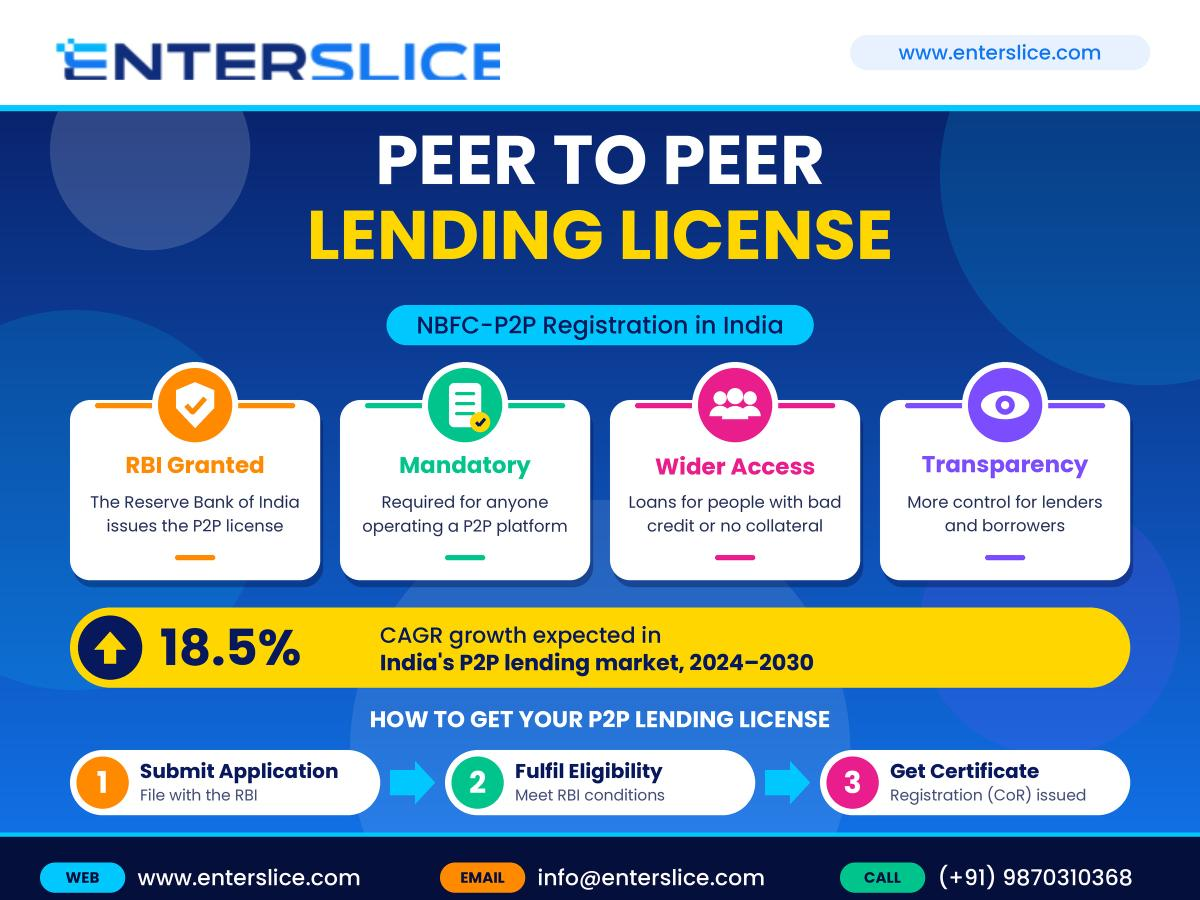
Peer-to-peer (P2P) lending has created an alternative channel through which individuals and businesses can access funds directly from lenders. Instead of depending entirely on traditional financial institutions, borrowers can connect with potential lenders through an online platform.
In India, this business operates under the regulatory framework of the Reserve Bank of India (RBI). A company intending to operate a P2P lending platform must obtain the appropriate registration as a Non-Banking Financial Company – Peer to Peer Lending Platform (NBFC-P2P).
However, setting up such a platform involves more than developing a website or mobile application. The company must satisfy RBI's eligibility conditions, establish appropriate technology and operational systems, and follow regulatory requirements concerning lending activities, fund transfers, disclosures and customer protection.
Understanding the peer to peer lending license requirements before starting the business can help promoters avoid regulatory complications and build a compliant lending platform.
What is a Peer to Peer Lending License?
A peer to peer lending license is the regulatory authorisation required by a company to operate a lending platform that connects borrowers with individual lenders. In India, this authorisation is granted by the RBI through a Certificate of Registration (CoR) under the NBFC-P2P framework.
An NBFC-P2P acts as an intermediary. It facilitates the connection between lenders and borrowers, conducts due diligence, assesses borrower credit profiles and assists with loan documentation, disbursement and repayment.
Unlike a conventional NBFC, an NBFC-P2P cannot use its own funds to lend to borrowers through the platform. Its role is limited to facilitating transactions between participants.
The RBI's NBFC-P2P Directions, 2025, issued on 28 November 2025, now provide the principal regulatory framework for these businesses, replacing the earlier 2017 Directions.
Reserve Bank of India+1
How Does the P2P Lending Business Model Work?
The P2P lending model operates through an online platform where borrowers and lenders register and complete the required verification.
The general process involves the following steps:
-
Borrower registration: An individual or eligible entity registers on the platform and submits the required financial and identity information.
-
Lender registration: Individuals or other eligible participants register to provide funds to borrowers.
-
Verification and credit assessment: The platform conducts due diligence, evaluates the borrower's credit profile and shares relevant information with prospective lenders.
-
Matching of participants: The platform connects borrowers with suitable lenders based on its Board-approved matching policy.
-
Loan agreement: The relevant participants approve the transaction and execute the necessary loan documentation.
-
Fund transfer: Money moves through the prescribed escrow accounts rather than being held by the platform.
-
Repayment: Borrowers repay through the designated mechanism, and the funds are transferred to the respective lenders.
This model provides an organised mechanism for direct lending while keeping the platform within its permitted intermediary role.
RBI Regulations Governing Peer to Peer Lending in India
The Reserve Bank of India regulates P2P lending platforms under the NBFC-P2P framework. The main regulatory reference is the RBI (Non-Banking Financial Companies – Peer to Peer Lending Platform) Directions, 2025.
These Directions address registration, permissible activities, capital requirements, governance, fund transfers, transparency, risk management and customer protection.
A significant point for new applicants is that an existing NBFC cannot operate as an NBFC-P2P. A separate eligible company must be established for this activity.
Reserve Bank of India
Eligibility Criteria for Obtaining a Peer to Peer Lending License
A company planning to apply for an NBFC-P2P registration must meet the eligibility requirements prescribed by the RBI.
The principal conditions include:
1. Company incorporation in India
Only a company incorporated in India can undertake the business of a P2P lending platform. Other forms of non-banking institutions cannot independently carry on this regulated activity.
2. Minimum Net Owned Fund
The applicant must maintain a Net Owned Fund (NOF) of at least ₹2 crore, or a higher amount if specified by the RBI.
Importantly, the applicant does not necessarily have to infuse the entire amount at the time of filing the application. It must provide the list of promoters and the sources of funds for meeting the capital requirement when applying. The required NOF must be infused before the Certificate of Registration is granted. No change in promoters is permitted during this intervening period.
3. Fit and proper promoters and directors
The promoters and directors must satisfy the RBI's fit and proper criteria. The overall management of the company should not be prejudicial to public interest.
4. Technological and managerial capabilities
The company must demonstrate that it has adequate technological, entrepreneurial and managerial resources to operate the platform.
5. Robust IT infrastructure
A secure and scalable technology system must be planned or implemented to support platform operations, protect participant information and maintain business continuity.
6. Viable business plan
The applicant must submit a practical business plan explaining its proposed operations, technology, business model and ability to conduct P2P lending activities in accordance with RBI requirements.
Meeting these conditions does not automatically guarantee approval. The RBI evaluates the application and may impose additional conditions where necessary.
Reserve Bank of India
Step-by-Step Process to Obtain an NBFC-P2P Registration
The peer to peer lending license application process involves regulatory assessment as well as preparation of the company's operational and technological infrastructure.
Step 1: Incorporate a Company
The first step is to incorporate a company in India under the Companies Act, 2013. The proposed business activities, shareholding structure, promoters and management arrangements should be planned carefully.
Step 2: Arrange the Capital Structure
The promoters should identify the sources of funds required to meet the minimum NOF of ₹2 crore. The promoter details and proposed funding sources must be disclosed in the registration application.
Step 3: Prepare the Business Plan
The business plan should explain the proposed P2P lending model, participant onboarding, borrower assessment, lender-borrower matching, revenue model, technology infrastructure and risk management arrangements.
Step 4: Prepare the Regulatory Application
The applicant must compile the relevant corporate, financial, managerial and operational information required by the RBI. The application should demonstrate how the company intends to comply with the applicable NBFC-P2P Directions.
Step 5: Submit the Application through PRAVAAH
Under the 2025 Directions, a prospective applicant must submit its registration application through the RBI's PRAVAAH portal to the Department of Regulation.
The RBI examines the application and evaluates whether the applicant satisfies the prescribed conditions.
Step 6: Obtain In-Principle Approval
If the RBI is satisfied with the application, it may grant in-principle approval subject to conditions.
The in-principle approval remains valid for 12 months from the date of issue.
Step 7: Establish the Technology Platform and Legal Documentation
During the approval period, the company must establish the required technology platform, complete the necessary legal documentation and report compliance with the conditions imposed by the RBI.
Step 8: Obtain the Certificate of Registration
Once the RBI is satisfied that the company is ready to commence operations and has fulfilled the applicable conditions, it may grant the Certificate of Registration.
The company must obtain the CoR before commencing or carrying on the NBFC-P2P business.
Reserve Bank of India
Documents Required for Peer to Peer Lending License
Proper documentation is essential for demonstrating the applicant's eligibility, financial position, management capabilities and operational preparedness.
The following is a practical preparation checklist. The exact documents and format should be confirmed against the RBI application requirements applicable at the time of filing.
|
Document category |
Important documents |
|
Corporate documents |
Certificate of Incorporation, MOA and AOA |
|
Promoter details |
PAN, identity and address proofs, profiles and background details |
|
Directors' information |
DIN, KYC documents, professional profiles and fit-and-proper declarations |
|
Financial documents |
Audited financial statements, capital details and source-of-funds information, as applicable |
|
Business information |
Detailed business plan, proposed activities and revenue model |
|
Technology documents |
IT infrastructure plan, information security arrangements and system architecture |
|
Operational documents |
Proposed participant onboarding, credit assessment and lending procedures |
|
Compliance documents |
Draft policies, agreements and regulatory compliance framework |
Applicants should ensure that information submitted across corporate records, financial statements and application documents is consistent.
Permissible Activities and Restrictions for NBFC-P2P Platforms
Obtaining a peer to peer lending license does not give a company unrestricted authority to conduct financial activities. The RBI has clearly defined what an NBFC-P2P can and cannot do.
Permitted activities
An NBFC-P2P can:
-
Provide an online marketplace connecting lenders and borrowers.
-
Conduct due diligence on platform participants.
-
Assess borrower creditworthiness and disclose risk profiles.
-
Facilitate loan documentation and agreements.
-
Assist with loan disbursement and repayment.
-
Provide loan recovery-related services.
-
Charge disclosed platform service fees in accordance with RBI requirements.
Activities that are not permitted
An NBFC-P2P cannot:
-
Accept public deposits.
-
Lend money from its own balance sheet.
-
Provide credit guarantees or credit enhancement.
-
Facilitate secured lending through its platform.
-
Assume direct or indirect credit risk arising from platform transactions.
-
Permit international flow of funds.
-
Use one lender's funds to replace another lender's funds.
-
Hold participants' lending or repayment funds on its own balance sheet.
These restrictions are central to the P2P lending model. The platform facilitates transactions but does not become the lender or guarantee repayment.
Reserve Bank of India
Important RBI Compliance Requirements for NBFC-P2P Companies
Registration is only the beginning. Once the company receives its peer to peer lending license, it must maintain ongoing regulatory compliance.
Some important requirements under the 2025 Directions are as follows:
|
Compliance area |
RBI requirement |
|
Net Owned Fund |
Minimum ₹2 crore |
|
Leverage ratio |
Not more than 2 |
|
Lender exposure |
Aggregate exposure capped at ₹50 lakh across platforms |
|
Higher lender exposure |
Above ₹10 lakh, a CA certificate confirming minimum net worth of ₹50 lakh is required |
|
Borrower exposure |
Aggregate borrowing capped at ₹10 lakh across NBFC-P2P platforms |
|
Single lender exposure |
Maximum ₹50,000 to the same borrower |
|
Loan maturity |
Maximum 36 months |
|
Fund transfer |
Through prescribed escrow accounts |
|
Escrow holding period |
Not beyond T+1 bank working day |
|
Grievance handling |
Complaints must be addressed within one month |
The exposure limits apply across all NBFC-P2P platforms, not separately to each platform.
Reserve Bank of India
Escrow Account Management
An NBFC-P2P must maintain at least two separate escrow accounts operated by a bank-promoted trustee:
-
Lenders' Escrow Account: Receives lender funds pending disbursement to identified borrowers.
-
Borrowers' Escrow Account: Receives loan repayments before transferring them to the respective lenders.
Funds must not be mixed between these accounts, and cash transactions are prohibited. The platform must also ensure that funds do not remain in the escrow accounts beyond the prescribed T+1 bank working day period.
Reserve Bank of India
Transparency and Fair Practices
The platform must disclose relevant borrower and lender information, loan terms, fees, applicable taxes and risk-related information.
Interest rates must be displayed in Annualised Percentage Rate (APR) format. The platform must also publish information about its credit assessment methodology, data protection practices, grievance mechanism and portfolio performance.
Lenders must explicitly acknowledge that they understand the risks involved, including the possibility of losing the entire principal amount. The platform cannot advertise lending as an investment product with assured minimum returns or guaranteed liquidity.
Reserve Bank of India
Technology and Data Protection
Since the P2P business is primarily technology-driven, the RBI expects appropriate information security and business continuity arrangements.
Data relating to the platform's activities and participants must be stored and processed on hardware located in India. An information system audit by a CISA-certified external auditor must be conducted at least once every two years.
The company must also maintain suitable arrangements for continued servicing of existing loans if it stops operating its platform.
Reserve Bank of India
Cost and Time Involved in Obtaining a Peer to Peer Lending License
The overall cost of establishing an NBFC-P2P depends on several factors, including company incorporation, capital arrangements, technology development, legal documentation, professional assistance and ongoing compliance.
The following expenses should be considered:
-
Company incorporation: Costs associated with establishing the company and completing statutory registrations.
-
Capital requirement: Minimum NOF of ₹2 crore, which is a regulatory capital requirement and not a government application fee.
-
Technology infrastructure: Expenses for developing and maintaining a secure lending platform.
-
Legal and professional services: Costs associated with application preparation, regulatory advice and documentation.
-
Compliance expenses: Ongoing costs for audits, reporting, data security and regulatory compliance.
There is no single fixed total project cost applicable to every applicant. Similarly, the RBI does not prescribe a guaranteed registration timeline. The processing period depends on the application, regulatory assessment and fulfilment of approval conditions.
Common Mistakes to Avoid During NBFC-P2P Registration
Entrepreneurs planning to enter the P2P lending industry should avoid the following mistakes:
-
Starting platform operations before obtaining RBI registration.
-
Treating the ₹2 crore NOF requirement as an optional business expense.
-
Submitting an incomplete or unrealistic business plan.
-
Failing to establish adequate IT security arrangements.
-
Using customer funds for the company's own lending activities.
-
Ignoring escrow account and fund transfer requirements.
-
Promising guaranteed returns or assured loan recovery to lenders.
-
Overlooking ongoing reporting and governance obligations.
Addressing these issues during the planning stage can make the registration process more organised and reduce the possibility of regulatory non-compliance.
How Enterslice Can Help with Peer to Peer Lending License Registration
Establishing an NBFC-P2P requires a clear understanding of RBI regulations, corporate structuring, capital requirements and operational compliance. Businesses entering this sector should ensure that their proposed model is aligned with the applicable regulatory framework before launching their platform.
Enterslice provides professional assistance to businesses seeking regulatory registrations and financial services compliance in India.
Our support can include:
-
Guidance on company incorporation and regulatory structuring.
-
Assistance with assessing NBFC-P2P eligibility requirements.
-
Support in preparing business plans and application documentation.
-
Assistance with identifying regulatory and compliance gaps.
-
Guidance on RBI application procedures.
-
Support with post-registration compliance requirements.
If you are planning to establish a P2P lending platform in India, connect with Enterslice to understand the applicable registration requirements and plan your regulatory journey.
Most popular services :
Mortgage Guarantee Company Registration
Regulatory Compliance and Advisory Services
Frequently Asked Questions (FAQs)
1. What is a peer to peer lending license in India?
A peer to peer lending license is an RBI Certificate of Registration that allows an eligible company to operate as an NBFC-P2P. It enables the company to facilitate lending transactions between borrowers and lenders through an online platform.
2. Is RBI approval mandatory for starting a P2P lending platform?
Yes. A company undertaking the business of a P2P lending platform must obtain a Certificate of Registration from the RBI before commencing operations as an NBFC-P2P.
3. What is the minimum capital requirement for NBFC-P2P registration?
The minimum Net Owned Fund requirement is ₹2 crore or a higher amount specified by the RBI. The applicant must disclose the promoters and sources of funds when applying and infuse the required capital before receiving the Certificate of Registration.
4. Can an existing NBFC start a P2P lending business?
No. Under the RBI NBFC-P2P Directions, 2025, an existing NBFC cannot operate as an NBFC-P2P. A separate eligible company is required for this regulated activity.
5. Can an NBFC-P2P lend money from its own funds?
No. An NBFC-P2P is permitted to act as an intermediary between lenders and borrowers. It cannot lend from its own balance sheet or assume credit risk arising from lending transactions facilitated through its platform.
6. How long is the in-principle approval valid?
The in-principle approval granted by the RBI is valid for 12 months. During this period, the applicant must establish the technology platform, complete the necessary legal documentation and demonstrate compliance with the approval conditions.
7. Can an NBFC-P2P guarantee returns to lenders?
No. An NBFC-P2P cannot assure the repayment of principal or payment of interest. Lenders must be informed about the possibility of losing their entire principal if a borrower defaults.





Comments (0)