

When Should a Small Business Hire a Google Ads Agency?
Plenty of small business owners start managing their own Google Ads account, and plenty do so successfully, at least for a while.

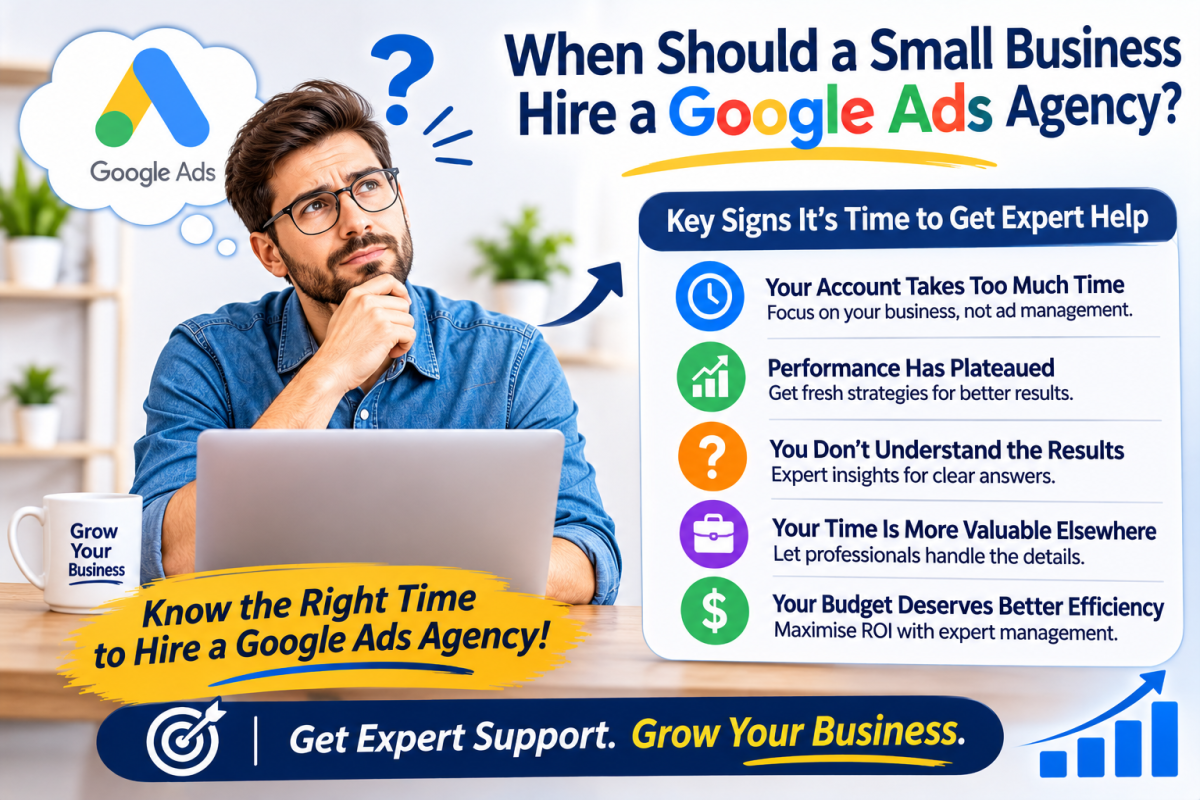
The platform is accessible enough that anyone can launch a campaign within an afternoon, and for a genuinely simple, low-budget setup, that self-managed approach can work perfectly well. The harder question is knowing when that's no longer true — when the complexity, time demands, or financial stakes of the account have outgrown what a business owner can reasonably manage alongside everything else running a business requires.
This article isn't about how to choose an agency once you've decided to hire one — it's about recognising the specific signals that suggest it's genuinely time to consider outside help, and understanding what that decision should actually weigh.
Managing Google Ads Yourself Is a Real, Ongoing Time Commitment
The most underestimated cost of self-managing Google Ads isn't financial — it's time. A genuinely well-managed account requires regular attention: reviewing the search terms report, refining negative keywords, monitoring Quality Score, testing ad copy, adjusting bids, checking conversion tracking accuracy, and responding to performance shifts as they happen, not just when something feels obviously wrong.
For a business owner already stretched across sales, operations, staff, and everything else a small business demands, finding genuine, consistent time for this ongoing management is often harder than the platform itself. Many self-managed accounts don't fail because the owner lacks the capability to learn Google Ads — they underperform because nobody has the time to give the account the regular attention it genuinely needs once the initial setup excitement fades.
Signal One: The Account Has Outgrown Casual Management
A campaign spending a few hundred dollars a month on a handful of tightly focused keywords is relatively forgiving of occasional, light-touch management. As budget grows, as the keyword list expands, or as the business adds multiple campaigns across different services or locations, the complexity and the cost of mistakes both increase substantially.
At a certain scale, an error that might have cost relatively little in a smaller account — a loose match type left unchecked, a missing negative keyword, a broken conversion tag — starts to represent meaningful, sometimes significant wasted spend. If the account has grown to a point where mistakes carry real financial weight, that growth itself is often a signal that dedicated, professional attention is worth the investment.
Signal Two: Performance Has Plateaued Despite Genuine Effort
Many business owners can get an account to a reasonable, functional starting point — generating some leads at a cost that feels roughly acceptable. Getting meaningfully better than that often requires a different level of expertise: understanding bidding strategy nuances, structural account improvements, advanced audience targeting, and the kind of pattern recognition that comes from managing many different accounts across various industries, rather than just one.
If performance has stayed essentially flat for an extended period despite genuine, consistent effort to improve it, that plateau is often a sign that the account has reached the limit of what self-directed, part-time management can achieve, rather than a sign that Google Ads itself has stopped working for the business.
Signal Three: You Don't Fully Understand Why the Campaign Is Performing the Way It Is
A meaningful difference exists between running a campaign and genuinely understanding it. If reviewing account performance leaves more questions than answers — uncertainty about why cost per click moved, why conversion rate dropped, whether a recent change actually helped or simply coincided with an unrelated shift — that gap in understanding often represents a real limitation on how effectively the account can be improved going forward.
This isn't a criticism of business owners managing their own accounts; Google Ads involves genuine depth and nuance that takes considerable time and exposure across many campaigns to develop fully. Recognising the specific point where confidence turns into genuine uncertainty is often more useful than assuming more time alone will resolve it.
Signal Four: The Opportunity Cost of Your Time Has Changed
Early in a business's life, an owner's time may be genuinely the most available, lowest-opportunity-cost resource available, making self-managed advertising a reasonable use of that time. As a business grows and the owner's time becomes increasingly valuable elsewhere — closing larger deals, managing a growing team, handling higher-value strategic work — the calculation shifts.
If an hour spent reviewing and adjusting a Google Ads account represents an hour not spent on higher-value work the business owner is uniquely positioned to do, the actual cost of self-management is considerably higher than it might first appear, even before accounting for the quality difference a dedicated specialist might bring to the account itself.
Signal Five: Budget Has Reached a Point Where Efficiency Gains Matter More Than Fees
Agency or freelancer management fees represent a real, ongoing cost that needs to be weighed against the value of outside expertise. For a very small budget, a management fee can represent a disproportionately large percentage of total spend, making the economics less favourable. As budget grows, even a modest percentage improvement in efficiency — a lower cost per lead, a stronger conversion rate — can represent a financial value considerably larger than the management fee itself.
A useful way to think about this: at what budget level would a 15 to 20% improvement in campaign efficiency, which an experienced specialist might reasonably be expected to achieve through better structure, targeting, and ongoing optimisation, outweigh the cost of paying for that expertise? For many businesses, there's a genuine budget threshold where this calculation clearly favours bringing in outside help.
Signal Six: The Business Is Expanding Into New Services, Locations, or Campaign Types
Scaling a Google Ads account into new territory — additional service lines, new geographic markets, more advanced campaign types like Performance Max or Local Service Ads — introduces complexity that differs meaningfully from simply running more of what's already working. Each expansion often requires fresh research, new account structure decisions, and careful initial monitoring to avoid costly early mistakes in an unfamiliar area.
Businesses at a genuine inflection point of expansion often benefit from experienced guidance specifically during that transition, even if they've successfully self-managed a simpler, more established account up to that point.
When It Might Still Make Sense to Continue Self-Managing
Hiring outside help isn't automatically the right move for every business at every stage. A very early-stage business still testing basic product-market fit, with a limited budget and relatively simple, single-service targeting, may reasonably continue self-managing for a period, particularly if the owner has genuine interest and some demonstrated aptitude for the platform.
Similarly, a business with a genuinely modest, stable budget and straightforward, low-competition keywords may find that a relatively simple, well-structured account continues performing adequately without requiring the ongoing complexity that justifies professional management fees. The key distinction is whether the account's complexity, budget, and performance expectations have genuinely outgrown what reasonable, consistent self-management can deliver — not simply whether outside help exists as an option.
What Changes Once You Bring in Outside Expertise
Businesses that do make the transition to professional management often notice changes beyond simply "better performance" in isolation. Reporting typically becomes more structured and regular, rather than checked sporadically. Account structure often gets rebuilt more deliberately around specific services or goals, rather than having grown somewhat organically over time through incremental additions. And perhaps most significantly, the business owner's own time is freed to focus on the parts of the business only they can genuinely drive forward, rather than splitting attention across an increasingly complex advertising account alongside everything else.
How to Approach the Transition
For businesses deciding to bring in outside help, a reasonable approach involves being transparent about historical account performance and data, since an experienced specialist can often identify specific structural issues and opportunities quickly when given genuine access to existing account history, rather than needing to start completely from scratch. Setting clear expectations about reporting frequency, communication, and specific goals from the outset helps ensure the relationship starts with aligned expectations rather than ambiguity about what "good performance" actually looks like for this specific business.
Final Thoughts
There's no single universal moment when every small business should hire a Google Ads agency — the right timing depends on account complexity, budget scale, available time, and how clearly current performance reflects the platform's genuine potential versus the limits of available in-house attention. The signals worth watching for are consistent, though: growing complexity outpacing casual management, a performance plateau despite genuine effort, a widening gap between running the account and truly understanding it, and a budget large enough that efficiency gains clearly outweigh management costs.
Recognising these signals honestly, rather than persisting with self-management purely out of habit or a reluctance to add a new cost, is often what allows a business to unlock meaningfully stronger results from a channel that may already be generating reasonable, but not yet optimal, returns.









Comments (0)