

CBG Plant in India 2026: Cost, Subsidy & Project Report
Complete guide to CBG (compressed biogas) plant setup in India: full form, cost, GOBARdhan subsidy, blending targets, project report and how to start.
Last updated: November 2026
Compressed biogas (CBG) is one of the fastest-growing renewable fuel markets in India. Government rules now require city gas companies to blend CBG into their supply, and new schemes are giving CBG producers guaranteed buyers and financial support. If you are planning a CBG plant in India, this guide explains what CBG is, how the plant works, what it costs, which subsidies apply and how to start.
What Is CBG Gas? Full Form and Meaning
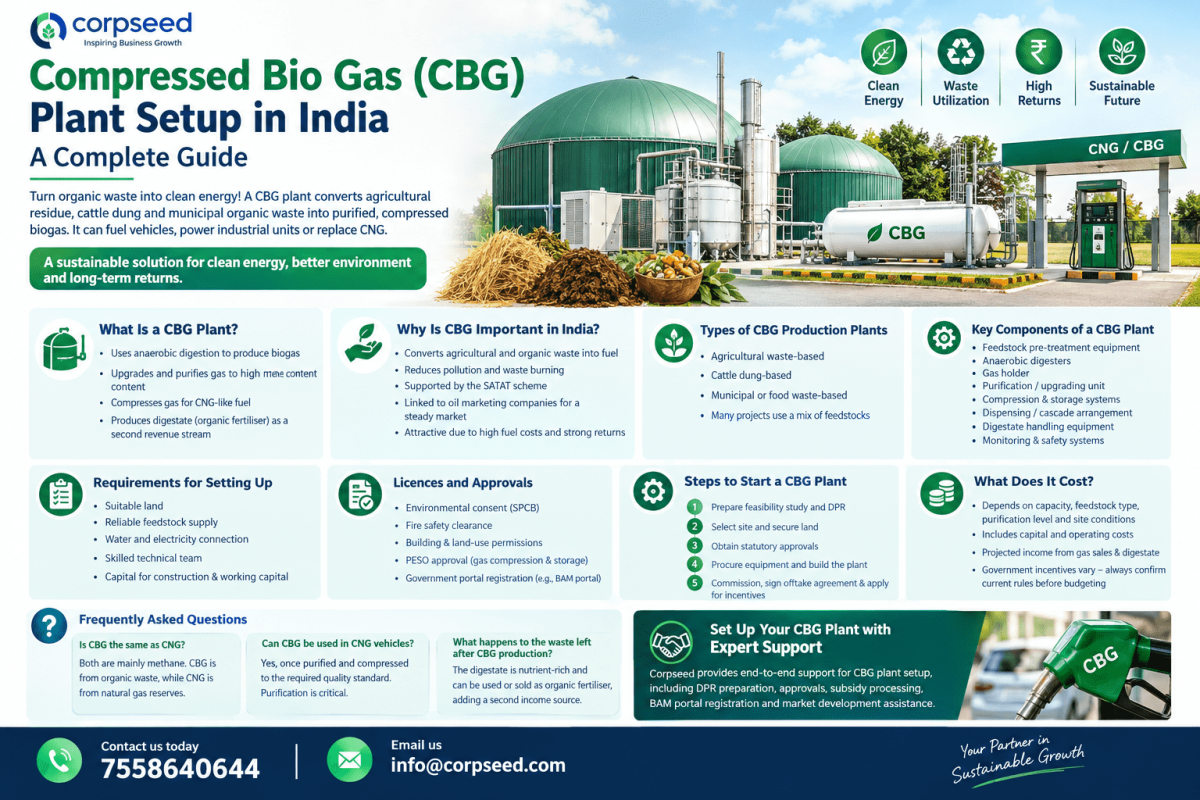
CBG stands for Compressed Biogas. Also written as compressed bio gas, it is biogas that has been cleaned and upgraded until it is mostly methane, then compressed for storage and transport. Because CBG is chemically similar to compressed natural gas (CNG), it can be used in many of the same applications, including vehicles, city gas networks and industrial burners.
Raw biogas and CBG are closely related. Raw biogas comes straight out of a digester and contains a lot of carbon dioxide and moisture. CBG is the purified, high-methane version that can replace fossil fuels.
How a CBG Plant Works
A compressed biogas plant turns organic waste into fuel in four main stages:
- Feedstock handling: Cattle dung, press mud from sugar mills, crop residues such as paddy straw, fruit and vegetable waste, or segregated municipal organic waste are collected, sorted and pre-treated.
- Anaerobic digestion: The material goes into airtight digesters, where microbes break it down and produce raw biogas, typically around 55 to 65 percent methane.
- Upgrading: Carbon dioxide, hydrogen sulphide, moisture and other impurities are removed, raising methane content above 95 percent.
- Compression and dispatch: The clean gas is compressed and delivered to CNG stations, city gas networks or industrial buyers.
The leftover digestate can be processed into fermented organic manure (FOM), which gives the plant a second revenue stream.
Compressed Biogas Uses in India
Compressed biogas uses are expanding across several sectors:
- Transport: fuel for CNG vehicles, including cars, buses and trucks.
- City gas: blending with CNG and piped natural gas (PNG) for homes and businesses.
- Industry: process heat for boilers, kilns and factories.
- Power and agriculture: electricity generation, plus organic fertilizer from digestate.
Compressed Biogas Plant Cost in India
There is no single price for a plant, because the compressed biogas plant cost depends on capacity, feedstock, technology, land and logistics. Published estimates vary widely. One industry analysis puts capital cost at about ₹8 to ₹10 crore per tonne per day of installed capacity. A national CBG blueprint from the Centre for Science and Environment (CSE) cites roughly ₹5 crore per tonne per day for plants using cattle dung, municipal waste or press mud, and about ₹6 to ₹7 crore for paddy-straw plants, which need extra pre-treatment.
Operating costs include manpower, feedstock, electricity and loan interest, so a realistic budget should cover both capital and running costs. Revenue depends on price too. HPCL, which operates CBG facilities, reports an average production cost of ₹40 to ₹42 per kg and selling prices of ₹70 to ₹78 per kg, depending on input and logistics costs.
Subsidy for Biogas Plant and Government Support in India
Several forms of support now apply to CBG projects, so anyone reviewing a subsidy for biogas plant investment should check each one:
- Blending obligation: City gas distributors must blend CBG into CNG and PNG at 3 percent in FY2026-27, 4 percent in FY2027-28 and 5 percent from FY2028-29 onward. This creates guaranteed demand for producers.
- GOBARdhan scheme: The Union Cabinet approved GOBARdhan, a national scheme for CBG, with an outlay of ₹23,731 crore. Under its rules, city gas companies must procure CBG. SATAT has been subsumed into the scheme from 1 September 2026, with earlier commitments honoured.
- Central financial assistance: Earlier guidelines offered about ₹4 crore per 4,800 kg per day of new CBG capacity, capped at ₹10 crore per project. Assistance is linked to milestones such as approvals, first commercial sale and plant performance rather than paid as an upfront grant.
- Pipeline connectivity: Assistance of up to 50 percent of eligible costs is available for pipelines linking CBG plants to city gas networks or trunk pipelines.
- Small household biogas units: Family and community biogas plants have been supported through separate schemes, so check current eligibility with your state agency.
Schemes and amounts change, so confirm the latest rules with the Ministry of New and Renewable Energy (MNRE) before you commit funds.
CBG Plants in India: Where the Sector Stands
India’s CBG sector is still early. Only 132 plants had been commissioned under SATAT by June 2026, with a combined capacity of 920 tonnes per day, against an original target of 5,000 plants. That gap is why the blending mandate matters: demand is set to rise faster than current supply. Larger projects are already showing what is possible. Gruner Renewable Energy reported producing 23.5 tonnes of CBG in a single day at its Satna plant in Madhya Pradesh in June 2026, which it said was the highest output of any CBG facility in Asia.
How to Start a CBG Plant Project
- Assess feedstock: Measure how much organic waste is available within roughly 25 to 50 km of the proposed site.
- Choose capacity and technology: Match the plant size and process to your feedstock, from smaller units to large industrial plants.
- Prepare a bankable project report: Model costs, revenue, loans and subsidy eligibility (see the next section).
- Secure land and approvals: Obtain the necessary environmental and local clearances.
- Sign an offtake agreement: Arrange a buyer, such as a city gas distributor or oil marketing company, before construction begins.
- Build, commission and sell: Work with an experienced EPC partner, commission the plant and start commercial sales.
What a CBG Plant Project Report Should Include
Banks and subsidy agencies expect a clear CBG plant project report. A strong one covers:
- Feedstock availability, prices and seasonal supply
- Plant capacity, technology and equipment list
- Capital cost, land, civil works and working capital
- Expected CBG and FOM output, with price assumptions
- Operating costs, including manpower, electricity, transport and loan interest
- Loan structure, subsidy eligibility, payback period and break-even point
Frequently Asked Questions About CBG Plants
What is the full form of CBG?
CBG stands for Compressed Biogas, also written as compressed bio gas.
Is there a gobar gas subsidy for CBG plants?
Yes. Projects can access central financial assistance and other support under the GOBARdhan framework, which now includes SATAT. Support is linked to project milestones and amounts can change, so check current guidelines before you apply for any gobar gas subsidy.
How much does a CBG plant cost?
Estimates range from about ₹5 crore to ₹10 crore per tonne per day of installed capacity, depending on feedstock, technology and location. A detailed project report gives the most accurate figure for your site.
How many CBG plants are there in India?
As of mid-2026, 132 plants had been commissioned under SATAT, and more projects are in development as blending targets rise.
What is compressed biogas used for?
Compressed biogas is used as vehicle fuel, blended into CNG and PNG for city gas networks, burned for industrial heat and used to generate electricity.
Start Your CBG Plant Project with Corpseed
If you are comparing CBG plant manufacturers in India, look for a partner that supports the whole project, from planning to commissioning. Corpseed offers CBG plant setup services in India. To discuss your site, feedstock or budget, call 7558640644 or email [email protected].
Sources and Further Reading
- Business Standard: GOBARdhan rules, assured CBG offtake and price support
- Energetica India: 132 CBG plants commissioned under SATAT
- ETV Bharat: HPCL CBG production cost and selling price
- Down To Earth: Budget 2026 and biogas blending
- Ministry of New and Renewable Energy (MNRE)
Disclaimer: This article is for general information only and is not financial or legal advice. Subsidy and blending rules change, so verify current guidelines with MNRE or the relevant authorities before making investment decisions.
Written by the Corpseed Project Team. Last updated November 2026.

The Cost of Setting Up a Petrol Pump depends on land availability, location, infrastructure, and equipment requirements. Additional expenses may include fuel storage tanks, dispensing machines, and statutory approvals. Understanding the investment structure helps in financial planning. Evaluate the expected expenses before entering the fuel retail business. Click here:- https://shorturl.at/Dibjg










Comments (0)