

How UAE Businesses Can Build Scalable Operations Through AI and Digital Transformation


Key Takeaways
- Fix the workflow before adding AI. Automating a messy process only makes the mess faster.
- Start with high-volume, rule-heavy work: invoicing, onboarding, approvals, reporting.
- Connect your data. Siloed systems are where most AI pilots stall.
- Faster responses, fewer hand-offs and Arabic-English self-service raise satisfaction for customers and staff alike.
- Automation takes repetitive tasks off people's plates, so they spend time on judgement and relationships.
- Most UAE businesses already use AI. The edge now comes from depth of integration, not from simply having a chatbot.
- Build governance in from day one. PDPL compliance and human oversight protect trust as you scale.
- Pilot two or three use cases, measure the result, then expand.
A Dubai logistics firm wins three new contracts in one quarter. Shipment volume doubles. So does the back office: more people re-keying data, more spreadsheets, more late invoices. Revenue grew, but operations didn't scale. They just got bigger.
Plenty of UAE businesses are walking into that trap. AI budgets are climbing fast, yet many organisations still run on disconnected systems and manual hand-offs. Real scale needs process redesign, connected data and enterprise automation solutions UAE teams can govern and trust.
This guide explains what scalable operations actually look like, why AI spending often fails to produce them, and how to close the gap step by step. You'll get a five-part framework, a phased roadmap, compliance pointers and the KPIs worth tracking.
What Are Scalable Operations?
Scalable operations are business processes that can handle two, five or ten times the workload without a matching rise in cost, headcount or error rates. In the UAE, that usually means automated workflows, connected data, AI-assisted decisions and clear governance, all running on cloud infrastructure that grows on demand.
Here's a simple test. If your workload doubles next quarter, does your cost double too? If yes, you have a growing business, not a scalable one. Scalable operations bend that line: volume climbs, cost per transaction holds or falls, and error rates stay put.
Three things make it possible: standardised processes, one trusted source of data, and technology doing the repeatable work so people can handle exceptions.
Why UAE Businesses Can't Afford to Wait
The national direction is unmistakable. PwC Middle East estimates AI could add around AED 353 billion to UAE GDP by 2030, roughly 13.6% of the total. The government says the digital economy already accounts for close to 12% of GDP and wants it above 20% by 2031. The UAE National Strategy for Artificial Intelligence 2031 pushes AI into healthcare, transport, energy, finance and government services.
When a country builds for that future, customer expectations move with it. People now expect instant answers, digital onboarding and paperless approvals.
Business adoption tells the same story. Research from AWS and the UAE Artificial Intelligence Office found that 72% of UAE businesses used AI in 2026, up from 53% in 2025. But depth varies widely:
| Adoption stage | Share of businesses | What it looks like |
|---|---|---|
| Basic | 47% | Ready-made tools for routine tasks |
| Intermediate | 19% | AI connected to some business systems |
| Transformative | 31% | Custom, agentic or autonomous AI in core operations |
Read that table as a warning. Using AI is no longer a differentiator. The businesses pulling ahead are the ones that moved from experimenting to embedding.
The Execution Gap: Why AI Spending Isn't Producing Scale
ServiceNow's 2026 Enterprise AI Maturity Index, compiled by ThoughtLab, found that UAE organisations raised AI spending by 105% year on year. Yet they scored only 48 out of 100 on maturity. The report pointed to legacy technology, siloed data and limited automation as the main brakes.
Deloitte's 2026 State of AI in the Enterprise survey adds another angle. Most companies are deploying AI widely, but 84% haven't redesigned jobs around it, and only 21% have mature oversight for autonomous systems.
Three patterns sit behind those numbers:
- Pilots that never leave the lab. A proof of concept works on clean sample data, then breaks on real, messy inputs.
- Data that lives in five places. The CRM, ERP, spreadsheets and email inboxes each hold part of the truth.
- Technology bolted onto old processes. Nobody asked whether the step should exist at all.
Deloitte also found that over 77% of respondents now treat the location where AI is developed as a key factor when choosing systems. For UAE companies with data residency needs or government clients, that makes a locally present delivery partner a practical requirement.
The Five Building Blocks of Scalable Operations
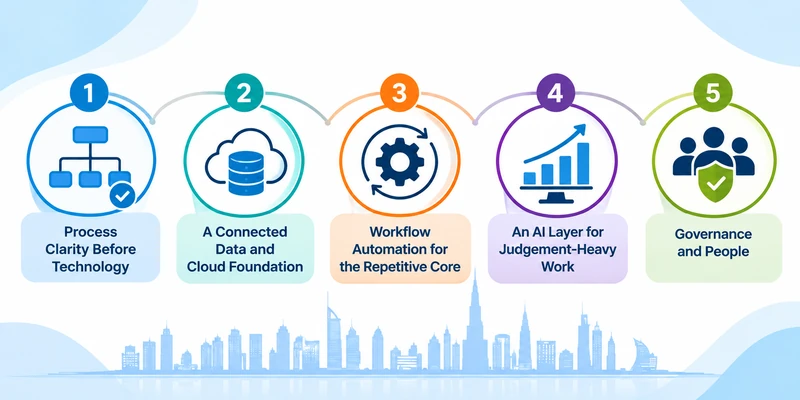
1. Process Clarity Before Technology
Pick one process and map it honestly: every step, every person who touches it, every wait time, every point where errors creep in. You'll usually find steps that exist only because two systems can't talk to each other.
Remove those first. Automation should speed up a good process, not preserve a bad one.
2. A Connected Data and Cloud Foundation
AI is only as useful as the data it can reach. That means APIs between your ERP, CRM and finance tools, a single source of truth for customers and transactions, and cloud infrastructure that scales up during peak periods without a hardware purchase.
Don't forget unstructured data. Contracts, invoices and emails arrive in Arabic and English, in PDFs and photos. If your foundation can't ingest them, your AI will be guessing.
3. Workflow Automation for the Repetitive Core
Rule-based work is the cheapest, fastest win. Approvals, notifications, data transfers, reconciliations and report generation all follow predictable logic, so they automate reliably.
Working with a specialist in business process automation services in Dubai helps you tie these workflows together across departments instead of automating isolated tasks. The payoff shows up in cycle time first, then in cost.
4. An AI Layer for Judgement-Heavy Work
Workflow tools follow rules. AI handles the work rules can't describe: reading a handwritten delivery note, classifying a customer complaint, forecasting demand, drafting a reply in the customer's language, or coordinating several steps through an AI agent.
This is where AI automation services in Dubai come in. Layering intelligence over stable workflows means the AI has structure to work within, which makes its output easier to test and trust.
5. Governance and People
Technology scales only as fast as your people accept it. A Cooper Fitch survey of UAE and GCC businesses found just 14% expect AI-related role reductions in the next 12 to 24 months, down from 31% a year earlier. Roles are being reshaped more than removed, with first-draft content, reporting, basic research and administrative coordination changing the most.
So budget for training, name an owner for every automated process, and decide upfront which decisions always need a human sign-off.
Enterprise Automation Solutions UAE Companies Can Deploy First
You don't need to automate everything at once. The best enterprise automation solutions UAE businesses start with share three traits: high volume, clear rules and measurable pain. These functions usually qualify.
| Function | What to automate | What users notice |
|---|---|---|
| Finance | Invoice capture, matching, reconciliation, payment reminders | Suppliers get paid on time; month-end closes faster |
| HR | Onboarding checklists, document collection, visa and ID renewal alerts | New hires are productive sooner |
| Customer service | Arabic-English chatbot, ticket triage, status updates | Instant answers, no queue |
| Procurement | RFQ routing, approvals, vendor onboarding | Shorter purchase cycles |
| Compliance | KYC checks, document verification, audit trails | Faster onboarding, cleaner records |
| Operations | Dispatch, shipment alerts, exception handling | Fewer "where is my order?" calls |
Here's a quick illustration, using assumptions you should replace with your own numbers. Say a mid-sized company handles 4,000 supplier invoices a month, and each takes about eight minutes of manual work across capture, matching and approval chasing. That's roughly 533 hours monthly. If automation processes 70% end to end and staff only review exceptions, about 373 hours return to the team every month. Multiply by your loaded hourly cost and the business case writes itself.
Where Customers and Employees Feel the Difference
Efficiency gets a project approved. Experience decides whether it survives. If customers don't notice an improvement and employees don't feel any relief, adoption stalls and the promised savings never show up.
For customers, the wins are visible within days. A tenant waiting on a maintenance request gets a status update without calling anyone. A new client uploading trade licence documents is verified in hours instead of a week. A hotel guest messaging at 2 a.m. in Arabic gets an answer in Arabic. None of that needs a bigger support team. It needs workflows that don't wait for someone to be at their desk.
Employees feel it differently. Nobody misses copying figures from one system into another or chasing a manager for the third time to approve a purchase. When automation absorbs that work, people spend their day on exceptions, negotiations and problem-solving, which is what they were hired to do. Teams that see that shift early become your best advocates, and that internal momentum is worth more than any training deck.
How Different UAE Industries Apply It
Logistics and trade. Automated customs documentation, route and dispatch optimisation, and proactive delay alerts reduce the manual coordination that eats margins at higher volumes.
Financial services. Digital KYC, automated transaction monitoring and AI-assisted document review speed up onboarding while keeping a clean audit trail for regulators.
Healthcare. Appointment scheduling, claims preparation and records integration free clinical staff from paperwork. Health data rules make governance non-negotiable here.
Retail and hospitality. Demand forecasting, dynamic inventory and instant multilingual guest support keep service consistent during peak seasons and events.
A Phased Roadmap: From First Audit to Enterprise Scale
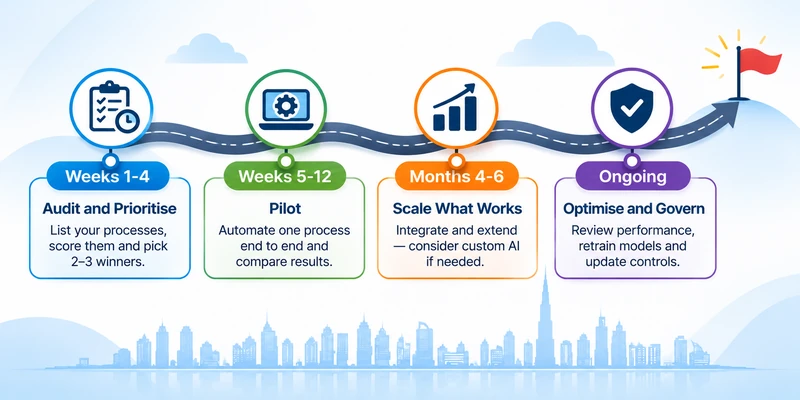
- Weeks 1-4: Audit and prioritise. List your processes and score each on volume, rule clarity, cost of errors and data readiness. Pick two or three winners and record baseline metrics.
- Weeks 5-12: Pilot. Automate one process end to end with real data, real users and a named owner. Compare results against your baseline.
- Months 4-6: Scale what works. Integrate the pilot with adjacent systems and extend it to similar processes. If off-the-shelf tools hit a ceiling, a specialist AI development company in Dubai can build custom models trained on your own data.
- Ongoing: Optimise and govern. Review performance monthly, retrain models when accuracy drifts, and update controls as regulations change.
A note on build versus buy. Off-the-shelf platforms deploy quickly and work well for standard processes like email routing or basic chatbots. Custom builds earn their cost when a process gives you a competitive edge, when data can't leave a controlled environment, or when your workflows simply don't fit a packaged product. Many UAE businesses end up with a hybrid: packaged tools for the commodity work, custom AI for the processes that set them apart. Decide per process, not per company.
Governance and Compliance: Scaling Safely
The UAE's Federal Decree-Law No. 45 of 2021 on the Protection of Personal Data (PDPL) came into effect on 2 January 2022 and is administered by the UAE Data Office. It covers organisations handling the personal data of UAE residents, including some operating from outside the country. Free zones such as DIFC and ADGM run their own data protection regimes, and sectors like healthcare add further rules.
Practical steps for any automation or AI project:
- Map what personal data each workflow touches before you build.
- Document the lawful basis for automated processing.
- Keep a human in the loop for decisions that significantly affect people.
- Log automated actions so you can explain them later.
- Check vendor contracts for data residency and cross-border transfer terms.
This is general guidance, not legal advice. Confirm specifics with qualified counsel.
Measuring What Matters
Set baselines before the pilot starts. Otherwise you can't prove anything afterwards.
| Goal | KPIs to track |
|---|---|
| Efficiency | Cost per transaction, cycle time, hours saved, error rate |
| User experience | First-response time, CSAT or NPS, employee onboarding time |
| Competitiveness | Capacity handled without extra hiring, time to launch new services, revenue per employee |
Five Mistakes That Stall Digital Transformation
- Starting with the tool. Choose the problem first. The tool follows.
- Automating a broken process. You'll just produce errors at higher speed.
- Skipping change management. Teams that don't understand the change will route around it.
- Treating compliance as a final checkbox. Retrofitting governance costs far more than designing it in.
- Trying to transform everything at once. Small, proven wins build the budget and the confidence for bigger ones.
How to Choose an Automation and AI Partner
Look for a team that can show:
- Delivery experience in the UAE and a working knowledge of local regulations.
- End-to-end capability, from process audit through build, integration and support.
- Experience connecting legacy ERP and CRM systems, not just greenfield projects.
- Arabic and English language handling.
- Clear security practices and transparent reporting on results.
Ask for a scoped pilot first. A partner confident in their work will agree to prove it on one process before you commit to a programme.
Conclusion
Scalable operations aren't bought in a single purchase. They're built: map the process, connect the data, automate the repeatable work, add intelligence where judgement is needed, and govern all of it carefully.
The UAE has made its direction clear, and 72% of businesses are already using AI. The question is whether yours will sit in the basic tier or move into the transformative one. Well-planned enterprise automation solutions UAE teams can run and govern are how you move up. If you're ready to start, explore business process automation services in Dubai to streamline your core workflows, add AI automation services in Dubai where decisions get complex, and work with an experienced AI development company in Dubai for custom solutions.
Start with one process. Prove the result. Then scale. Talk to the SISGAIN team about a scoped pilot for your business.





Comments (0)