

CRM Chatbots in Dubai: Why Integration Matters More Than AI in 2026

Key Takeaways
- Conversations aren't results. A standalone chatbot answers questions. A CRM-connected chatbot creates the lead, assigns the owner and books the next step.
- Efficiency: automatic record creation, lead routing and follow-ups remove manual data entry and stop enquiries slipping through.
- Better customer experience: one WhatsApp thread, full history, Arabic and English, and no need for customers to repeat themselves.
- Competitive edge: Dubai buyers expect instant, personal replies. Integrated systems deliver that at scale; disconnected tools can't.
- Trust by design: role-based access, UAE PDPL-aware data handling and human escalation protect your brand as you automate.
- Measure what matters: track qualified leads, booked appointments and revenue influenced, not message volume.
A buyer messages your Dubai business on WhatsApp at 11:40 pm. Your chatbot replies within seconds, politely, in the right language. The next morning your sales team opens the CRM and finds nothing: no new lead, no budget, no owner, no follow-up task.
That gap is where many chatbot investments quietly stall. Businesses across the UAE now use AI chatbots for customer enquiries, lead generation and support, yet plenty still run them as a website add-on instead of part of the sales process.
Here's the argument of this guide. In 2026, CRM chatbots in Dubai succeed or fail on integration, workflow execution and reliable data exchange, not on how clever the AI model is. A chatbot that can't write to your CRM, WhatsApp, calendar and ERP is just a conversation. One that can is an operating asset.
Why Dubai Businesses Are Moving Beyond Traditional AI Chatbots
Dubai customers expect an answer now, in their preferred language, on the app they already use. A website widget that collects a name and email and promises a callback no longer meets that bar.
WhatsApp Has Become a Primary Customer Communication Channel
A YouGov and Zbooni survey found that 65% of UAE residents had used WhatsApp to enquire about products or services. For many buyers, WhatsApp is the first touchpoint, not a secondary one. A website chat widget only reaches people already on your site. WhatsApp reaches them on their phones, in a thread they can return to hours later.
That's why WhatsApp chatbot integration matters more than a widget. The thread persists, so the conversation history has to persist on your side too, attached to the right customer record. If it lives only inside a chat tool, your team can't see it when the same customer calls next week.
The Shift from Automated Responses to Business Operations
FAQ bots answer questions. Operational bots do work: qualify a lead against your criteria, book a viewing, open a support ticket, chase a payment.
The difference matters because speed alone doesn't convert. A reply in four seconds that ends with "someone will contact you" still leaves the lead waiting on a person who has no context. Dubai teams are starting to ask a better question. Not "how fast does the bot answer?" but "what happened in our systems after it answered?"
CRM Chatbots vs Traditional AI Chatbots: What's the Actual Difference?
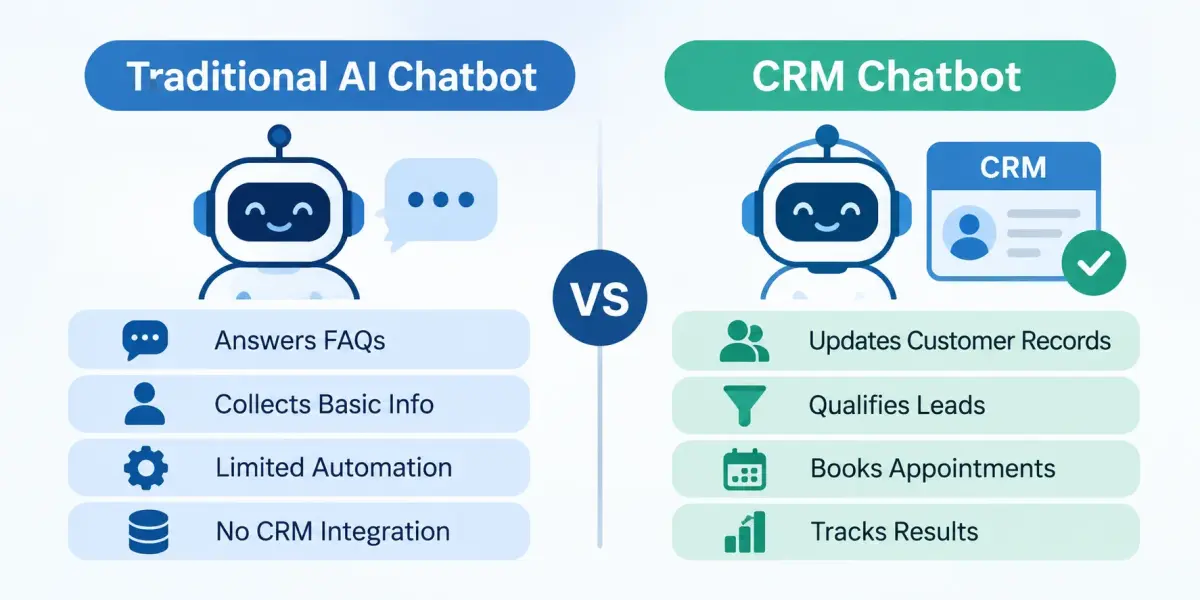
A CRM chatbot is an AI assistant connected directly to your customer relationship management system, so every conversation creates or updates a customer record, qualifies the lead and triggers the next step. A traditional chatbot stops at the reply.
How Traditional AI Chatbots Handle Customer Conversations
They answer frequently asked questions, share predefined information, collect a name and phone number, and run light automation such as a callback request. Without integration, each chat is an isolated transcript. Nobody can see the customer's history, and the same person messaging twice shows up as two strangers.
How CRM-Connected AI Chatbots Work
They create and update contacts automatically, detect intent, qualify leads, assign them to the right sales representative, book appointments, update support tickets and trigger follow-ups. The conversation turns into structured fields: budget, location, product interest, preferred language, next action.
Quick Q&A: Can a CRM chatbot replace my sales team?
No. It handles repeatable first-touch work such as qualification, scheduling and routing, so your people spend their time on conversations that need judgment, negotiation and trust.
Why CRM Integration Creates More Business Value
Integration keeps customer context in one place, removes manual data entry, gives every lead an owner and makes the funnel measurable. You can finally see how many chats became qualified leads, meetings and deals, and where they dropped out.
|
Traditional chatbot |
CRM-connected chatbot |
|---|---|
|
Answers customer questions |
Answers and executes workflows |
|
Collects basic information |
Creates structured CRM records |
|
Limited customer history |
Centralised customer history |
|
Manual lead assignment |
Automated lead routing |
|
Basic conversation analytics |
Sales and conversion tracking |
The CRM Integration Gap Holding Back AI Chatbots in Dubai
The biggest commercial opportunity in this market isn't a smarter model. It's connecting the chatbot that already exists to the systems that run the business.
Why Standalone Chatbot Deployments Fail to Deliver Expected Results
The pattern repeats across industries. A chatbot goes live, message volume climbs, and revenue doesn't move. The reasons are usually mundane:
- Disconnected customer information. Chat data sits in one tool, deal data in another.
- Duplicate CRM records. One customer appears three times because the number was saved as +971 50 123 4567, 0501234567 and 971501234567.
- Missed follow-ups. Nothing creates a task when a lead goes quiet.
- Inconsistent lead assignment. Leads land in a shared inbox and wait for someone to claim them.
- No link to outcomes. Nobody can say which conversations produced a sale.
The Integration Challenges Facing UAE SMEs
Smaller businesses face a harder version of the same problem: high up-front implementation costs, limited in-house technical expertise, legacy software that was never built to connect, undocumented APIs, data that drifts out of sync, and a stack of separate subscriptions that don't talk to each other.
The wider data points the same way. A 2026 du–Huawei study of UAE SMEs reported that only 8% had reached advanced digital maturity and just 15% were using AI or analytics platforms. Many businesses are adopting tools faster than they're connecting them.
Why Businesses Need an Integrated Automation Strategy
Your CRM, WhatsApp, ERP, calendars, payment systems and support tools should work as connected components of one workflow, not isolated apps. When they do, a single customer message can update a record, check stock, book a slot and notify the right person without anyone retyping a thing.
How CRM Chatbots Integrate with WhatsApp, ERP and Other Business Systems
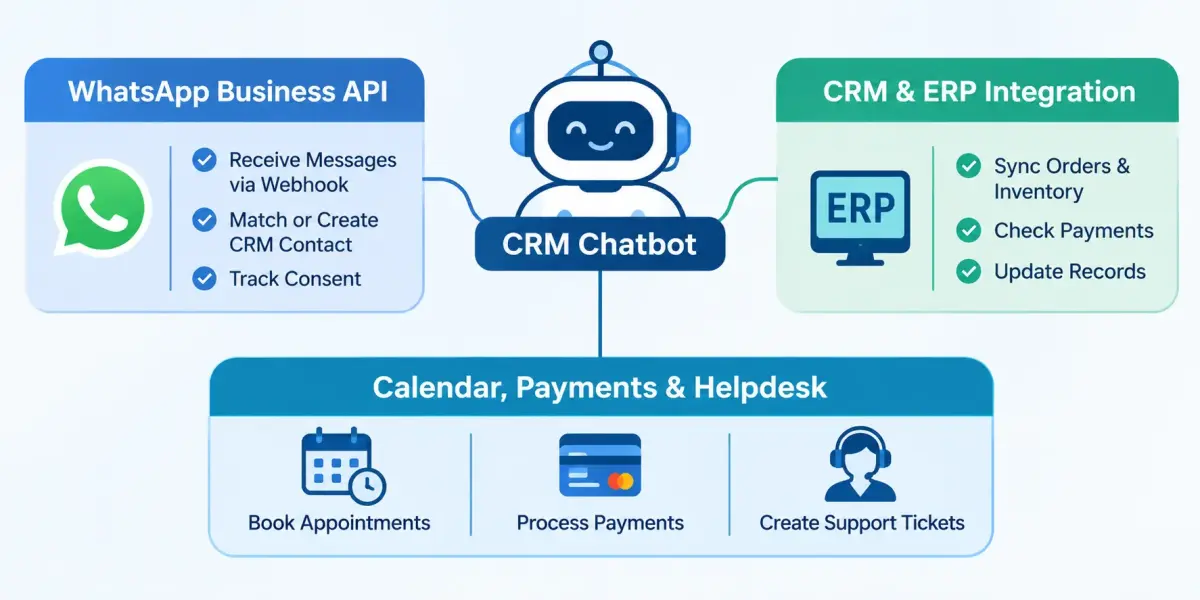
This is where projects are won or lost, so it's worth understanding the moving parts. When you evaluate software integration companies Dubai businesses can rely on, ask them to walk you through each of the layers below.
WhatsApp Business API and CRM Integration
The WhatsApp Business API delivers each incoming message to your system through a webhook. Your integration layer then matches the sender's number to an existing CRM contact, creates a new lead if there's no match, and logs the message against the record.
Two details separate a clean build from a messy one. First, normalise phone numbers to one international format before matching, or you'll create duplicates. Second, use idempotency checks so a retried webhook doesn't create the same lead twice.
You also need to manage opt-in properly. Outside the 24-hour customer service window, businesses can only start conversations with pre-approved message templates, so your CRM should store consent status and template history.
CRM and ERP Integration for Connected Business Operations
When the chatbot reads from and writes to your ERP, it can sync customer and order information, check inventory and product availability, report invoice and payment status, create sales orders and send automated customer notifications. A customer asking "where's my order?" gets a live answer, not a ticket.
Calendar, Payment Gateway and Helpdesk Integration
Calendar links handle appointment booking, payment gateways issue payment links inside the chat, and helpdesk tools create tickets and escalate to a human when needed. Common platforms include Zoho CRM, Salesforce, HubSpot, Microsoft Dynamics 365 and Shopify, alongside the booking and accounting systems your team already uses.
How Agentic AI Is Making CRM Chatbots More Intelligent in 2026
The shift this year is from conversational AI, which generates replies, to agentic AI, which carries out defined business tasks inside guardrails. Any serious AI chatbot development Dubai project in 2026 should be scoped around that difference.
From Answering Questions to Executing Multi-Step Workflows
An agentic CRM chatbot can understand what the customer needs, pull the relevant record from the CRM, qualify the opportunity, create or update the contact, book an appointment, trigger a follow-up sequence and escalate anything complex to an employee. One message can set off six actions, each logged.
AI Agents, APIs and Real-Time CRM Data Access
Agents don't touch your CRM directly. They call controlled tools through APIs, and workflow orchestration decides what each tool is allowed to do. Good design means four things:
- Authentication: the agent uses scoped credentials, not an admin login.
- Permissions: it can read a lead but can't delete one.
- Validation: every field it writes is checked against rules before it's saved.
- Human approval: sensitive actions, such as discounts, refunds or contract changes, wait for a person.
Retrieval-Augmented Generation for More Accurate Customer Responses
Retrieval-augmented generation (RAG) lets the chatbot look up answers in approved company documents, product catalogues, service policies and internal knowledge bases before it replies. That cuts unsupported answers and keeps responses tied to your actual terms. It doesn't remove errors altogether, so the knowledge base needs an owner and a review cycle.
Human-in-the-Loop Automation
Keep people in charge of complaints, sensitive requests, financial decisions and any conversation where the AI's confidence is low. The best handoffs pass the full transcript and CRM context to the agent, so the customer never repeats their story.
Why Arabic-First and Multilingual CRM Chatbots Matter in Dubai
Most chatbot vendors treat Arabic as a translation feature. In Dubai, it's a conversion factor, and it's still a gap many competitors haven't closed.
Supporting Arabic and English Customer Conversations
Dubai customers switch between Arabic and English mid-conversation, sometimes mid-sentence. A good chatbot follows them without resetting the flow. Direct machine translation isn't enough: it produces stiff phrasing, misses politeness conventions and can change the meaning of a sales message.
Understanding Emirati and Gulf Arabic Dialects
Real customers don't write Modern Standard Arabic. They write Khaleeji expressions, colloquial shortcuts and Arabizi, which is Arabic typed in Latin letters with numbers standing in for sounds. Mixed Arabic-English messages are common.
So test with real customer scenarios, not scripted demo phrases. Collect actual enquiries from your WhatsApp inbox, anonymise them, and check how the bot handles each one.
Connecting Language Preferences with CRM Customer Profiles
The language a customer uses should be saved as a CRM field. Then the chatbot can reply in the right language next time, and your routing rules can send Arabic-speaking customers to a representative who speaks it. Two small technical checks save pain later: confirm that your templates render correctly right-to-left, and that Arabic names are stored and searchable in the CRM without being corrupted.
CRM Chatbot Use Cases Across Different Dubai Industries
These are illustrative workflows, not client case studies. They show how one WhatsApp message can move through connected systems.
Real Estate: Automating Property Enquiries and Lead Qualification
WhatsApp enquiry → budget and location qualification → CRM lead creation → agent assignment → property viewing booked. The agent opens the CRM and sees the buyer's budget, preferred community and viewing time before making the first call.
Healthcare: Simplifying Patient Communication and Appointments
Appointment enquiry → availability check → booking → reminder → human escalation for any clinical question. Keep clinical detail out of the chat. Patient records need strict access controls, and UAE health-data rules can restrict where that data is stored and processed, so involve your compliance team early.
Retail and E-commerce: Connecting Product Enquiries with Order Management
Product enquiry → stock check → recommendation → payment link → order update → CRM follow-up. The same thread later handles "where's my order?" using live ERP data.
Hospitality and Professional Services
Reservation enquiries, consultation scheduling, guest preferences and service requests all follow the same pattern: capture the request, check availability, confirm, and store the preference on the customer profile for next time.
UAE PDPL Compliance and Security Considerations for CRM Chatbots
No chatbot is compliant by default. Compliance comes from how you configure, document and govern it.
Understanding UAE Personal Data Protection Law
The UAE's Personal Data Protection Law (Federal Decree-Law No. 45 of 2021) sets the baseline for chatbots that handle customer data. In practice, that means:
- processing personal information lawfully and for stated purposes;
- obtaining consent where it's required;
- giving customers clear privacy notices;
- collecting only the data you need;
- retaining and deleting data on a defined schedule;
- supporting customer rights, such as access and correction.
Quick Q&A: Does a CRM chatbot need customer consent in the UAE?
Often, yes. Consent is a core basis for processing personal data under the PDPL, with specific exceptions. Tell customers what you collect and why, record their consent, and confirm your exact obligations with legal counsel.
Securing Customer Information During CRM Integration
Use role-based access controls, encryption in transit and at rest, authenticated APIs, audit logs of what the chatbot read and wrote, and secure data synchronisation between systems. Assess any third-party AI vendor before it touches customer data.
Cross-Border Data Transfers and Human Oversight
Many AI models run on servers outside the UAE, so evaluate where data is processed and what transfer rules apply. Businesses in the DIFC and ADGM may face additional obligations under their own data protection regimes. Keep a human accountable for reviewing the chatbot's decisions. Always verify the latest legislation and guidance on the official UAE Government legislation portal.
How to Choose the Right CRM Chatbot Development and Integration Partner in Dubai
A good partner will ask about your sales process before they mention a model. Use these criteria to separate them from vendors selling a chatbot template.
Evaluate CRM and Third-Party Integration Capabilities
Ask for proven experience with APIs, your CRM platform, the WhatsApp Business API, ERP and payment systems, and legacy applications. Ask how they'd handle a system with no documented API.
Assess AI, Arabic Language and Security Expertise
Test conversational accuracy in both Arabic and English using your own enquiries. Check how they handle data security, access control and human escalation.
Look Beyond Initial Development Costs
The quote is only part of the cost. Ask about licensing, WhatsApp and AI API usage fees, integration testing, ongoing maintenance, scalability as message volume grows, and who owns the code and data in the long term.

Building Integrated CRM Chatbot Solutions with SISGAIN Technologies
SISGAIN Technologies is an IT software development company founded in 2009, with capabilities in software development, CRM development, AI development and software integration.
Custom CRM Development for Business-Specific Workflows
SISGAIN builds CRM solutions around how your business actually sells and serves: your processes, customer data requirements, sales workflows and operational needs. If you're looking for a custom CRM development company Dubai businesses can build a long-term system with, that process-first approach is the starting point.
Connecting Chatbots with Existing Business Applications
Most companies don't want to replace their stack. SISGAIN connects chatbots with the CRM platforms, APIs, WhatsApp channels, ERP systems and business applications already in use, so data flows both ways.
Developing Scalable AI-Powered Business Automation Solutions
Volumes grow, new channels appear and workflows change. SISGAIN designs automation so it can add integrations and handle higher customer volumes without a rebuild.
Ready to turn WhatsApp conversations into qualified leads? Talk to SISGAIN about your CRM chatbot and integration requirements and get a free consultation.
Conclusion
Deploying AI alone doesn't create business automation. The value sits in the connections: CRM integration that keeps one customer record, WhatsApp connectivity where your buyers already are, Arabic conversational capability that sounds natural, agentic AI with sensible guardrails, and data handling that respects UAE data protection requirements.
So judge any chatbot by what happens after it replies. Did the conversation become a qualified lead, a completed workflow, a measurable outcome?
Turn Customer Conversations into Business Growth. Build smarter CRM chatbots with WhatsApp, AI and seamless software integration. Let's connect your business systems: book your free consultation.







Comments (0)