

Fallopian Tube Blockage Treatment: What to Expect at Every Stage
Fallopian tube blockage can affect natural conception, but the right treatment depends on the location, severity, and underlying cause of the blockage. This guide explains what to expect at every stage, including fertility evaluation, diagnostic tests, treatment options, and when procedures such as tubal surgery or IVF may be considered. Couples can also understand how individualized care at the Best Fertility Centre in Coimbatore can help them make informed decisions about their fertility journey.

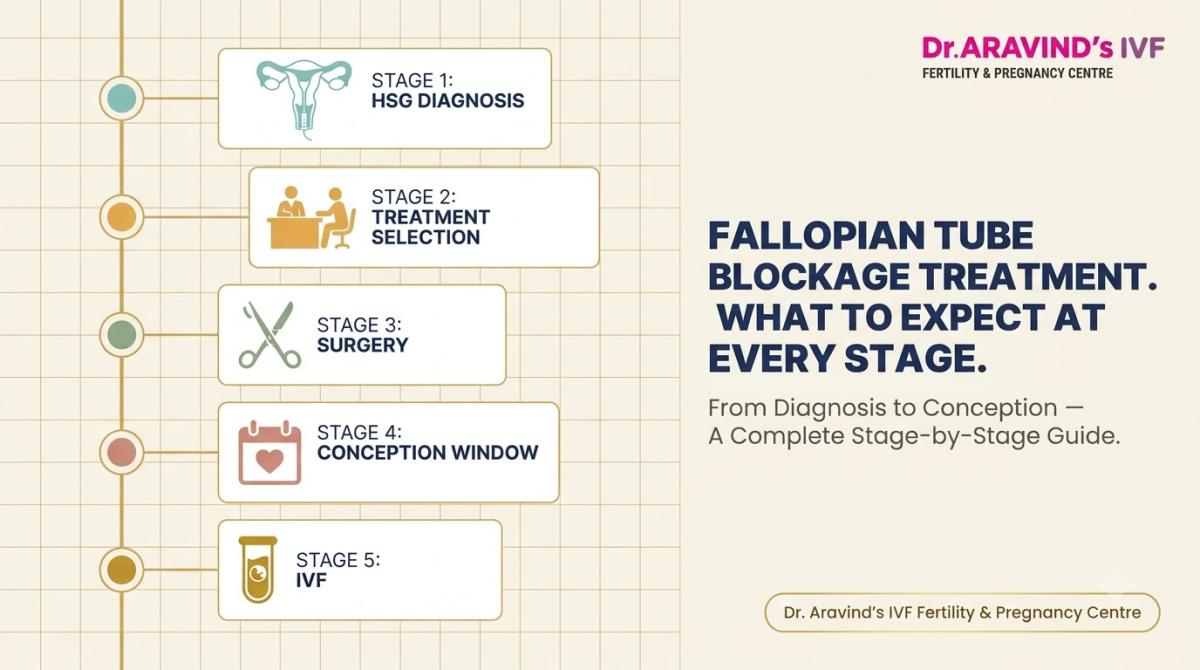
Knowing what is coming makes everything more manageable.
That is true for most medical situations. It is especially true for fallopian tube blockage treatment — where the journey from diagnosis to conception involves multiple stages, each with its own timeline, its own procedures, and its own emotional weight.
This guide walks through every stage clearly — what happens, what to expect physically and emotionally, and what comes next at each step.
Stage 1 — Confirming the Diagnosis
Best Fertility Centre in Coimbatore — Where Every Treatment Journey Begins
Before any treatment can begin — the blockage must be accurately confirmed and characterised.
Fallopian tube blockage is not visible on standard ultrasound. Specific diagnostic procedures are required:
Hysterosalpingography (HSG)
A contrast dye is injected through the cervix into the uterine cavity — then X-ray imaging tracks whether the dye flows freely through both tubes into the pelvic cavity. Blockage appears as dye stopping at a specific point.
What to expect — mild to moderate uterine cramping during and shortly after the procedure. Most women describe it as similar to period pain. The procedure takes approximately 15–30 minutes. Normal activities resume the same day.
Diagnostic Laparoscopy
Where HSG findings are unclear or a proximal blockage needs confirmation — laparoscopy provides direct visual assessment of the tubes, ovaries, and pelvic cavity. Performed under general anaesthesia — day procedure, recovery 2–3 days.
Understanding the common signs of fallopian tube blockage and how PID creates tubal damage helps contextualise why accurate diagnosis is the non-negotiable foundation of effective treatment.
Stage 2 — Treatment Selection
Why this decision requires more than the HSG result alone
Once blockage is confirmed — treatment selection is the most important clinical decision in the entire journey.
The reasons for fallopian tube blockage — infection, endometriosis, surgical history, spasm — combined with blockage location and severity determine which treatment is appropriate.
What to expect at this stage — a detailed consultation reviewing HSG findings, laparoscopy results where applicable, ovarian reserve testing (AMH, AFC), partner semen analysis, and age-related fertility considerations.
This is not a rushed decision. A complete picture — not just the tubal finding — determines whether surgical repair, cannulation, or direct IVF gives the best realistic outcome.
Stage 3 — Surgical Treatment (Where Appropriate)
What happens during and after tubal surgery
For women where tubal repair is the recommended pathway — here is what each procedure involves:
Selective Tubal Cannulation
Performed under hysteroscopic or fluoroscopic guidance — no incisions, no general anaesthesia. A thin catheter clears the proximal blockage directly. The procedure takes 20–30 minutes. Mild cramping is common for 24 hours. Most women resume normal activity the following day.
Laparoscopic Surgery — Adhesiolysis, Fimbrioplasty, Salpingostomy
Performed under general anaesthesia through small keyhole incisions.
What to expect physically:
-
Procedure duration: 45 minutes to 2 hours depending on complexity
-
Hospital stay: same day or overnight
-
Recovery: 3–5 days before returning to light activity, 2 weeks before full activity
-
Shoulder tip pain from surgical gas — resolves within 24–48 hours
-
Mild bloating and fatigue for the first week
What to expect emotionally — post-surgical recovery carries a mix of relief and cautious hope. Natural conception attempts typically begin after one full menstrual cycle post-surgery — giving the pelvic environment time to settle.
Stage 4 — The Post-Treatment Conception Window
What realistic timelines look like after treatment
After successful tubal surgery — natural conception attempts begin.
Realistic timelines:
-
After cannulation — natural conception attempts begin immediately after the next period
-
After laparoscopic adhesiolysis — most specialists recommend 3–6 months of natural attempts before reassessment
-
After salpingostomy for hydrosalpinx — close monitoring for ectopic pregnancy is essential in the first positive cycle, as tubal ectopic risk is elevated after distal tubal surgery
If natural conception has not occurred within 6 months of successful tubal surgery — reassessment at the best IVF centre in India evaluates whether IVF is the more appropriate next step.
Stage 5 — IVF (When Tubes Cannot Be Repaired or Surgery Has Not Succeeded)
What the IVF pathway looks like for tubal factor infertility
When tubal repair is not possible — or has not achieved pregnancy within an appropriate window — IVF bypasses the tubes entirely.
The IVF process for tubal factor infertility follows standard protocol:
-
Ovarian stimulation — hormone injections over 10–12 days stimulate multiple follicle development. Ultrasound monitoring every 2–3 days tracks response
-
Egg retrieval — performed under light sedation, taking approximately 20 minutes. Mild bloating and pelvic discomfort for 1–2 days post-procedure
-
Fertilisation and embryo development — eggs and sperm combined in the embryology laboratory. Embryos monitored for 3–5 days
-
Embryo transfer — a simple, painless procedure placing the selected embryo into the uterine cavity. No anaesthesia required
-
Two-week wait — the most emotionally challenging stage. Progesterone support continues. A blood HCG test at day 14 confirms pregnancy
One important note for hydrosalpinx — surgical removal or occlusion of hydrosalpinx before IVF is standard protocol at a specialist fertility centre in Coimbatore. Hydrosalpinx fluid impairs embryo implantation — addressing it before transfer significantly improves IVF success rates.
Every Stage Has a Clear Next Step
Fallopian tube blockage treatment is not a single event. It is a sequential journey — each stage informing the next, each decision made on the basis of what the previous stage revealed.
At Dr. Aravind's IVF Fertility & Pregnancy Centre — the fertility centre in Coimbatore — every stage of that journey is managed with complete diagnostic accuracy, genuine clinical expertise, and the kind of transparent communication that makes each next step feel clear rather than uncertain.
Dr. Aravind's IVF Fertility & Pregnancy Centre
Coimbatore, Tamil Nadu, India












Comments (0)