

Smart Meters Market Size, Growth Analysis, Industry Trends & Forecast 2034
The global smart meters market grew from USD 28.6 Billion in 2025 to USD 30.6 Billion in 2026

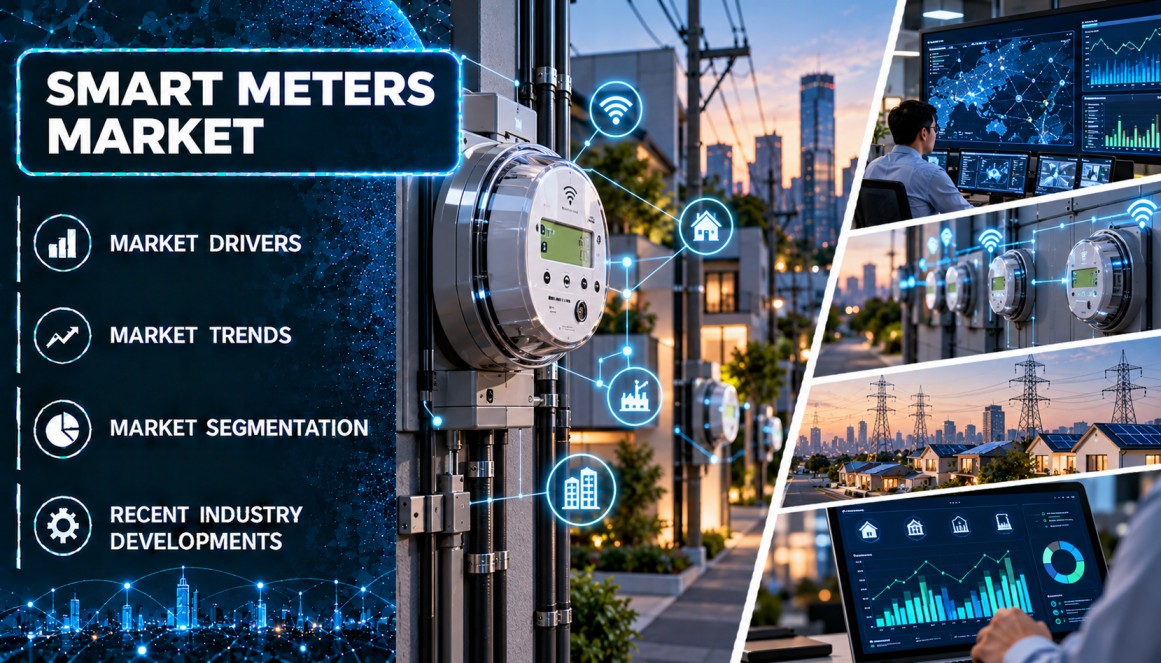
IMARC Group, a leading global market research and management consulting firm, has published its latest market intelligence report on the smart meters market. The global smart meters market grew from USD 28.6 Billion in 2025 to USD 30.6 Billion in 2026. Looking forward, IMARC Group expects the market to reach USD 52.0 Billion by 2034, exhibiting a growth rate CAGR of 6.88% during 2026-2034. Growth is driven by the rising emphasis on energy efficiency, growing investments in modernizing aging utility infrastructure, expanding regulatory mandates and incentives for advanced metering, and the integration of IoT and AI-enabled analytics. These give utilities and consumers real-time visibility into electricity, water, and gas consumption worldwide.
The market is experiencing strong momentum as utilities, regulators, and consumers align around the practical advantages of digital metering. Smart meters replace manual meter reading with automatic two-way data transmission, enabling accurate billing, faster fault detection, quicker service restoration after outages, and detailed consumption insights that help households and businesses manage usage. They also serve as the backbone of smart grids, which are essential for integrating rooftop solar, wind, electric vehicle charging, and other distributed energy resources. Asia Pacific leads the global landscape with a share of over 44.6%, while the residential segment alone accounts for around 71.4% of end use demand. Together, these figures show how large household deployment programs are shaping the industry.
How AI is Reshaping the Future of the Smart Meters Market
-
Distributed Intelligence at the Grid Edge Is Turning Meters into Analytical Nodes: Utilities are moving from simple data collection to running analytics directly on the meter. Itron reports more than 16 million distributed intelligence enabled meters shipped and over 100 million endpoints under management. In the United States, Duquesne Light Company is working with Itron to deploy tens of thousands of smart meters that use real-time data to identify anomalies and support faster interconnection of new distributed energy resources. This reduces the need for separate field sensors and gives distribution operators a granular, feeder-level view of grid conditions.
-
Predictive Load Management and Demand Response Orchestration: AI-driven analytics use interval data from smart meters to forecast peak demand, support time-of-use pricing, and coordinate flexible loads such as EV chargers, heat pumps, and rooftop solar. Itron's platform has dispatched around 70 GWh of flexible customer load and generation, showing how meter data can be converted into measurable peak reduction. Utilities can defer costly capacity additions, while consumers receive pricing signals that reward efficient behavior.
-
AI-Powered Resilience and Faster Restoration After Extreme Weather: Smart meters already speed up outage detection by reporting loss of supply in real time. Utility technology providers are now layering predictive AI on top. In October, Itron signed a USD 325 million agreement to acquire Urbint, an AI-driven provider of storm response, damage prevention, and worker safety software, and later also acquired Locusview for digital construction management. This signals a shift from metering hardware toward software that predicts risks to infrastructure and shortens power restoration times.
Grab a sample PDF of this report: https://www.imarcgroup.com/smart-meters-market/requestsample
Smart Meters Market Trends and Drivers:
The global smart meters market is witnessing steady expansion, fueled by the convergence of energy efficiency priorities, the urgent need to modernize aging grids, and supportive government programs across major economies. Traditional metering systems cannot show where energy is being wasted, whereas smart meters give utilities and consumers transparent, real-time data for better decisions. According to the International Energy Agency, global energy efficiency investment climbed 16% to USD 600 Billion in a single year, supported by the rise of electric vehicles and government stimulus for efficient buildings, while heat pump sales rose by around 40% in Europe. Infrastructure age adds urgency. Roughly 70% of the United States energy infrastructure is more than 25 years old, and grid disruptions cost the country an average of USD 1.2 Billion every year. US utilities already operate about 119 million advanced metering infrastructure installations, equal to roughly 72% of all electric meter installations, and more than 100 million smart meters are in place nationwide.
Government schemes are accelerating deployment in every major region. In the United States, the Department of Energy's Grid Resilience and Innovation Partnerships program, funded through the Bipartisan Infrastructure Law, channels USD 10.5 Billion into grid flexibility and resilience, and its Smart Grid Grants have supported advanced metering projects. Rappahannock Electric Cooperative received a federal cost share of about USD 38.16 million, matched by an equal contribution from the recipient, while Liberty Utilities was selected for up to USD 13 million to deploy advanced metering in the Lake Tahoe area. In India, the Revamped Distribution Sector Scheme carries an outlay of Rs 3,03,758 crore, including gross budgetary support of Rs 97,631 crore. Central support for smart meters is 15% of cost per meter capped at Rs 900, rising to 22.5% capped at Rs 1,350 for special category states. Around 20 crore smart meters have been sanctioned, and more than 5 crore are installed nationwide across schemes, of which about 3.9 crore fall under the scheme. In Europe, the Third Energy Package set a target of rolling out smart electricity meters to 80% of consumers wherever cost-benefit assessments were positive. The EU Agency for the Cooperation of Energy Regulators reports that roughly 66% of household customers in the EU and Norway now have a smart meter, with most Member States above 80% and ten countries at 99% or more. In Great Britain, suppliers face binding annual installation targets, and more than 40 million smart and advanced meters are in operation, representing about 70% of all gas and electricity meters in homes and small businesses. In Saudi Arabia, Saudi Electricity Company awarded contracts worth SAR 9.5 Billion (USD 2.5 Billion) under the Kingdom's Vision agenda and installed over 10 million smart meters in less than 14 months, with about 4 million manufactured locally.
Beyond regulation, utilities are adopting smart meters to protect revenue and manage a more complex energy mix. Non-technical losses from fraud and theft can account for up to 15% of energy distribution losses in some countries, and smart meters with tamper detection and advanced security features help utilities identify unauthorized usage. The integration of IoT allows meters to communicate with home energy systems, EV chargers, and solar inverters, supporting the shift from centralized supply to localized, grid-connected generation. In Latin America, programs such as Brazil's ProGD for distributed generation are lifting demand for advanced metering. Rising competition among manufacturers is lowering device costs and widening access for a broader range of utilities. Expanding smart city projects, rising urbanization, and growing consumer awareness of consumption patterns are reinforcing demand across residential, commercial, and industrial users.
Ask an analyst for customized report: https://www.imarcgroup.com/request?type=report&id=6218&flag=E
Smart Meters Industry Segmentation:
The report has segmented the market into the following categories:
Breakup By Product:
- Smart Electricity Meter
- Smart Water Meter
- Smart Gas Meter
Smart electricity meters account for the largest product segment, driven by the universal need for electricity across residential, commercial, and industrial applications and the role of power in homes, offices, factories, and data centers. These meters provide real-time tracking, consumption analytics, and accurate billing, while the shift toward renewable energy creates a need for meters that can manage complex, two-way grid interactions. Government efficiency and sustainability programs mostly target electricity metering first, which is why large national rollouts in the United States, India, Europe, and Saudi Arabia have centered on electric meters.
Breakup By Technology:
- AMI (Advanced Metering Infrastructure)
- AMR (Automatic Meter Reading)
AMI holds the largest technology share because it goes beyond measurement to offer two-way communication, near real-time data monitoring, and remote control functions. Utilities gain streamlined operations, accurate billing, and the ability to run demand response programs, while consumers receive granular consumption analytics. Utilities such as Southern California Edison and Pacific Gas and Electric are expanding AMI systems to enable real-time energy monitoring and demand response. The technology's scalability and easy integration with other smart grid solutions make it a future-proof investment.
Breakup By End Use:
- Residential
- Commercial
- Industrial
The residential segment accounts for the largest end use share at around 71.4%. Household programs support more accurate billing, real-time consumption data, and better conservation, and adoption continues to rise as awareness grows and device costs fall. Commercial users such as offices and retail stores rely on smart meters for precise billing, data analytics, and demand response features that cut operating costs and support sustainability goals. Industrial facilities use them for real-time monitoring and control of high utility consumption, often integrated with industrial control systems for operational efficiency and safety.
Breakup By Region:
- North America (United States, Canada)
- Asia Pacific (China, Japan, India, South Korea, Australia, Indonesia, Others)
- Europe (Germany, France, United Kingdom, Italy, Spain, Russia, Others)
- Latin America (Brazil, Mexico, Others)
- Middle East and Africa
Asia Pacific dominates the global smart meters market with a share of 44.6%, supported by rapid urbanization, population growth, and rising electricity, water, and gas consumption in China and India. China's State Grid Corporation program has driven extensive installations, while India's Smart Meter National Program targets around 25 crore smart meters and the Smart Cities Mission includes smart metering. Lower penetration of conventional advanced metering in parts of the region opens a clear path for AMI and AMR adoption, and competitive local manufacturing helps keep device costs low. In North America, the United States accounts for over 74.60% of the regional market, supported by federal and state grid modernization programs. Europe continues to advance through the Green Deal's smart grid projects and strict energy regulations, with Sweden achieving full coverage early. Latin America is gaining from loss reduction and distributed generation programs, and the Middle East and Africa are being shaped by smart city initiatives, with industry sources indicating USD 17.6 Billion of planned spending on smart metering and related smart grid infrastructure.
Competitive Landscape:
The report provides a comprehensive analysis of the competitive landscape in the smart meters market with detailed profiles of all major companies, including:
- Apator SA
- Arad Group
- Badger Meter Inc.
- Diehl Stiftung & Co. KG
- Holley Technology Ltd.
- Itron Inc.
- Kamstrup
- Landis+Gyr
- Linyang Energy
- Neptune Technology Group Inc.
- Pietro Fiorentini S.p.a
- Xylem
- ZENNER International GmbH & Co. KG
Competition is shaped by R&D investment in accuracy, reliability, and cybersecurity, strategic partnerships with utilities and governments, and active portfolio reshaping. Landis+Gyr serves more than 2,000 utilities and has over 180 million connected intelligent devices in the field. It also agreed to divest its Europe, Middle East and Africa business, which generated about USD 600 million in net revenue and included five production sites, for an enterprise value of USD 215 million, to sharpen its focus on higher-value software and services. Xylem sold its international water and heat metering business, which generated about USD 250 million in revenue, to the same buyer. Itron committed USD 325 million to acquire Urbint to expand AI-enabled software, and Badger Meter reported quarterly sales of USD 222.3 million as awarded advanced metering projects began shipping.
What Does The Full Report Cover?
If you are tracking the smart meters market for investment decisions, market entry planning, competitive benchmarking, or strategic advisory, IMARC Group's report gives you everything in one place:
- Complete market sizing with revenue forecasts covering the full projection period
- Quantified growth driver analysis across product, technology, end use, and regional markets
- Sub-segment breakdowns for smart electricity meter, smart water meter, smart gas meter, AMI, AMR, residential, commercial, and industrial with individual share data
- Country-level data for the United States, Canada, Germany, France, the United Kingdom, Italy, Spain, Russia, China, Japan, India, South Korea, Australia, Indonesia, Brazil, and Mexico
- Competitive profiles of 13 leading companies with strategic landscape assessment
- Porter's Five Forces analysis covering the threat of new entrants, competitive rivalry, supplier power, buyer power, and the threat of substitution
- Latest technology trends covering IoT integration, AI-enabled analytics, advanced metering infrastructure adoption, grid modernization programs, and cybersecurity and interoperability developments shaping competition and utility procurement across key regional markets
Recent News and Developments in Smart Meters Market
-
September: Landis+Gyr and Thales announced a strategic collaboration to provide secure, scalable eSIM cellular connectivity and remote connectivity management for smart meter deployments across North America. Landis+Gyr serves more than 2,000 utilities worldwide and has over 180 million connected intelligent devices in the field, so the collaboration is aimed at reducing field interventions across very large meter fleets.
-
July: Badger Meter reported total quarterly sales of USD 222.3 million, up sequentially as previously awarded advanced metering infrastructure projects began shipping. The company had completed its acquisition of UDlive Limited effective May 1 to extend its sewer line monitoring capabilities.
-
May: Xylem completed the sale of its international water and heat metering business to AURELIUS, creating Sensus International as a standalone company. The unit generated approximately USD 250 million in revenue, while Xylem retained its North American smart metering business under the Sensus brand.
-
February: Genus Power surpassed 1 crore smart meters deployed under the Revamped Distribution Sector Scheme as an advanced metering infrastructure service provider. Its order book stood at around Rs 27,000 crore, covering about 2.75 crore smart meters, which shows the scale of India's execution phase.
-
October: Itron signed a definitive agreement to acquire Urbint, a provider of AI-powered operational resilience solutions, for USD 325 million. The deal expands Itron's software and recurring revenue offerings in storm response, damage prevention, and worker safety.
-
December: LUMA announced the next phase of Puerto Rico's smart meter rollout, partnering with Itron to install 1.5 million smart meters to replace damaged meters and modernize the grid. The program is expected to create more than 150 direct and indirect jobs and strengthen energy management, customer service, and disaster response.
-
November: Iskrameco announced an investment of Rs 1,000 crore to establish a hardware and software facility for smart metering solutions in New Town, Kolkata. The 11-story facility will dedicate two floors to hardware production and the rest to smart metering software, with completion targeted within three years.
Note: If you require specific details, data, or insights that are not currently included in the scope of this report, we are happy to accommodate your request. As part of our customization service, we will gather and provide the additional information you need, tailored to your specific requirements. Please let us know your exact needs, and we will ensure the report is updated accordingly to meet your expectations.
Key Questions This Report Answers
- What is the current global smart meters market size and what is its projected value?
- Which product segment holds the largest share in the global smart meters market?
- Which technology, AMI or AMR, leads the global smart meters market and why?
- What are the key drivers of global smart meters market growth, including government mandates and grid modernization programs?
- Which region dominates the global smart meters market and why?
- How are IoT, AI-enabled analytics, and renewable energy integration reshaping product development and utility procurement strategies in the smart meters industry?
- Who are the top companies in the global smart meters market and what are their competitive strategies?
About Us:
IMARC Group is a global management consulting firm that helps the world's most ambitious changemakers to create a lasting impact. The company provides a comprehensive suite of market entry and expansion services. IMARC offerings include thorough market assessment, feasibility studies, company incorporation assistance, factory setup support, regulatory approvals and licensing navigation, branding, marketing and sales strategies, competitive landscape and benchmarking analyses, pricing and cost research, and procurement research.
Media and Sales Contact
IMARC Group
Email: [email protected]
United States: +1-201-971-6302
India: +91-120-433-0800
United Kingdom: +44-753-714-6104













Comments (0)