

Electric Vehicle Battery Recycling Market Size, Trends, and Industry Analysis 2034
The electric vehicle battery recycling market grew from USD 4.48 Billion in 2025 to USD 5.47 Billion in 2026

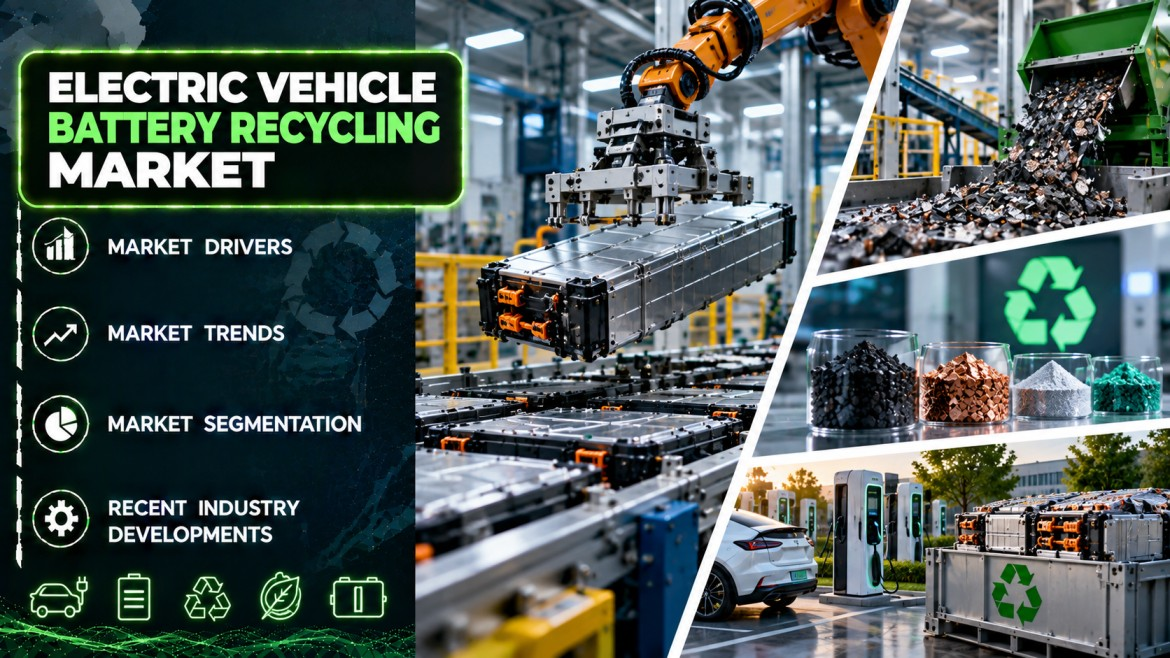
IMARC Group, a leading global market research and management consulting firm, has published its latest market intelligence report on the electric vehicle battery recycling market. The global lectric vehicle battery recycling market grew from USD 4.48 Billion in 2025 to USD 5.47 Billion in 2026 and is projected to reach USD 28.25 Billion by 2034, growing at a CAGR of 22.01% during 2026-2034, exhibiting rapid expansion. Growth is driven by the accelerating retirement of first-generation electric vehicle battery packs and the strategic need to secure critical minerals such as lithium, cobalt, and nickel. Tightening recycling mandates across Europe, China, India, and North America, and growing corporate circular economy commitments, add further momentum.
The market is experiencing strong growth momentum because electric vehicle adoption has created a structurally guaranteed and expanding supply of end-of-life batteries. Annual global electric car sales have crossed 17 million units, growing by more than 25% in a single year. With average battery lifespans of 8 to 12 years, packs from early adoption cohorts are now entering end-of-life processing at scale, and feedstock volumes roughly double every three years as each cohort matures. Hydrometallurgical processing holds 60.6% of the process segment because it delivers battery-grade purity that cathode manufacturers can reuse directly. Asia Pacific leads with 50.5% of the regional market, anchored by China’s integrated cluster of battery makers, vehicle OEMs, and recyclers. Meanwhile, geopolitical concentration of lithium, cobalt, nickel, and manganese supply is turning recycling from an environmental choice into an economic and strategic necessity.
How AI is Reshaping the Future of the Electric Vehicle Battery Recycling Market
- AI-Enabled Robotic Disassembly Improving Safety and Throughput: Disassembly of EV battery packs remains largely manual because pack designs vary widely, exposing workers to electric shock and toxic gas risks. The Eureka-funded Project LAMBDA, a collaboration between AICA, Circu Li-ion, and the Swiss Battery Technology Center, demonstrated at Circu Li-ion’s facility in Luxembourg an industrial Kuka robot that used 3D vision, force feedback, and a reinforcement-learning neural network to cut and remove a cable harness from a live high-voltage EV battery pack. The result shows how automation can remove human operators from the most hazardous dismantling steps while keeping pace with diverse pack architectures.
- Machine Vision and Autonomous Task Planning Lifting Recovered Material Value: The UK’s Manufacturing Technology Centre developed a machine learning enabled vision system and autonomous task planner on an industrial robot that detects and unfastens bolts on complex end-of-life battery packs, with GBP 1.85 million in grant funding secured to continue the work in a dedicated disassembly cell. The program found that disassembling packs down to cell level first can increase the value of recovered battery materials by 27%, giving recyclers a clear economic case to invest in intelligent dismantling lines rather than relying on direct shredding.
- AI Data Center Power Demand Creating a Second-Life Value Chain Before Recycling: Redwood Materials operates a 12 MW / 63 MWh microgrid at its Sparks, Nevada campus built from 792 second-life EV battery packs, supplying power to modular AI data centers run by Crusoe. Investors including Google and Nvidia’s venture arm backed Redwood’s USD 425 million funding round, signaling that AI infrastructure demand is giving retired batteries a profitable second life before final recycling and improving the overall economics of the recycling loop.
Grab a sample PDF of this report: https://www.imarcgroup.com/electric-vehicle-battery-recycling-market/requestsample
Electric Vehicle Battery Recycling Market Trends and Drivers:
The global electric vehicle battery recycling market is witnessing rapid expansion, fueled by the convergence of a guaranteed feedstock base, critical mineral supply security priorities, and a regulatory environment that is making recycling an economic necessity. As early adoption cohorts of electric vehicles retire, recyclers gain predictable volumes, and China alone is home to nearly 180,000 enterprises engaged in battery recycling. Lead-acid batteries, which hold 32.6% of the type segment, show what a mature recycling loop looks like, with global recycling rates above 95% and recycled lead supplying 80 to 85% of global lead demand. Lithium-ion batteries, with the largest type share at 44.8%, are now following the same path as passenger EVs reach end of life in growing numbers.
Critical mineral security and regulation are the second pillar of growth. The EU Battery Regulation requires the recovery of 50% of lithium and 90% of cobalt, copper, lead, and nickel from waste batteries, with targets rising to 80% and 95% respectively. New batteries must also contain minimum recycled content of 16% cobalt, 6% lithium, and 6% nickel, rising to 26%, 12%, and 15% over time, while digital battery passports will make recycled content data traceable across the value chain. Europe holds 21.3% of the global market, making it the most regulation-driven region. In China, new Interim Measures on the recycling of retired power batteries, supported by a national traceability platform that assigns every battery a unique digital identity, are steering retired packs into formal channels. This is happening in a market where new energy vehicle production and sales exceed 16 million units and account for nearly half of all new vehicle sales.
Government programs are also funding capacity directly. In India, the Battery Waste Management Rules apply Extended Producer Responsibility to EV batteries, with material recovery targets stepping up to 90% of battery dry weight and collection obligations reaching 70% of EV batteries placed on the market. Complementing this, the INR 1,500 crore incentive scheme for critical mineral recycling under the National Critical Mineral Mission is expected to build at least 270 kilotonnes of annual recycling capacity, yield around 40 kilotonnes of annual critical mineral production, attract about INR 8,000 crore in investment, and create nearly 70,000 direct and indirect jobs. One-third of the outlay is reserved for small and new recyclers, with incentives capped at INR 50 crore for large entities and INR 25 crore for small ones. In the United States, the Bipartisan Infrastructure Law authorized USD 335 million for battery recycling and second-life programs, and Cirba Solutions received about USD 75 million in federal funds to expand its lithium-ion processing facility in Lancaster, Ohio. Second-life use adds another growth layer, since EV batteries retain at least 70% of original capacity at the end of vehicle life, extending economic life by 5 to 10 years and opening an opportunity estimated at USD 8 to 12 billion. Direct recycling technologies, which can use approximately 80% less energy than hydrometallurgy, are also moving toward commercial scale.
Ask an analyst for customized report: https://www.imarcgroup.com/request?type=report&id=5313&flag=E
Electric Vehicle Battery Recycling Industry Segmentation:
The report has segmented the market into the following categories:
Breakup By Type:
- Lithium-ion
- Lead-acid
- Others
Lithium-ion batteries account for the largest type share at 44.8%, driven by their near-universal use in passenger EVs and the first large-scale retirement cycle of packs from early adoption waves. Lead-acid batteries follow with 32.6%, supported by an established, self-sustaining recycling industry that gives recyclers a stable complementary revenue stream alongside advanced chemistries.
Breakup By Process:
- Hydrometallurgical
- Pyro-metallurgical
- Others
Hydrometallurgical processing commands the largest process share at 60.6%, because cathode active material manufacturers need lithium, cobalt, nickel, and manganese at purities above 99.5% in specific sulfate or carbonate forms, which acid leaching and chemical refining can deliver. Pyro-metallurgical processing holds 26.4%, valued for its chemistry-agnostic flexibility and its ability to handle batteries of unknown or variable condition.
Breakup By Vehicle Type:
- Passenger Cars
- Commercial Vehicles
Passenger EVs represent the fastest-growing source of end-of-life battery packs, as the earliest adoption cohorts reach the end of their service life. Commercial vehicles, including buses and trucks, add high-capacity packs with more predictable, fleet-based retirement cycles that make collection and aggregation more efficient for recyclers.
Breakup By Application:
- Electric Cars
- Electric Buses
- Energy Storage Systems
- Others
Electric cars generate the bulk of end-of-life feedstock, while energy storage systems play a dual role as both a second-life destination and a future source of recyclable batteries. EV packs that retain at least 70% of original capacity can serve stationary storage for several additional years before final recycling, a pathway now being used by automakers and recyclers to cut factory electricity costs and support grid reliability.
Breakup By Region:
- North America (United States, Canada)
- Asia Pacific (China, Japan, India, South Korea, Australia, Indonesia, Others)
- Europe (Germany, France, United Kingdom, Italy, Spain, Russia, Others)
- Latin America (Brazil, Mexico, Others)
- Middle East and Africa
Asia Pacific dominates the global electric vehicle battery recycling market with 50.5% of the regional share, reflecting China’s position as the world’s largest EV market and its most mature recycling ecosystem, where manufacturers, vehicle makers, and recyclers operate in geographic proximity and recovered materials flow straight back into domestic battery production. Europe follows with 21.3% and North America with 16.8%, the latter seeing the fastest capacity build-out outside Asia as domestic supply chain incentives and critical mineral security programs attract new recycling investment. Latin America and the Middle East and Africa hold 6.2% and 5.2% respectively, supported by growing EV adoption and emerging battery waste frameworks.
Competitive Landscape:
The report provides a comprehensive analysis of the competitive landscape in the electric vehicle battery recycling market with detailed profiles of all major companies, including:
- Umicore
- Redwood Materials Inc.
- Glencore
- Fortum Corporation
The market is moderately fragmented and moving toward consolidation, with the top four players holding roughly 35 to 42% of global revenue and a mid-market of 15 to 20 regional and specialty operators below them. Integrated mining, refining, and recycling groups are gaining ground as acquisitions combine technology, feedstock access, and material offtake across the value chain.
What Does The Full Report Cover?
If you are tracking the electric vehicle battery recycling market for investment decisions, market entry planning, competitive benchmarking, or strategic advisory, IMARC Group’s report gives you everything in one place:
- Complete market sizing with revenue forecasts covering the full projection period
- Quantified analysis of market drivers, restraints, opportunities, and challenges shaping recycler economics, feedstock availability, and regulatory exposure
- Sub-segment breakdowns by type, process, vehicle type, and application with individual share data, covering lithium-ion, lead-acid, hydrometallurgical, pyro-metallurgical, passenger cars, commercial vehicles, electric cars, electric buses, and energy storage systems
- Country-level data for the United States, Canada, Germany, France, the United Kingdom, Italy, Spain, Russia, China, Japan, India, South Korea, Australia, Indonesia, Brazil, and Mexico
- Competitive profiles of leading companies including Umicore, Redwood Materials Inc., Glencore, and Fortum Corporation, with strategic landscape assessment
- Porter’s Five Forces, value chain analysis, and market concentration analysis
- Latest technology and innovation trends covering hydrometallurgical refining, direct recycling, second-life battery applications, closed-loop OEM partnerships, and recycling of emerging chemistries such as lithium iron phosphate
Recent News and Developments in Electric Vehicle Battery Recycling Market
- June: General Motors became the first automaker to engage Redwood Materials across every stage of the battery lifecycle, with Redwood planning to deploy approximately 100 repurposed GM battery packs at a Michigan plant to provide 1.5 MW and 7.2 MWh of dispatchable energy and save the site more than USD 3 million in electricity costs. Redwood has already processed over 28,000 metric tons of material from GM and Ultium Cells, and around 10,000 GM packs are earmarked for second-life use.
- April: Rivian partnered with Redwood Materials to deploy 10 MWh of second-life battery storage at its Normal, Illinois factory, described as the first repurposed battery system at a U.S. automaker’s manufacturing plant. The project shows how automakers are turning retired packs into plant-level energy assets before final recycling.
- April: China launched its national power battery traceability platform, requiring battery manufacturers, vehicle producers, maintenance providers, and recyclers to upload lifecycle data and assigning a unique digital identity to every battery. The platform supports a market where new energy vehicle production and sales exceed 16 million units and account for nearly half of all new vehicle sales.
- January: Redwood Materials closed its expanded Series E at USD 425 million, up from the earlier USD 350 million, with Google joining existing investors Capricorn and Goldman Sachs and valuing the company at more than USD 6 billion. The capital will accelerate its energy storage platform while strengthening its integrated recycling and critical minerals business.
- August: Glencore completed its acquisition of Li-Cycle’s recycling spoke facilities in Arizona, Alabama, New York, Ontario, and Germany, along with the Rochester Hub project and intellectual property, following a stalking-horse bid of at least USD 40 million. The deal brings one of Europe’s largest battery recycling plants, in Magdeburg, into Glencore’s global metals network.
- June: BASF started commercial operation of its black mass plant in Schwarzheide, Germany, with annual capacity of up to 15,000 tonnes of end-of-life lithium-ion batteries and production scrap, equal to roughly 40,000 EV batteries a year. The plant positions BASF to cover the full European recycling chain from collection and dismantling to black mass production and refining.
Note: If you require specific details, data, or insights that are not currently included in the scope of this report, we are happy to accommodate your request. As part of our customization service, we will gather and provide the additional information you need, tailored to your specific requirements. Please let us know your exact needs, and we will ensure the report is updated accordingly to meet your expectations.
Key Questions This Report Answers
- What is the current global electric vehicle battery recycling market size and what is its projected value?
- Which type segment holds the largest share in the global electric vehicle battery recycling market?
- Which recycling process dominates the market and why is it preferred by battery material producers?
- What are the key drivers of global electric vehicle battery recycling market growth?
- Which region dominates the global electric vehicle battery recycling market and why?
- How are regulations such as the EU Battery Regulation, India’s Battery Waste Management Rules, and China’s traceability framework reshaping recycling investment and compliance strategies?
- Who are the top companies in the global electric vehicle battery recycling market and what are their competitive strategies?
- What investment and market entry opportunities exist across direct recycling, second-life battery applications, and emerging market recycling infrastructure?
About Us:
IMARC Group is a global management consulting firm that helps the world’s most ambitious changemakers to create a lasting impact. The company provides a comprehensive suite of market entry and expansion services. IMARC offerings include thorough market assessment, feasibility studies, company incorporation assistance, factory setup support, regulatory approvals and licensing navigation, branding, marketing and sales strategies, competitive landscape and benchmarking analyses, pricing and cost research, and procurement research.
Media and Sales Contact
IMARC Group
Email: [email protected]
United States: +1-201-971-6302
India: +91-120-433-0800
United Kingdom: +44-753-714-6104











Comments (0)