

How to Apply for 12A and 80G Registration in India: Complete Guide

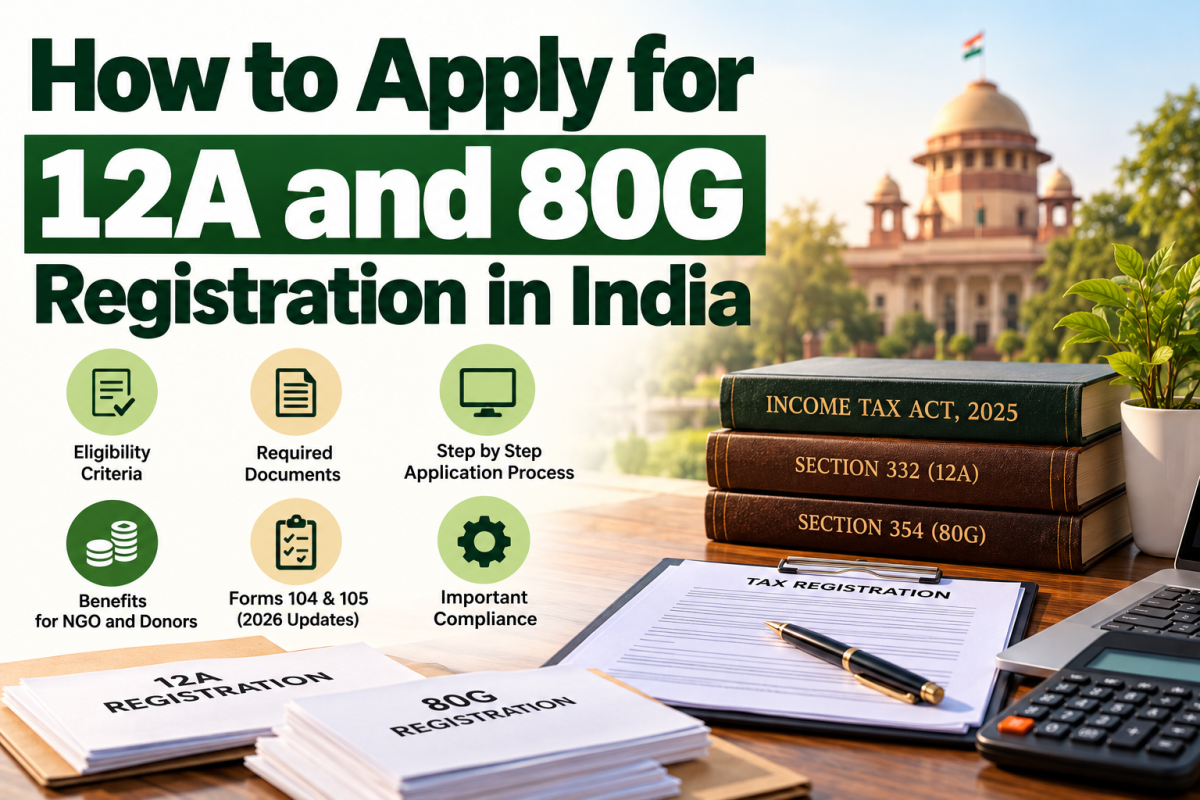
Obtaining tax registration and approval is an important step for charitable trusts, societies, and Section 8 companies seeking to operate transparently and attract donations. 12a and 80 g registration helps eligible non-profit organisations access applicable income-tax benefits and enables donors to claim deductions on eligible donations. From 1 April 2026, the Income-tax Act, 2025 introduced updated provisions and application forms, making it important for NGOs to understand the current requirements before applying.
What Are 12A and 80G Registrations?
These registrations serve different purposes and should not be treated as interchangeable.
1. What Is 12A Registration?
Traditionally, Section 12A and subsequent Section 12AB registration provided the framework for eligible charitable and religious institutions to claim income-tax exemption, subject to applicable conditions.
Under the Income-tax Act, 2025, Section 332 provides the corresponding framework for registration of eligible non-profit organisations. Approval alone does not automatically exempt every receipt; the organisation must satisfy the relevant conditions and compliance requirements.
2. What Is 80G Registration?
Under the earlier Income-tax Act, 1961, Section 80G provided for approval of eligible institutions so donors could claim deductions for qualifying donations.
Under the Income-tax Act, 2025, Section 354 provides the corresponding approval framework, while Section 133(1)(b)(ii) addresses the relevant donor deduction. The deduction depends on the applicable conditions and is not necessarily available for every donation.
What Is the Difference Between 12A and 80G Registration?
Understanding the distinction helps NGOs identify which approvals they need.
| Basis | 12A / Section 332 | 80G / Section 354 |
|---|---|---|
| Main purpose | Tax benefits for the eligible organisation | Approval for eligible donor deductions |
| Primary beneficiary | The non-profit organisation | Eligible donors |
| Application framework | Section 332 | Section 354 |
| Provisional application | Form 104 | Form 104 |
| Regular application | Form 105 | Form 105 |
Both approvals may be relevant to an NGO, but eligibility and approval conditions must be satisfied separately where applicable. Read more about the 12a and 80g registration requirements to understand how they work together.
Who Can Apply for 12A and 80G Registration?
Eligible charitable trusts, societies, and Section 8 companies can apply, subject to the relevant legal requirements.
Applicants should generally ensure that:
-
The organisation is legally established or registered under the applicable law.
-
Its objectives are charitable or otherwise permitted under the relevant provisions.
-
Its governing documents support its stated activities.
-
Its income and funds are applied according to applicable legal requirements.
-
Its financial records and supporting documents are available for verification.
-
It meets the relevant conditions for registration or approval.
For Section 354 approval, the organisation must also meet the applicable requirements relating to its Section 332 registration or application status.
What Documents Are Required?
Preparing complete and accurate documents can reduce the risk of queries or delays during processing.
Commonly required documents include:
-
Registration certificate of the trust, society, or Section 8 company.
-
Trust deed, memorandum of association, articles of association, or governing rules, as applicable.
-
PAN of the organisation.
-
Details of trustees, members, or directors.
-
Registered office address proof.
-
Activity report or description of charitable activities, where applicable.
-
Financial statements and books of account, where applicable.
-
Details of existing registrations, approvals, and previous applications.
-
Other declarations and supporting documents required by the applicable form.
The final checklist depends on the organisation's status, whether activities have commenced, and the type of application being submitted.
How to Apply for 12A and 80G Registration Online
Organisations should select the correct application route based on the applicable provisions and their current registration status.
Step 1: Check Your Organisation's Eligibility
Review the governing documents, charitable objectives, legal status, and existing tax registrations before starting the application.
Step 2: Prepare the Required Documents
Collect the registration certificate, PAN, governing documents, financial information, and other supporting records relevant to the application.
Step 3: Select the Applicable Form
For applications under the Income-tax Act, 2025:
-
Form 104: Generally used for provisional registration or approval.
-
Form 105: Generally used for regular registration or approval, including specified renewals and other applicable cases.
Existing registrations and pending applications may follow transitional rules. Check the applicable category before filing.
Step 4: File Through the Income-Tax Portal
Log in to the official Income Tax e-Filing portal, access the applicable form, enter the organisation's details, upload the required documents, and complete verification using the prescribed method.
Step 5: Respond to Departmental Queries
The tax authorities may review the application and request clarification or additional documents. Respond within the specified time and retain the acknowledgement for reference.
Step 6: Receive the Order
The competent authority examines the application and issues the applicable order. Check the approval details, validity, and conditions before relying on the registration for tax benefits.
Organisations that want practical filing assistance can use this guide to apply for12a and 80g registration.
What Should NGOs Do After Approval?
Registration does not eliminate ongoing responsibilities. NGOs should maintain proper accounts, use funds according to their objectives, file applicable income-tax returns, and meet audit and reporting requirements.
Organisations with Section 354 approval should also check their applicable donation-reporting obligations, including the prescribed statements and donor certificates where required.
Conclusion
Applying for 12A and 80G registration is an important step for eligible NGOs seeking tax benefits and stronger donor confidence. Although the familiar terms remain widely used, applications from 1 April 2026 must account for the Income-tax Act, 2025 and its updated Sections 332 and 354 and Forms 104 and 105.
Before applying, verify your organisation's eligibility, prepare the correct documents, and select the form appropriate to your circumstances. Accurate filing and continued compliance can help your organisation maintain its approvals and focus on its charitable objectives.











Comments (0)