

SAP SuccessFactors Variable Pay Study Plan: A 21-Day Schedule
Follow this SAP SuccessFactors Variable Pay Study Plan: a 21-day schedule covering setup, employee data, bonus plans, calculations, and integration.
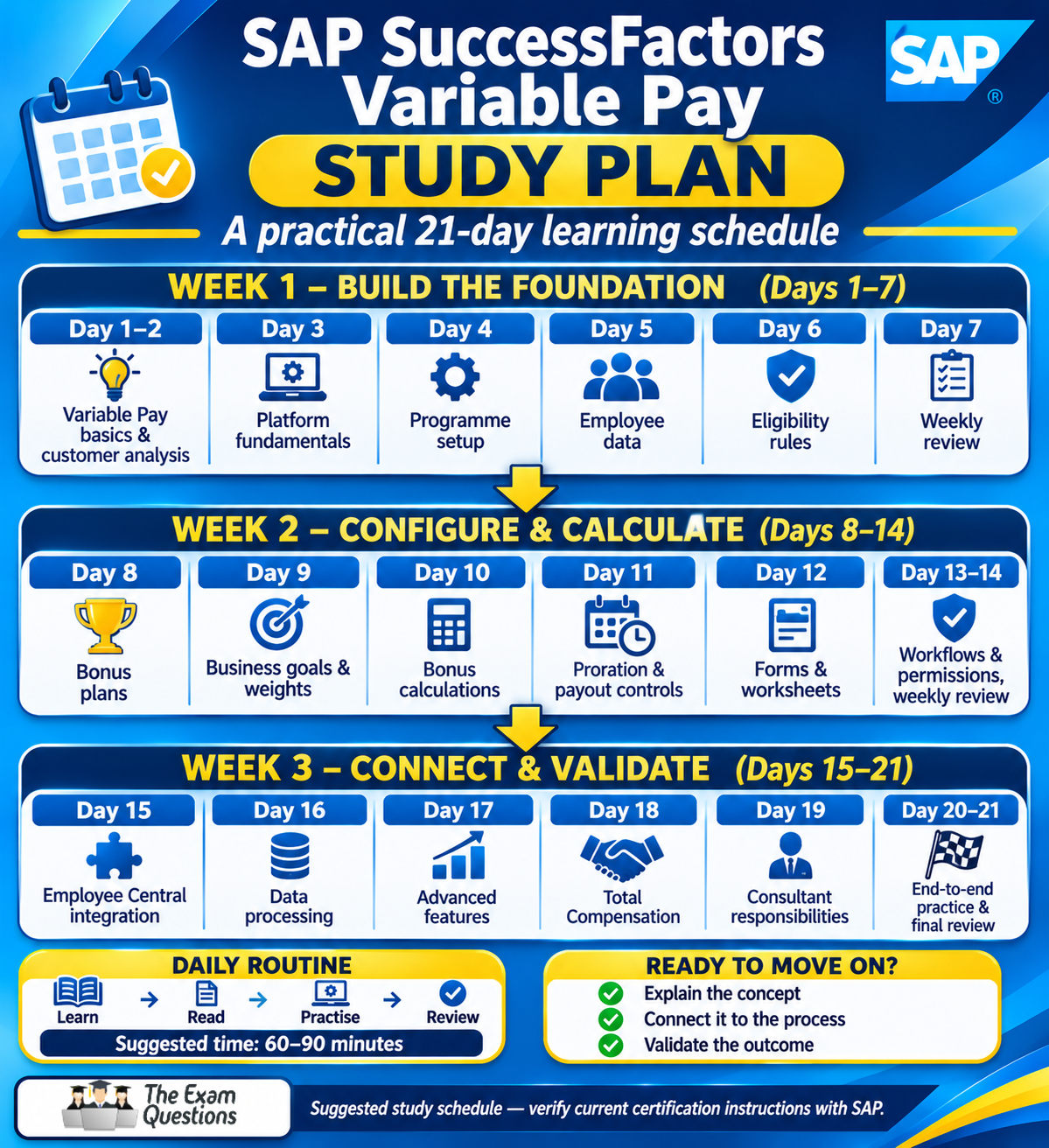
Quick Summary
This SAP SuccessFactors Variable Pay Study Plan offers a structured 21-day schedule covering platform fundamentals, program configuration, employee data, bonus calculations, and integrations. It combines SAP Academy lessons, focused revision, and practical exercises. Candidates build product knowledge step by step.
Introduction: Why a structured plan helps
A SAP SuccessFactors Variable Pay Study Plan divides a connected product into manageable sections. Program configuration, employee history, bonus plans, eligibility, and payout calculations all depend on each other, so a clear order makes revision easier. Focus on one subject, practise it, and review the connections before moving forward.
This schedule follows SAP's official Variable Pay curriculum and includes objectives, practical tasks, weekly milestones, and a final review.
Before starting the 21-day plan
The SAP SuccessFactors Variable Pay Academy is the main recommended course. SAP lists it as an intermediate course with seven units and an estimated duration of 5 hours and 24 minutes. It covers customer analysis, program setup, employee data, bonus plans, forms, advanced features, Employee Central integration, Total Compensation, and consultant responsibilities.
SAP lists THR80, the SAP SuccessFactors Platform Introduction Academy, as a prerequisite for the course, and certification exam requirements are listed separately. Prepare access to SAP's training platform and Help Portal documentation, a notebook for revision notes, an authorized practice environment where available, and a tracker for completed lessons. The schedule assumes 60 to 90 minutes of study per day, so adjust it to your experience.
Week one: build the product foundation
Goal: understand the purpose of Variable Pay, customer requirements, program structure, and employee information.
- Days 1 and 2, fundamentals and customer analysis: Study why organizations use Variable Pay, short term incentives, individual, team, and business performance, and target incentives. Review how consultants gather employee populations, performance measures, bonus policies, and approval responsibilities. Task: write a fictional company with two employee groups and explain how their incentive requirements differ.
- Day 3, platform fundamentals: Cover Admin Center, People Profile, Role-Based Permissions, Business Rules, and the Metadata Framework. Task: explain how employee records and permissions support compensation administration.
- Day 4, program setup: Review program properties, dates, hierarchy, guidelines, bonus cap behavior, and calculation settings. Task: draft a configuration checklist.
- Day 5, employee data: Study user data, employee history, employment dates, salary information, and effective dated records. Task: explain how a salary or date change affects incentive calculations.
- Day 6, eligibility rules: Study the Global Eligibility Rule, the Employee History Eligibility Rule, and the Bonus Plan Eligibility Rule. Task: write three fictional employee situations and match each to the area to investigate.
- Day 7, review: Confirm you can explain how customer requirements, program settings, employee data, and eligibility connect.
Week two: bonus plans, calculations, and forms
Open the SAP official certification page now to see how this study connects with the exam. Goal for the week: understand plan structure, payout calculation, and manager review.
- Day 8, bonus plans: Study plan assignments, eligibility requirements, target incentives, and bonus basis. Task: compare two fictional plans with different populations and measures.
- Day 9, business goals and weights: Separate the goal, its assigned weight, and the actual result. Task: build an example with three goals and show how weights shape the calculation.
- Day 10, calculation principles: Review bonus basis, target incentive, business performance, individual and team performance, and additive and multiplicative structures. Task: take a sample payout and list the inputs that could change it.
- Day 11, proration and payout controls: Study how history, assignment changes, salary changes, proration, and bonus caps affect awards. Task: compare two employees who participate for different periods and explain why their opportunities differ.
- Day 12, forms and worksheets: Study form structure, planner hierarchy, and employee information. Task: draw a process diagram from calculation results to manager review.
- Day 13, workflow and permissions: Review route maps and Role-Based Permissions. Permission roles define allowed actions, and permission groups decide who receives them and the target population. Task: describe a fictional manager access situation and the areas to check.
- Day 14, review: Explain how plans, goals, history, and settings produce payouts, and how forms, workflows, and permissions support the review.
Week three: integration, advanced features, and implementation
Goal: understand connected functionality, review complex requirements, and test your overall product knowledge.
- Days 15 and 16, Employee Central integration and data processing: Study history field mapping, employee data, imports, and validation. Understand which records matter for the program period and why updated Employee Central information may call for another import. Task: create a checklist for verifying employee history after an import.
- Day 17, advanced features: Cover forecasting, budgeting, proration, advanced payout configuration, reporting, and validation. Task: describe how forecasting helps estimate incentive costs before results are final.
- Day 18, Total Compensation Plan Template: Review template relationships, compensation components, and integration requirements. Task: explain why an organization may review salary and Variable Pay together.
- Day 19, consultant responsibilities: Practise explaining why a setting is required, what it depends on, and how to validate its result. Task: write an implementation summary for a fictional bonus program.
- Day 20, end to end exercise: Walk through the standard cycle: prepare configuration, import employee and incentive information, validate data and run calculations, generate manager forms, review results, route forms for approval, and complete them. Task: explain the process in your own words and place each academy unit within it.
- Day 21, final review: Check that you can explain the purpose of Variable Pay, program setup, employee history and eligibility, plans and goals, calculation inputs, forms and workflows, integration, and Total Compensation. Treat course content as a foundation, and confirm the exam duration and topics on SAP's page before booking.
Daily study routine
A steady routine keeps the plan manageable. A suggested split: 20 to 25 minutes on an SAP lesson, 15 to 20 minutes on product documentation, 10 to 15 minutes writing revision notes, 15 to 20 minutes on the practical task, and 5 to 10 minutes of recap. These are suggestions, and unfamiliar configuration or calculation topics deserve extra time.
How to track your progress
Rate each section by what you can explain: the business purpose of Variable Pay, the relevant program configuration areas, the link between employee data and eligibility, the role of bonus plans and goals, the key payout inputs, manager review and access, integration mapping, and the purpose of advanced features and Total Compensation. Mark a section complete once you can explain it without leaning on your notes. Watching a lesson alone leaves the topic unfinished.
Final thoughts
The first week builds the foundation, the second covers incentive configuration and calculations, and the third joins integration, advanced functionality, and implementation practice. Follow the schedule consistently and stay flexible when a subject needs more time, since understanding how the components work together outweighs finishing all 21 days quickly.
Treat SAP's academy and Help Portal as your main references and pair them with practical exercises. Visit The Exam Questions for additional certification information and practice material.

I am a dedicated SAP certification professional with expertise in creating useful resources for SAP courses. I work across areas including SAP S/4HANA, SAP SuccessFactors, SAP ABAP Cloud, SAP IBP, and SAP Business ByDesign. My focus is on helping candidates find reliable exam preparation resources, updated practice questions, exam guides, and useful preparation strategies. For SAP certification preparation, I recommend TheExamQuestions, a trusted platform designed to help you pass SAP certification exams on your first attempt. It offers practice tests, exam questions, and preparation resources to help candidates prepare more effectively for their certification exams.











Comments (0)