

Oman E-Invoicing Software Pricing Factors to Compare
Compare Oman e-invoicing software pricing, including provider fees, ERP integration, implementation, invoice volume and ongoing support.

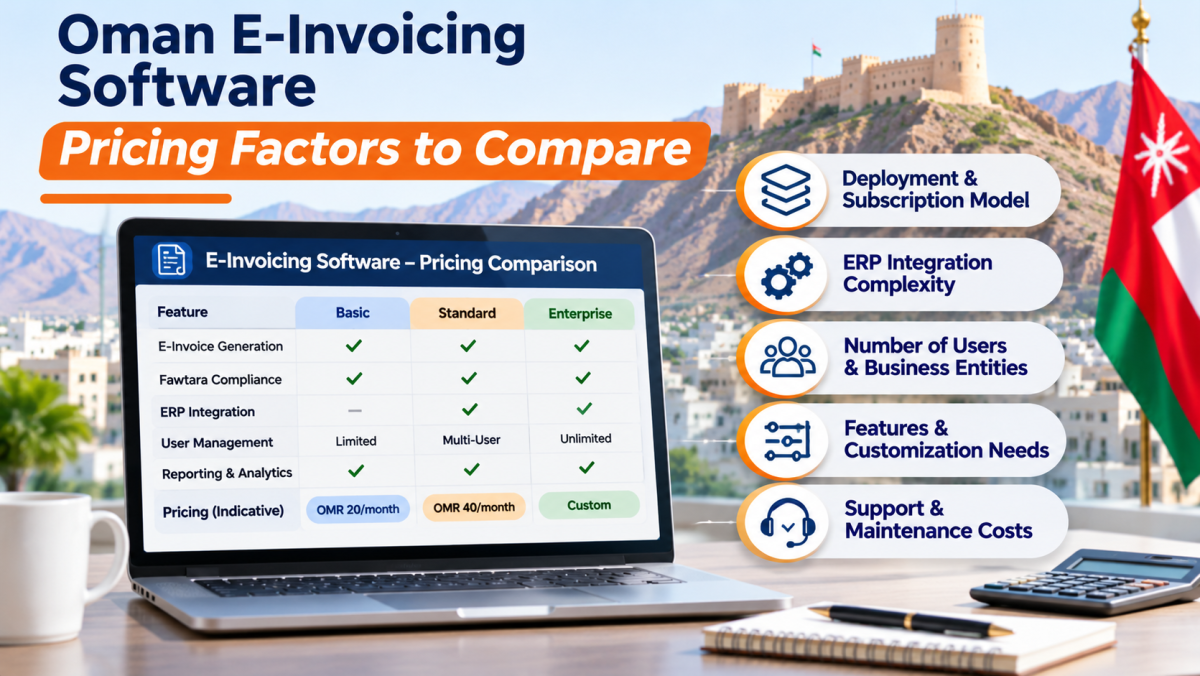
Oman e-invoicing software pricing depends on more than the monthly subscription offered by a provider. Businesses should consider service-provider charges, ERP integration, invoice volume, implementation work, support and ongoing maintenance before comparing proposals. A low starting price may not represent the total cost of operating a Fawtara-compliant invoicing system.
Under Oman's Fawtara programme, businesses exchange structured electronic invoices through the required service-provider network. The Oman Tax Authority (OTA) does not charge taxpayers for using the system or set the prices charged by service providers. Each provider determines its own commercial model. Businesses can review this Oman e-invoicing overview to understand the implementation requirements before requesting quotations.
The best way to compare software costs is to separate recurring charges from one-time implementation expenses and check exactly what each proposal includes.
1. Service Provider Subscription and Transaction Charges
One of the first costs to review is the fee charged by the OTA-accredited service provider. According to the OTA's published FAQ, providers may use different pricing arrangements, including:
-
Monthly or annual subscriptions: A fixed recurring fee for access to the e-invoicing service.
-
Transaction-based pricing: Charges calculated according to the number of invoices processed.
-
Other commercial arrangements: Custom pricing based on the provider's service package or business requirements.
The OTA does not mandate a particular pricing structure. Therefore, two providers may quote different amounts for similar businesses.
When comparing proposals, check whether the quoted fee includes both outgoing and incoming invoice processing, user access, reporting, standard support and service-provider connectivity. Also ask whether additional charges apply when transaction volumes increase.
2. ERP Integration and Customisation Costs
Businesses already using ERP or accounting software may need an integration layer to connect their existing systems with the e-invoicing process.
The cost depends on how easily invoice information can be extracted, mapped and transferred. A business with a supported connector may require less development work than one using a heavily customised or legacy system.
Consider these factors:
-
Existing ERP compatibility: Check whether the provider supports your current SAP, Oracle, Microsoft Dynamics, Tally or other accounting environment.
-
API availability: Systems with accessible APIs may require less custom development.
-
Data mapping: Customer details, supplier information, invoice fields and VAT codes may need review and mapping.
-
Custom workflows: Multiple entities, branches or billing applications can increase integration requirements.
-
Two-way data exchange: Returning invoice statuses and supplier invoice information to the ERP may require additional configuration.
Webtel's Oman ERP integration services describe connections with leading ERP platforms, custom API integrations and two-way data synchronisation. Businesses should assess the actual work required for their own system before accepting an integration quotation.
3. Invoice Volume and Business Size
Invoice volume can affect the service-provider pricing model and the technical capacity required from the software.
A business processing a few hundred invoices each month may have different requirements from a retailer generating thousands of transactions through multiple POS systems.
Ask providers:
-
How many invoices are included in the quoted package?
-
Are incoming and outgoing invoices counted separately?
-
What happens when the monthly limit is exceeded?
-
Are additional invoices charged individually or through a higher subscription tier?
-
Can the package support seasonal increases in transaction volume?
Also consider future growth. Choosing a package based only on current invoice volume may lead to additional charges or a plan change when the business expands.
4. Implementation, Testing and Data Preparation
The initial implementation cost can be a significant part of the total project budget. It depends on the condition of existing systems and the amount of preparation required.
Typical project expenses may include:
-
Initial system assessment and technical planning.
-
Customer and supplier master-data cleanup.
-
Invoice field mapping and configuration.
-
PINT-OM structured invoice preparation.
-
ERP or accounting software integration.
-
Testing of invoices, credit notes and other relevant scenarios.
-
Employee training and go-live assistance.
Ask for these activities to be listed separately in the quotation. This makes it easier to identify whether the provider has included the full implementation scope or only basic software setup.
5. Support, Maintenance and Additional Charges
Software costs continue after implementation. Businesses should understand the recurring expenses associated with technical support and system maintenance.
Check whether the proposal includes:
- Technical support: Assistance with failed transactions, validation errors and integration issues.
- Software updates: Changes required to maintain compatibility with updated technical specifications.
- User access: Charges for additional employees, departments or business entities.
- Data storage and archiving: Any separate fees for storing and retrieving invoice records.
- Training: Initial training and charges for additional sessions when new employees join.
- Custom development: Fees for changes to ERP workflows, reports or integrations after go-live.
The OTA's FAQ states that taxpayers remain responsible for archiving invoices according to applicable VAT laws and regulations. Confirm how the software supports your record-management responsibilities and whether storage is included in the quoted package.
6. How to Compare E-Invoicing Software Quotations
A useful comparison should show the complete cost of using each solution, rather than just its advertised subscription price.
| Cost component | What to compare |
|---|---|
| Service-provider fee | Monthly, annual or transaction-based charges |
| Setup fee | Initial configuration and onboarding |
| ERP integration | Standard connector or custom development |
| Invoice volume | Included transactions and additional usage charges |
| Data preparation | Mapping, cleanup and configuration |
| Training | Included sessions and additional training fees |
| Support | Support hours, response arrangements and maintenance |
| Storage | Archiving, retrieval and retention-related costs |
Request a written quotation with one-time and recurring costs shown separately. Ask the provider to explain any exclusions and confirm how charges may change as your business grows.
Build a Realistic Budget Before Choosing a Provider
Oman e-invoicing software pricing should be evaluated according to the business's systems, invoice volume and support requirements. The OTA does not impose a taxpayer fee, while accredited service providers determine their own charges. Integration and implementation expenses depend on the work needed to connect existing business applications.
Before making a decision, compare the full cost over the expected contract period. A solution with a higher initial quotation may include integration, training and ongoing support that another provider charges separately. Reviewing these details helps businesses choose a suitable Fawtara solution without overlooking costs that may appear after implementation.










Comments (0)