

What Actually Makes a Motorcycle Jacket "Safe"? Armor, Abrasion Resistance & CE Ratings Explained
Understand what makes a motorcycle jacket safe, from CE-rated armor and abrasion-resistant materials to impact protection, safety standards, and riding confidence.

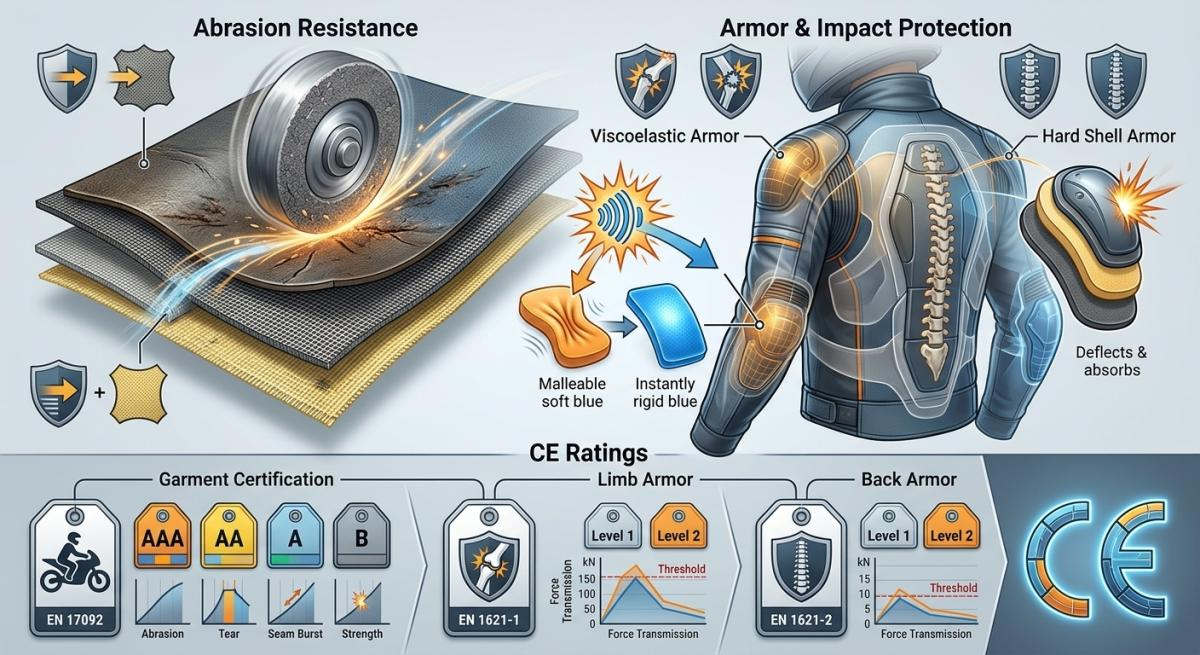
Two jackets can look equally rugged and both contain armor, yet offer very different levels of real-world protection. Whether you're considering a heavy duty men's twill jacket or browsing leather motorcycle jackets for men, genuine safety depends on how impact protection, abrasion resistance, seams, closures, and fit work together as one complete protective system.
What Makes a Jacket Protective?
Motorcycle jacket protection relies on several pillars working together:
-
Impact protection from certified armor
-
Abrasion resistance from the outer shell
-
Tear and seam strength
-
Secure closures and cuffs
-
Correct fit and armor positioning
-
Verified garment certification
No single feature proves a jacket is protective on its own. The shell, armor, seams, closures, and fit must function as one integrated system.
What Does Motorcycle Armor Do?
Armor reduces impact forces reaching protected body areas during a crash. Shoulder protectors, elbow protectors, back protectors, and chest protectors each absorb and spread energy across a wider area. However, armor does not prevent all injuries, make a jacket crash-proof, or replace the need for an abrasion-resistant shell. Its specific job is impact attenuation, not complete invulnerability.
Level 1 vs Level 2 Armor
Under EN 1621 standards, protectors come in two performance levels:
-
Level 1: meets the first defined impact-protection threshold
-
Level 2: allows lower transmitted forces, representing higher tested impact attenuation
A very common misconception is calling an entire jacket Level 2. These levels describe individual protectors, not the garment itself. A jacket is not a Level 2 jacket simply because it contains Level 2 armor.
Why Does Abrasion Matter?
When a rider slides across a road surface, the jacket shell faces intense friction. Impact abrasion can tear through weak materials quickly, creating holes that expose skin to the road. Armor manages impact at specific body points, but the shell must resist abrasion across the entire slide zone. A jacket with excellent armor but a weak shell leaves the rider dangerously exposed.
Does Jacket Material Matter?
Material choice affects construction and potential performance, but labels alone do not prove protection. Leather, textile, twill, nylon, polyester, reinforced fabrics, and mesh can all appear in motorcycle jackets. The finished garment's design, reinforcement, seam construction, and actual testing matter far more than the material name printed on the product tag.
Is Twill Protective Enough?
A men's twill jacket may look rugged, but twill describes a diagonal weave, not a motorcycle protection rating. It appears in fashion jackets, workwear, and riding gear alike. A genuinely protective twill riding jacket needs reinforced zones, armor pockets, stronger structural seams, and secure closures to function as real motorcycle PPE.
Is Leather Always Safer?
When shopping for real leather motorcycle jackets for men, remember that cowhide, buffalo leather, and goatskin each perform differently. Thicker leather is not automatically safer, and full-grain does not guarantee a higher protection class. The complete garment construction, seam quality, armor, and tested certification determine the actual protection level.
Why Do Strong Seams Matter?
The strongest shell material cannot protect effectively if its seams separate under crash stress. Shoulder seams, sleeve seams, side seams, zipper attachments, and armor-pocket seams all face enormous force during a slide or impact. Structural seam integrity keeps the jacket intact when it matters most. A jacket is only as strong as its weakest stitch.
Why Does Sleeve Retention Matter?
Sleeves and armor must stay correctly positioned during a crash. Cuff closures, sleeve adjustments, and wrist fastenings prevent the sleeve from rotating or riding up the arm. If the elbow protector shifts away from the elbow joint, it simply cannot do its job. Protective equipment only works when it covers the intended body area.
Does Jacket Fit Affect Safety?
Fit directly affects protection. Check shoulder fit, elbow armor alignment, sleeve length, chest room, waist adjustment, and riding-posture mobility. A jacket that is too loose allows armor to shift excessively during a crash, while one that is too tight restricts movement and control. Protective fit means secure positioning without preventing normal motorcycle operation.
What Is EN 17092?
EN 17092 is the European standard specifically designed for motorcycle protective garments. It evaluates the complete jacket across impact abrasion, tear strength, seam strength, structural closures, sleeve restraint, ergonomics, and fit. This standard assesses much more than the armor installed inside, testing the entire garment as a complete protective system.
What Do AAA, AA and A Mean?
EN 17092 defines three main garment protection classes:
-
AAA: highest protection requirements within the hierarchy
-
AA: balances defined protective performance with practical road use
-
A: a lower protective class within the same standard
These are garment performance classes, not armor levels. Each represents a distinctly different tested protection threshold.
What Are Class B and Class C?
Two additional classes address more specific needs:
-
Class B: provides abrasion protection equivalent to Class A but does not include impact protectors
-
Class C: provides impact protection only in covered areas without minimum whole-garment abrasion resistance
Impact and abrasion protection can exist as entirely separate functions within the standard.
What Does CE Marking Mean?
CE marking indicates that a product conforms to applicable European PPE requirements. The manufacturer declares conformity and maintains supporting documentation. However, CE alone does not tell you whether the jacket is AAA, AA, A, or which armor levels are installed. It signals regulatory conformity, not a specific motorcycle protection grade.
CE Rating vs Armor Rating
This is one of the most common rider misunderstandings:
-
Garment ratings use EN 17092 classes: AAA, AA, A, B, C
-
Armor ratings use EN 1621 levels: Level 1, Level 2
A jacket can be Class AA while containing Level 2 shoulder and elbow protectors. These ratings describe entirely different parts of the protective system and should never be confused.
How Do You Read the Label?
Look for these specific details on the jacket label:
-
CE marking and motorcycle pictogram
-
EN 17092 reference and garment class
-
Protector information and EN 1621 markings
-
Manufacturer details and sizing
Avoid vague phrases like "CE armor" or "race protection." Always read the actual standard and class rather than relying on marketing language alone.
Which Features Should You Check?
When evaluating a men's twill jacket or leather motorcycle jackets for men, prioritize:
-
Motorcycle-specific construction and EN 17092 class
-
Shoulder and elbow armor with back-protector provision
-
Abrasion-resistant shell and strong seams
-
Secure cuffs and reliable front closure
-
Correct fit with stable armor positioning
Compare the protective structure first, then convenience features.
Final Thoughts
Armor handles impact, the shell handles abrasion, seams keep the garment together, and fit keeps protection where it belongs. Brands like First Manufacturing Co offer motorcycle apparel options worth considering when choosing between a men's twill jacket and a leather motorcycle jacket. Always evaluate the complete protective system rather than focusing on one feature alone.







Comments (0)