

Automotive Aftermarket Industry Forecast Points to USD 613.17 Billion by 2034
The global automotive aftermarket industry size was valued at USD 446.01 billion in 2025 and is projected to grow from USD 462.07 billion in 2026 to USD 613.17 billion by 2034, registering a CAGR of 3.6% during the forecast period from 2026 to 2034.

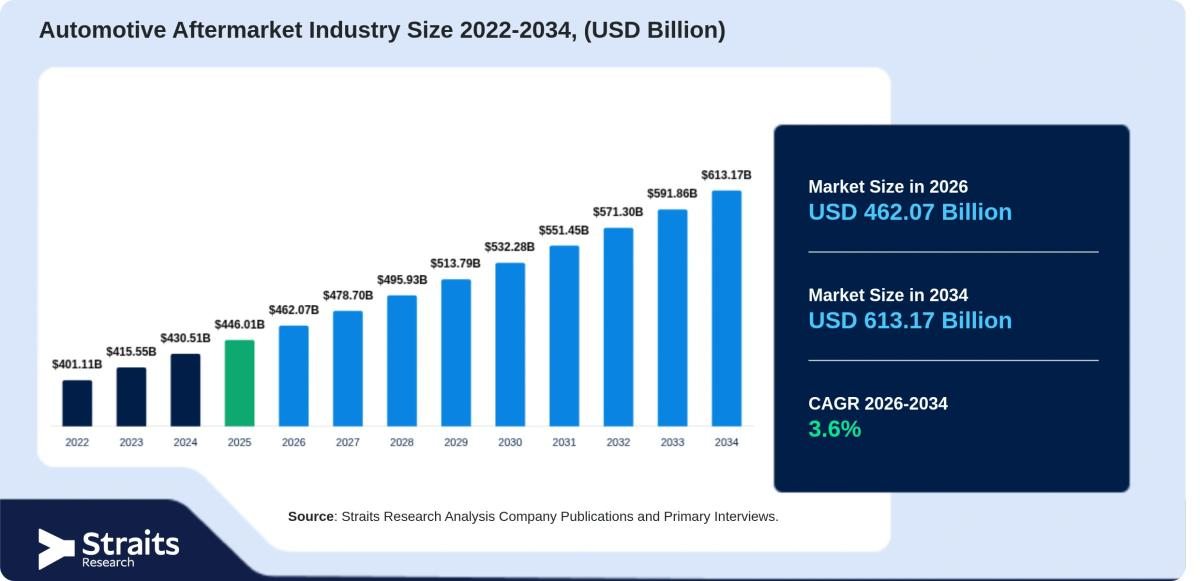
Automotive Aftermarket Industry Forecast, 2034
The global automotive aftermarket industry is being shaped by the expanding vehicle parc, longer vehicle ownership periods, increasing demand for maintenance and repair services, and the wider availability of replacement components. The aftermarket covers parts, accessories, maintenance, repair, diagnostics, and related services required after vehicles enter operation, making it an essential part of the automotive value chain.
The global automotive aftermarket industry size was valued at USD 446.01 billion in 2025 and is projected to grow from USD 462.07 billion in 2026 to USD 613.17 billion by 2034, registering a CAGR of 3.6% during the forecast period from 2026 to 2034.
The industry is also undergoing structural changes as connected vehicles, electric vehicles, digital commerce, and advanced diagnostics reshape how consumers purchase parts and access vehicle services. Online platforms and technology-enabled workshops are improving product discovery, service convenience, and inventory management across aftermarket channels.
Market Drivers
Expansion of the Global Vehicle Parc
The growing number of vehicles in operation is creating a larger installed base that requires periodic maintenance, replacement parts, and repair services. A broader vehicle parc provides sustained demand for tires, batteries, filters, lubricants, braking components, and other aftermarket products throughout the vehicle lifecycle.
Longer Vehicle Ownership Periods
Longer vehicle ownership is extending the period during which vehicles require replacement parts and maintenance services. Owners are increasingly maintaining older vehicles rather than replacing them quickly, creating recurring demand for repair and refurbishment across passenger and commercial vehicles.
Growth of Digital Automotive Commerce
Online marketplaces and specialized automotive platforms are making aftermarket parts more accessible to consumers, workshops, and fleet operators. Digital catalogs, vehicle compatibility tools, doorstep delivery, and online service booking are improving purchasing convenience while enabling suppliers to reach wider customer bases.
Increasing Adoption of Advanced Vehicle Diagnostics
Modern vehicles increasingly rely on electronic systems, sensors, software, and connected components, creating demand for sophisticated diagnostic and repair capabilities. Workshops and aftermarket service providers are investing in digital diagnostic equipment and technician training to address increasingly complex vehicle maintenance requirements.
Market Challenges
Increasing Vehicle Technology Complexity
Advanced driver-assistance systems, connected electronics, hybrid powertrains, and software-controlled components are making vehicle repair more technically demanding. Independent aftermarket businesses may need specialized equipment, software access, and technician training to service newer vehicle generations effectively.
Fragmented Distribution and Service Networks
The aftermarket remains highly fragmented across manufacturers, distributors, independent workshops, retailers, and digital platforms. Coordination across these participants can create inconsistencies in inventory availability, service quality, pricing, and customer experience.
Counterfeit and Low-Quality Replacement Parts
The availability of counterfeit and substandard components can create safety concerns and weaken consumer confidence in aftermarket products. Genuine-part manufacturers and distributors must strengthen authentication, traceability, and channel monitoring to protect brand reputation and maintain product quality.
Limited Access to Vehicle Repair Data
Connected and software-defined vehicles generate extensive diagnostic and operational data that can improve maintenance and repair decisions. Restrictions or limitations around access to vehicle-generated information can make it more difficult for independent service providers to offer competitive repair and diagnostic services.
Market Segmentation
-
By Replacement Part: Tires, Batteries, Brake Parts, Filters, Lighting Components, Lubricants, Engine Components, Others
-
By Vehicle Type: Passenger Cars, Commercial Vehicles, Two-Wheelers
-
By Distribution Channel: Offline, Online
-
By Service: Maintenance and Repair, Diagnostics, Customization, Others
-
By Region: North America, Europe, Asia Pacific, Middle East & Africa, Latin America
Regional Insights
North America Automotive Aftermarket Industry Analysis
The North American automotive aftermarket industry is supported by a large vehicle parc, established repair networks, and strong demand for vehicle maintenance and replacement parts. The presence of independent workshops, national service chains, specialty retailers, and digital commerce platforms is creating a mature and competitive aftermarket ecosystem.
Europe Automotive Aftermarket Industry Analysis
The European market is reinforced by a large installed vehicle base, diverse vehicle fleets, and established independent repair networks. Demand for maintenance, replacement components, diagnostics, and specialized services is supported by the continued operation of older vehicles alongside newer connected and electrified models.
Asia Pacific Automotive Aftermarket Industry Analysis
The Asia Pacific market benefits from rapid vehicle ownership growth, expanding urban mobility, and the development of automotive service networks. India, China, Japan, South Korea, and Southeast Asian markets are creating opportunities for parts manufacturers, distributors, digital marketplaces, and independent workshops.
Latin America Automotive Aftermarket Industry Analysis
The Latin American market is strengthened by the expansion of vehicle ownership, extended vehicle usage, and demand for affordable maintenance solutions. Independent repair shops and local parts distributors remain important channels, while digital platforms are improving access to aftermarket products and services.
Middle East & Africa Automotive Aftermarket Industry Analysis
The Middle East & Africa market is underpinned by vehicle fleet expansion, demanding operating conditions, and the need for regular maintenance and replacement components. Commercial vehicles and passenger cars operating in challenging environments are generating continued requirements for durable parts, tires, batteries, and repair services.
Key Players Analysis
The automotive aftermarket industry includes vehicle manufacturers, original equipment suppliers, specialized parts manufacturers, distributors, retailers, service chains, and digital marketplaces. Competition is centered on product quality, pricing, parts availability, distribution reach, brand reputation, technical support, service coverage, and digital purchasing capabilities.
Key players include Robert Bosch GmbH, DENSO Corporation, Continental AG, ZF Friedrichshafen AG, and Magna International Inc.
For Detailed Insights, Visit: https://straitsresearch.com/report/automotive-after-market
About Us
Straits Research is a leading research and intelligence organization specializing in research, analytics, and advisory services, providing comprehensive business insights and market research reports across diverse industries.
Contact Us
Email: [email protected]
Tel: +1 646 905 0080 (U.S.), +44 203 695 0070 (U.K.)












Comments (0)