

The 2-Metre Problem: Why Open Manholes Become a Bigger Risk Than Expected on Busy Sites

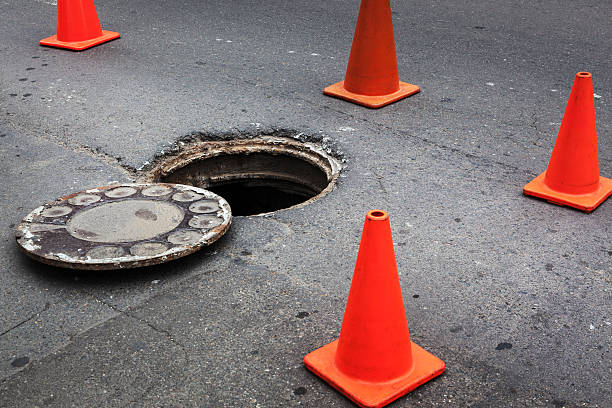
An open manhole doesn't have to be enormous to cause a serious problem. In fact, one of the things that makes an open manhole particularly awkward on a busy site is that people often underestimate the amount of space around it that needs to be controlled.
The opening itself might only occupy a small area of the pavement, road or work zone. But people don't walk in perfect straight lines, and neither do forklifts, delivery vehicles or contractors carrying equipment. Once normal site activity is added to the equation, the area that needs to be managed can become much larger than the opening itself.
That is where the so-called 2-metre problem becomes useful to think about. It isn't really about a magic two-metre measurement that applies to every situation. It's about understanding that the hazard created by an open manhole extends beyond the hole itself.
Once you add movement, visibility, distraction and changing site conditions, a relatively small opening can become a much larger operational problem.
Key Takeaways
-
The physical size of an open manhole does not tell you the full extent of the hazard.
-
People and vehicles need space to move around a work area, which can bring them dangerously close to an unprotected opening.
-
A barrier needs to be visible, stable and positioned appropriately to create meaningful separation from the hazard.
-
Busy sites are particularly difficult because pedestrian and vehicle movements can change throughout the day.
-
Night work, poor weather, dust, temporary lighting and clutter can make an open manhole harder to see.
-
A warning sign alone does not physically prevent someone from approaching an opening.
-
Manhole barriers are part of a broader site-control strategy and should be selected according to the conditions of the work area.
The Hole Isn't the Whole Hazard
Imagine an open manhole in the middle of a quiet construction area. There is nobody nearby, no machinery is moving and the area is clearly visible. Workers know exactly where it is, so at first glance, it might appear relatively straightforward to manage.
Now change the scene. It's 10:30 on a weekday morning, a delivery is arriving, two workers are carrying materials across the site and a contractor is walking towards a temporary office. A small excavator is operating nearby, while someone has placed a stack of materials beside the pedestrian route.
The manhole hasn't changed. The environment has.
That is the important part. The risk associated with an opening isn't determined only by its dimensions; the surrounding activity matters too.
A person doesn't need to deliberately step into the opening for it to become dangerous. They might trip while trying to walk around it, step backwards while carrying something, or approach from an angle where the opening isn't immediately obvious.
A vehicle could clip a poorly positioned barrier, while someone carrying equipment may simply have too much to think about at once. The hazard has effectively expanded beyond the hole.
Why Two Metres Can Disappear Very Quickly
Picture an open manhole positioned near a pedestrian route. A worker approaches from one direction while another person approaches from the opposite side, and a trolley is being pushed through the same area.
Suddenly, the available walking space starts shrinking. Someone moves slightly sideways to make room, another person steps around the trolley and the worker carrying a box can't see the ground directly in front of their feet.
The person nearest the manhole takes one step sideways. That's how a seemingly generous safety margin can disappear without anybody deliberately doing anything reckless.
This is why simply asking, "How big is the manhole?" isn't enough. A better question is, "How much space does this opening need to be safely separated from everything else happening around it?"
That question changes the way you look at temporary site protection.
People Don't Move Like Measuring Tapes
There is a tendency in site planning to imagine people as predictable objects moving between two fixed points. Real people aren't like that.
A worker may stop suddenly, someone may turn around, or two employees walking side by side might spread out. Someone carrying a long piece of equipment may need considerably more room than somebody walking empty-handed.
Even something as simple as a conversation can change someone's path. "Can you give me a hand with this?" is enough to make a worker turn, step sideways and suddenly move closer to a hazard than they were a moment earlier.
That's why physical separation matters. A barrier isn't there merely to tell someone that an opening exists; it should also help influence where people actually walk.
Why a Warning Sign Isn't Always Enough
A sign can tell somebody there is an open manhole, but it can't stop them from walking towards it. That's the difference between information and physical control.
Signs are useful because they can attract attention and communicate what is happening. But on a busy site, relying exclusively on a warning sign can leave too much responsibility with the person approaching the hazard.
They have to notice the sign, read it, understand it and remember it while moving through the area. They still have to physically avoid the opening.
A barrier adds another layer. Instead of simply saying, "Don't go here," it helps establish a physical boundary around the hazard.
That distinction becomes particularly useful where pedestrians and vehicles are moving through the same area.
Busy Sites Create a Moving Target
One of the biggest challenges with temporary hazards is that the surrounding conditions don't stay the same. A manhole may be opened for maintenance at 8:00 in the morning, when the work area is relatively quiet.
By lunchtime, there could be delivery vehicles, subcontractors, visitors and additional equipment moving through the site. The barrier that seemed perfectly positioned at 8:00 might no longer provide the same level of separation at midday.
This is why temporary traffic and pedestrian management can't always be treated as a "set it and forget it" exercise. Conditions change, routes change and people change.
The hazard doesn't necessarily become more dangerous because the manhole itself has changed. It becomes more difficult to manage because the environment around it has become more complicated.
Vehicles Make the Problem Bigger
Pedestrians are only part of the story. Consider an open manhole close to a route used by forklifts, site vehicles or delivery trucks.
A driver sitting inside a vehicle has a different field of view from a pedestrian, and there may be blind spots. The driver may also be concentrating on a reversing manoeuvre, another worker or a delivery point.
A barrier that is clearly visible to a pedestrian might be less obvious from inside a cab. Then there is vehicle movement to consider.
A vehicle doesn't have to drive directly over the opening for things to go wrong. It could strike a barrier, move it out of position and leave the opening exposed.
This is why the suitability and stability of temporary barriers matter. A barrier that looks impressive when photographed but moves easily when bumped isn't providing much practical protection.
The Danger of the "Just For Five Minutes" Mindset
Temporary work has a strange habit of becoming longer than expected. A contractor removes a manhole cover for what is supposed to be "just a quick inspection," and then they find a problem.
Someone needs a tool, then a replacement part, and then another person arrives. Thirty minutes becomes two hours, two hours becomes the rest of the morning, and meanwhile the opening remains there.
This is one of the reasons temporary hazards deserve proper controls from the beginning. The phrase "we'll only be here for a few minutes" doesn't change the consequences of somebody falling into an opening.
In fact, short-duration work can sometimes encourage people to take shortcuts because they don't feel it is worth setting up proper protection. That is exactly when a simple, repeatable procedure can help.
Open the manhole? Establish the exclusion area, position suitable barriers, make the hazard visible and control nearby pedestrian and vehicle movement.
Then check the setup when site conditions change. It doesn't have to be complicated.
Why Visibility Matters More Than People Think
An open manhole during bright daylight is relatively obvious. Now consider the same opening at dawn, after sunset, during heavy rain or in dusty conditions.
It could also be behind temporary equipment, near construction materials, in a poorly lit car park, beside a busy road or around a corner. The opening hasn't changed, but its visibility has.
This is why high-visibility barriers and clear visual separation can be so useful around temporary hazards. The objective isn't to make the site look colourful; it's to make the boundary around the hazard obvious.
A person should be able to understand, almost immediately, that something is different about the area ahead.
The Human Factor Is Usually the Difficult Part
There is a frustrating reality about site safety: people sometimes do exactly what you don't expect them to do. Someone moves a barrier because it is "in the way," and another person steps underneath it.
A delivery driver doesn't know why the access route has changed. A contractor moves the barrier to bring equipment through and forgets to put it back.
A worker assumes someone else is monitoring the opening. None of these behaviours necessarily come from somebody deliberately ignoring safety.
Often, people are trying to get their job done. That's why good temporary controls should work with normal human behaviour rather than assuming perfect compliance.
A physical barrier that is obvious and inconvenient to cross can be more effective than a small sign that relies entirely on attention.
What Happens When the Barrier Is Too Close?
There is another side to the 2-metre problem. A barrier positioned immediately beside an open manhole may technically identify the boundary, but it can leave very little room for error.
If someone trips near the barrier, there may be nowhere safe for them to recover. If a trolley passes too close, it could collide with the barrier, while a worker moving around the perimeter may end up dangerously close to the opening.
The exact distance needed will depend on the worksite, the hazard, applicable requirements and the surrounding movement. There isn't a universal rule that says every manhole needs exactly two metres of clearance.
Instead, the useful principle is to create a meaningful buffer between the hazard and normal activity. The more movement and uncertainty there is around the opening, the more carefully that buffer needs to be considered.
Manhole Protection Is Also About Controlling Routes
One of the easiest mistakes is to treat a barrier as an isolated object. Put it around the manhole and walk away.
A better approach is to look at the route. Where are people coming from? Where are they trying to go? Where will vehicles travel?
Could somebody approach the opening from behind? Is there another route available? Will the barrier force pedestrians into a vehicle path?
Will equipment need to pass through the area later? These questions can reveal problems that aren't obvious when you're standing directly beside the manhole.
The goal isn't simply to surround the opening. The goal is to manage how people and vehicles interact with the opening.
What Makes a Temporary Manhole Barrier Useful?
Different sites require different solutions, but several characteristics are worth considering.
High Visibility
The barrier should be easy to identify against its surroundings, particularly where there is construction equipment, road traffic or poor lighting.
Physical Presence
A barrier should create an obvious boundary rather than functioning purely as decoration. People approaching the area should be able to recognise that the space around the opening is not part of the normal route.
Stability
If the barrier can easily be pushed, knocked or blown out of position, it may need additional consideration or securing depending on the application. A barrier that has moved away from the opening may no longer be protecting the area it was intended to protect.
Easy Deployment
Temporary hazards often appear unexpectedly. A system that takes excessive time or specialised equipment to deploy may encourage shortcuts, particularly when contractors are under pressure to complete a job quickly.
Suitable Footprint
The barrier needs to work within the available space without creating another hazard or unnecessarily blocking essential routes. Bigger isn't automatically better if the protection itself creates an awkward access problem.
Reconfigurability
Busy sites change. Being able to adjust the protected area can be useful as work progresses and pedestrian or vehicle routes are altered.
Clear Visual Communication
Where appropriate, signs, reflective elements or high-visibility markings can help communicate the presence of the hazard. These should complement physical protection rather than being treated as its replacement.
The best solution isn't necessarily the biggest barrier available. It is the one that fits the actual conditions.
The 2-Metre Problem Gets Worse at Night
Night work changes the equation. Artificial lighting can create shadows, vehicle headlights can produce glare and workers may be wearing equipment that restricts peripheral vision.
A barrier that was obvious during daylight may become much harder to distinguish. This is where reflective materials, appropriate lighting and clear separation become particularly important.
It is also worth thinking about what happens if the site's normal lighting fails. A temporary hazard shouldn't suddenly become invisible because one light isn't working.
Where work continues after dark, the control measures should be considered as part of the overall night-work setup rather than added as an afterthought.
Weather Can Change the Risk
Rain introduces another variable. Wet surfaces can become slippery, visibility can deteriorate and water can collect around low points.
Wind can also affect temporary barriers, signage and other lightweight equipment. Dust creates a different problem, particularly on construction sites where visibility may already be reduced.
None of this means an open manhole automatically becomes unsafe whenever the weather changes. It means the controls may need to be reassessed when conditions change.
A barrier that was perfectly adequate on a calm, dry morning may need attention after a storm or strong winds.
The lesson is simple: temporary hazards require temporary controls that can be checked and adjusted.
Don't Let the Work Area Become a Shortcut
There is a particularly common problem on busy sites. A normal route becomes inconvenient, workers start taking a shortcut and that shortcut passes close to the open manhole.
Nobody planned for that route because it didn't exist when the work started. But once people begin using it, it becomes part of the site's real-world movement pattern.
This is why site inspections matter. Walk the area from the perspective of someone who has no knowledge of the work.
Where would you naturally walk? Where would you cut across the site? Where would you go if the normal entrance was blocked?
Where would a delivery driver turn around? Where would someone carrying equipment choose to pass?
Those answers can reveal unexpected approaches to the hazard.
A Simple Site Question Can Expose the Problem
Here's a useful question for supervisors and site managers: "If someone wasn't paying attention for three seconds, would our current setup still keep them away from the opening?"
It's not a substitute for a formal risk assessment. But it is a useful reality check.
Because people get distracted. They talk, they rush, they carry things, they look backwards and they follow somebody else.
Good temporary protection doesn't depend on every person behaving perfectly. It creates another layer of protection when attention inevitably wanders.
Don't Forget the People Who Don't Know the Site
Permanent employees may know exactly where an open manhole is. Visitors don't, and neither might a delivery driver.
A subcontractor arriving halfway through a project may have no idea that the normal walkway has been redirected. They may simply follow the route that appears to be available.
This is why temporary hazards should be obvious to somebody who has never seen them before. A good setup communicates quickly: Something is happening here. Stay out of this area.
That message is much easier to understand when physical barriers and clear visual warnings work together.
The Real Lesson Behind the 2-Metre Problem
The "2-metre problem" isn't really about measuring two metres and declaring the job finished. It's about perspective.
An open manhole may occupy a relatively small physical area, but the practical hazard can extend into the surrounding space because people and vehicles need room to move.
Once you add distractions, poor visibility, changing routes, equipment, weather and human behaviour, the margin for error gets smaller.
That's why temporary manhole protection should be approached as a site-management issue rather than simply a hole-covering exercise. Where exactly is the opening? Who is likely to approach it?
How will they approach it? What happens if the normal route changes? What happens if a barrier is moved?
What happens at night? What happens when a delivery arrives?
Those questions are often more valuable than simply asking whether a barrier has been placed around the hole.
Frequently Asked Questions
How far should a barrier be placed from an open manhole?
There isn't one universal distance that is appropriate for every situation. The required separation depends on the work environment, pedestrian and vehicle movement, the size and location of the opening, applicable safety requirements and the risk assessment.
The important principle is to create a meaningful exclusion area rather than positioning protection so close to the opening that people can still easily enter the hazard zone.
Is a warning sign enough to protect an open manhole?
A warning sign can help communicate the hazard, but it does not physically prevent access. Where an open manhole creates a fall or access hazard, physical barriers may provide an additional layer of protection by creating a visible boundary around the opening.
Why are open manholes particularly dangerous on busy sites?
Busy sites contain more movement and more opportunities for people to approach a hazard unintentionally. Pedestrians, forklifts, delivery vehicles, contractors and visitors may all use the same area, while temporary routes can change during the day.
These factors can make an opening more difficult to control.
Can a manhole barrier be moved during construction work?
Temporary barriers may need to be moved when site access or work requirements change. However, if a barrier is moved, the protected area should be reassessed and the barrier should be repositioned appropriately.
Leaving an opening unprotected while equipment is moved or work is paused can create an unnecessary exposure.
Does an open manhole need different protection at night?
Night work can reduce visibility and introduce additional factors such as shadows, glare and artificial lighting. The protection required depends on the site conditions and applicable safety requirements, but visibility and lighting should form part of the planning for any open manhole that remains exposed after dark.
Are manhole barriers only needed on construction sites?
No. Open manholes can occur in roads, pavements, car parks, utility areas, industrial premises, commercial properties and other locations where access covers are removed temporarily.
The appropriate protection depends on the hazard, location and people or vehicles that could be exposed to it.
Conclusion
An open manhole is easy to think about as a single hole.
That's the mistake.
The real problem is everything that happens around it. A worker steps sideways, a forklift turns, a delivery arrives or someone carries a box that blocks their view.
The light changes. A barrier gets moved. A temporary walkway becomes a shortcut.
None of those events sounds particularly dramatic on its own. Together, they can turn a small opening into a much larger site hazard.
That is why the area around an open manhole deserves as much thought as the opening itself. Physical barriers, clear warning systems, sensible exclusion zones, appropriate visibility and regular checks can all contribute to better control.
And perhaps the most useful question isn't, "Have we put a barrier around the manhole?"
It is: "Have we made it difficult for someone to accidentally get close to it?"
That shift in thinking is where better temporary site safety starts.










Comments (0)