

How to Build Brand Authority for ChatGPT, Gemini & Google AI Overviews
Learn how to build brand authority for ChatGPT, Gemini, and Google AI Overviews with proven strategies for content, credibility, SEO, and brand visibility.
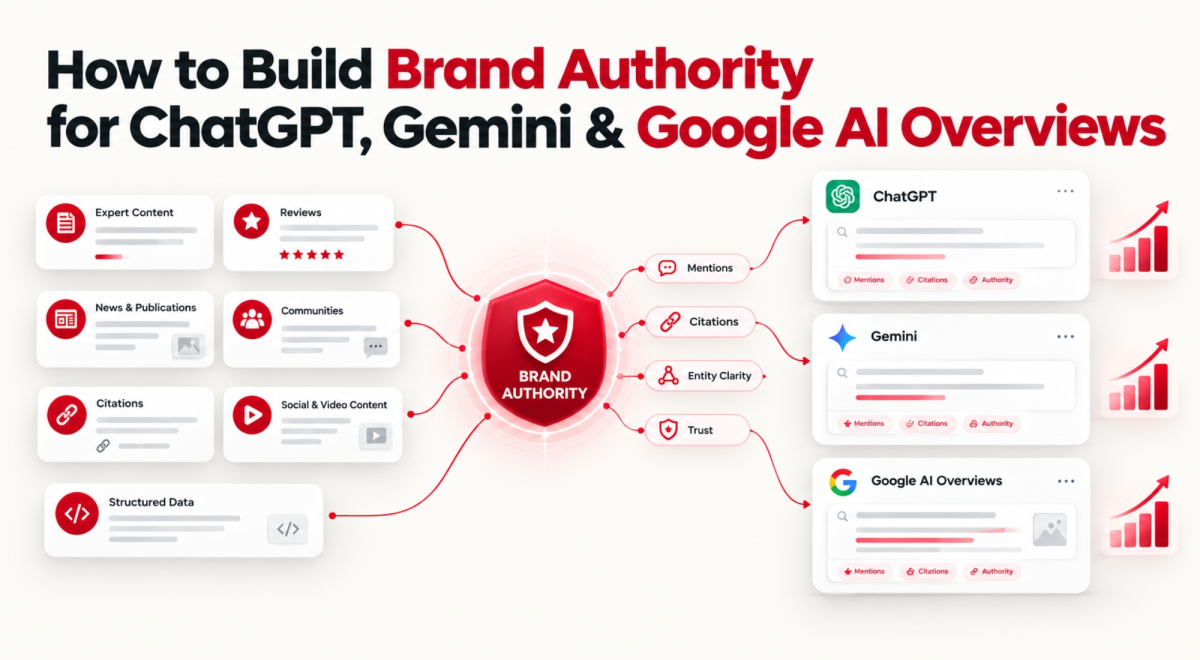
The first time I asked an AI tool about a company I was researching, I noticed something interesting. I wasn't looking at ten blue links and deciding which business seemed credible. I was reading one synthesized answer and paying attention to the brands and sources mentioned inside it.
That changed how I think about SEO.
Today, building brand authority isn't only about ranking a webpage on Google. Businesses also need to make their information clear, consistent, useful, and credible enough to be understood across AI-powered search experiences.
So, how do you actually build that authority?
What Does Brand Authority Mean in AI Search?
In traditional SEO, authority is often associated with rankings, backlinks, relevant content, and the overall reputation of a website.
AI search adds another layer.
When someone asks ChatGPT, Gemini, or Google AI Overviews a question, the system may combine information from multiple sources before producing an answer. That means your brand needs more than a collection of keyword-focused pages.
It needs a recognizable digital identity.
Your company name, products, services, expertise, authors, locations, publications, and third-party mentions should tell a consistent story across the web.
Start With Information You Can Prove
One mistake I see businesses make is trying to sound authoritative instead of actually demonstrating expertise.
A better approach is to publish information that can be checked.
Share original research, explain how you solved real customer problems, publish expert insights, include relevant data, and update outdated information. When making claims, link to credible sources rather than making every statement sound like a sales pitch.
This matters for Google as well. Google's current guidance emphasizes useful, reliable, people-first content, while its policies warn against creating large amounts of low-value content simply to manipulate Search or generative AI results.
Build a Consistent Brand Entity
Think beyond your homepage.
If your business describes itself as an SEO company on one website, an AI SEO company on another, and something completely different on a third-party profile, you're creating unnecessary ambiguity.
Keep important business information consistent across your website, professional profiles, industry directories, publications, social platforms, and other legitimate references.
This is particularly useful when working on Generative Engine Optimization (GEO) because GEO isn't simply about inserting keywords. It involves making your content, brand information, authority signals, and relationships easier for AI systems to understand.
Create Content Around Real Questions
One of the most useful changes I've made to my own content strategy is to stop thinking only in terms of keywords.
Instead, I start with questions.
For example:
-
What does this company actually do?
-
Is this product suitable for small businesses?
-
How does this service compare with alternatives?
-
What problems does this solution solve?
-
Who are the experts behind the company?
-
Is this business trustworthy?
These are the types of questions people increasingly ask conversationally.
Creating clear answers can also help your content cover related search intent instead of producing dozens of thin pages targeting slightly different keyword variations.
Earn Mentions, Don't Manufacture Them
Brand authority becomes much stronger when other credible sources independently discuss your business.
Relevant industry publications, expert interviews, partnerships, original research, case studies, associations, and genuinely useful contributions can all help establish reputation.
The important word is relevant.
Buying hundreds of unrelated links or publishing the same guest post everywhere isn't the same as building authority. Google explicitly identifies link spam and scaled, low-value content as practices that can violate its Search policies.
Don't Forget Google AI Overviews
Optimizing for AI search doesn't mean abandoning traditional SEO.
Google's own documentation says the best practices for Search continue to apply to its generative AI experiences. Pages still need to be accessible, indexable, useful, and aligned with Search policies.
So I would treat AI SEO as an extension of a strong SEO strategy—not a shortcut around it.
A Practical Authority Checklist
Before expecting ChatGPT, Gemini, or Google AI Overviews to understand your brand, check five things:
Clear identity: Is it obvious who you are and what you do?
Useful content: Do you answer the questions your audience genuinely asks?
Evidence: Do you support important claims with experience, data, or credible sources?
Consistency: Is your brand information accurate across the web?
Authority: Are credible, relevant third parties talking about your work?
While researching this approach, I found Orvador's Generative Engine Optimization work interesting because it treats AI visibility as a combination of content, technical SEO, entity signals, and authority rather than simply another keyword-ranking exercise. Its educational material on how GEO works for nonprofits and AI search also provides a useful practical perspective on entities, FAQs, structured information, and credibility.
The biggest lesson for me is simple: AI search authority can't be manufactured overnight.
Build a brand that is genuinely useful, make its expertise easy to understand, keep its information consistent, and earn credible recognition across the web.
When you do that, you're not optimizing for just one AI platform. You're building a digital reputation that can remain valuable wherever your audience chooses to search.
Orvador is a leading Sustainable Digital Marketing Agency dedicated to empowering eco-conscious brands and nonprofits. As a purpose-driven Sustainable Marketing Agency, Orvador crafts impactful digital strategies that drive growth while staying aligned with environmental and ethical values. From SEO and social media marketing to content creation and paid advertising campaigns, Orvador helps businesses and nonprofit organizations build a powerful online presence that supports their mission and sustainability goals. With a strong focus on innovation, transparency, and measurable growth, Orvador provides customized digital marketing solutions designed to improve visibility, engagement, and conversions. The company combines ethical marketing practices with data-driven strategies to help organizations achieve long-term digital success while making a positive impact. Partner with Orvador — the Sustainable Agency for a better tomorrow. Visit us: https://orvador.com/







Comments (0)