

What Makes A Steel Project Technically Viable: Insights From Dinesh Kumar Saraogi
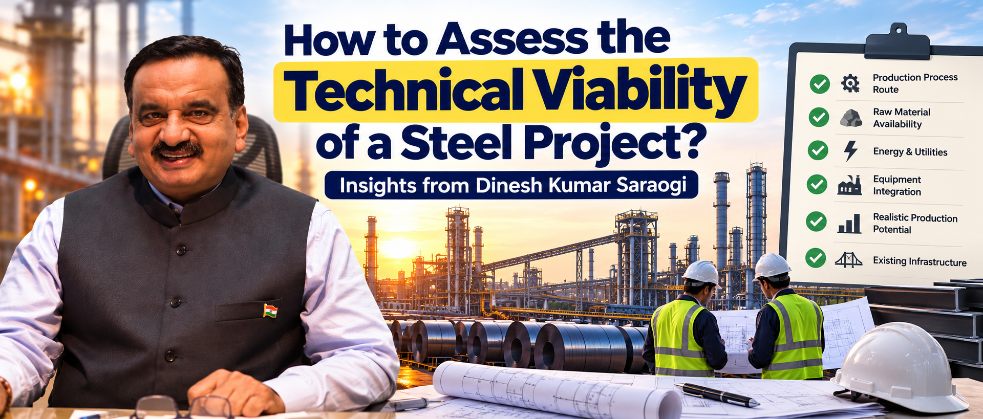
A steel project may look really promising on pen and paper and still face serious challenges during execution. Enhanced production capacity, modern equipment, and attractive technology do not automatically make a project technically viable. The success of a steel project depends on whether its different processes can work together under actual operating conditions. This is where the role of an independent steel advisor and consultant becomes relevant.
Professionals like Dinesh Kumar Saraogi Jindal Steel, who has been in the steel industry for decades now, bring attention to the practical questions behind project implementation. Can the project work be carried out with the available raw materials? Is there a reliable supply of energy available? Can the equipment be integrated with the existing systems? Does the infrastructure support plant production? Assessing technical viability begins with answering the questions before making any kind of major investment decision.
Start with the production process route:
The first consideration in any steel project is the production route to be undertaken. A project based on DRI or EAF will have different technical requirements from an integrated steel plant that uses conventional ironmaking and steelmaking processes. Similarly, projects involving alternate fuel, coal gasification, or low-carbon technology require their own assessments of inputs, equipment, and operating conditions.
Dinesh Kumar Saraogi CEO's approach to project evaluation can be understood through this principle: he believes that technology should be examined in relation to the complete production system rather than considering it in isolation. The process route determines how much of what is required, including raw material requirements, equipment configuration, energy demand, etc. This can determine the outcome of a project.
Check the availability of raw materials:
A technically sound project is difficult to execute if the required raw materials are not consistently available or quality scrap is not available. Their quality and availability will also have to be considered during project planning rather than after the equipment selection phase. A project designed around a particular quality of feed material may not perform as expected if the actual supply varies. So, these aspects should be considered before actually determining the process.
Energy and utilities require serious attention:
Steel production is highly dependent on reliable energy sources and other utilities. Electricity, fuel, water, gas, steam, and other supporting systems can influence whether a plant reaches its intended production level. For a new project, this becomes even more important as producers consider renewable electricity, electric furnaces, hydrogen-related processes, and other lower carbon pathways.
A steelmaker evaluating technical viability should therefore look beyond the main production equipment. The question is not whether the reactor furnace or processing unit delivers the desired output. It is more about whether the supporting infrastructure is capable of supplying what the process needs. A technically advanced plant cannot perform reliably if its utility systems are inadequate and are not functioning as per their potential equipment integration method.
The processes must operate in coordination with one another:
Selecting the right equipment is only a part of the project planning. Those systems must also operate together as a single coordinated system. Only then will the plant be able to deliver the desired outcome. Material handling, raw material preparation, iron making, steelmaking, and refining all need to be connected appropriately. Bottlenecks in one area can limit the performance of the entire operation.
This is the reason why equipment specifications will also have to be considered alongside plant layout, process sequence, and material availability. Dinesh Kumar Saraogi's experience as a steel industry professional highlights the importance of looking at the complete chain rather than simply evaluating equipment in isolation.
Capacity on paper is not the same as actual production:
This is another important consideration to be made. The difference between installed capacity and achievable production can become huge if proper considerations and evaluations are not done before the project execution. A project may be designed for specific annual output; however, actual production will mainly depend on maintenance requirements, operating hours, equipment reliability, raw material availability, and other constraints.
Technical viability, therefore, requires a realistic production consideration. So, instead of asking how much a plant is designed to produce, project evaluation should involve examining how consistently the output can be achieved under normal operating conditions. This difference can become extremely relevant when assessing expansion projects or modifying the existing facilities.
Existing infrastructure can change the equation:
For brownfield projects, the existing plant can turn out to be an advantage as well as a disadvantage. Existing roads, power systems, water facilities, material handling systems, and other infrastructure save the need for you to build new facilities from scratch. At the same time, old existing layouts and older equipment can create limitations for the newer technology.
A proposed expansion must therefore be evaluated against the actual condition and capacity of the existing plant. This is one area where the practical experience of Dinesh Kumar Saraogi Jindal Steel can make a difference. Understanding how the existing plant facility operates can help uncover integration issues within the plant. This ensures that the project planning is carried out properly at all times.
In Conclusion:
Steel projects involve complex equipment, substantial capital investment, and a long operating lifecycle. This makes it really important for steelmakers to carry out careful technical evaluation at the beginning of the project. The role of Dinesh Saraogi becomes extremely relevant in this context. Rather than looking at a project through the lens of technology, he evaluates how the complete plant will function in real operating conditions. This is what helps turn a promising steel project from a concept on paper into a plant capable of delivering consistent performance over significant periods.

Dinesh Kumar Saraogi is a well-known business leader and former CEO of Jindal Steel with over 40 years of experience in the global steel industry. Recognized for his expertise in steel manufacturing, greenfield project development, and operational excellence, Dinesh Kumar Saraogi CEO has successfully led large-scale industrial projects in India and overseas.Mr Saraogi has been accredited with many prestigious awards, including the Best Corporate Leader Award of Odisha, 2013 and the Best Corporate Leader Award of the Year 2014 .









Comments (0)