

Coretek Services vs. Cambay Solutions Azure Cloud Transformation Services in the USA
Compare Coretek Services and Cambay Solutions for Azure cloud transformation, migration planning, security, costs, and support.
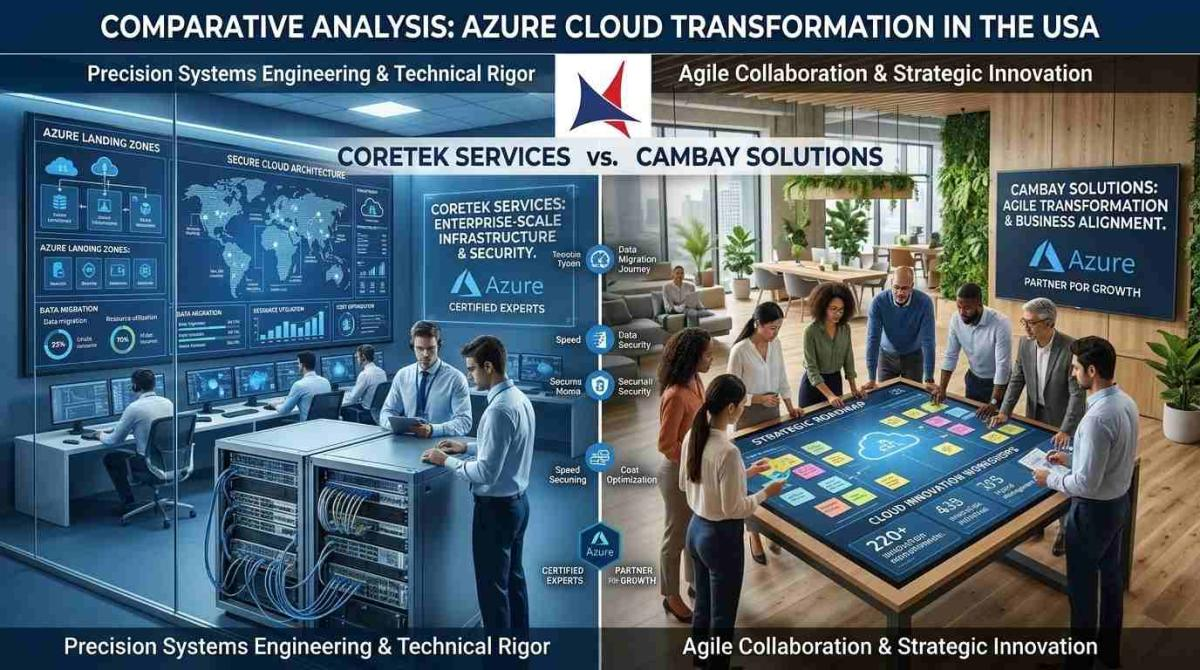
Choosing the right provider for Azure Cloud Transformation Services involves more than transferring applications from local servers to the cloud. You need a plan for workloads, data, security, costs, and ongoing support. Comparing Coretek Services and Cambay Solutions can help you identify a provider whose Microsoft expertise, project approach, and support options match your business needs.
Understanding Azure Cloud Transformation
Azure cloud transformation involves assessing existing technology, moving suitable workloads to Microsoft Azure, and improving how applications and infrastructure operate. Depending on business requirements, a project may include migration, modernization, security improvements, backup planning, monitoring, and cost management.
Some organizations begin by moving virtual machines to the cloud with minimal changes. Others redesign applications, adopt managed databases, or connect cloud services with Microsoft 365 and Dynamics 365. Each approach has different costs, technical requirements, and operational risks.
Effective cloud transformation should begin with an assessment rather than a blanket recommendation to move everything. Applications with complex dependencies may require additional preparation, while outdated systems might need replacement or retirement instead of direct migration.
Before selecting a provider, establish the business outcome you want. That could mean reducing dependence on aging hardware, improving disaster recovery, supporting remote teams, or preparing applications for future development.
Coretek Services: Microsoft Cloud and Modernization Expertise
Coretek Services is known for its focus on Microsoft technologies, cloud services, and digital workplace solutions. Businesses evaluating Coretek may find its Microsoft-oriented service portfolio relevant when planning Azure adoption, infrastructure changes, or improvements to their broader technology environment.
For organizations with established Microsoft systems, a provider with relevant platform experience can help assess how existing applications, identity services, and infrastructure fit into a cloud plan. However, the suitability of any provider depends on the actual team, project scope, and technical requirements.
Ask Coretek to explain how it assesses application dependencies, estimates migration effort, and handles systems that cannot move immediately. You should also clarify whether the proposed engagement includes post-migration monitoring, cost reviews, security configuration, and employee knowledge transfer.
A detailed proposal should identify deliverables, assumptions, responsibilities, and acceptance criteria. These details make it easier to compare the offer with other providers on an equal basis.
Cambay Solutions: Microsoft-Focused Cloud Services
Cambay Solutions offers Microsoft-related technology services that include Azure, cloud transformation, managed services, security, and cost optimization. These areas may be relevant to businesses seeking support across both cloud migration and the operational work that follows.
For example, a business moving applications to Azure may also need help reviewing identity permissions, organizing cloud resources, monitoring usage, and establishing backup procedures. Planning these activities alongside migration can reduce the risk of treating cloud adoption as a one-time infrastructure project.
When assessing Cambay Solutions for Azure Cloud Transformation Services, ask about its experience with your workloads, target architecture, security requirements, and migration priorities. Request a clear description of the assessment process, proposed migration phases, testing responsibilities, and support available after deployment.
It is equally important to confirm what the engagement does not include. Licensing, application refactoring, third-party integrations, data transfer, and ongoing administration can affect the overall cost. A written scope helps you identify these expenses before work begins.
Coretek Services vs. Cambay Solutions: What Should You Compare?
A fair comparison should focus on your project requirements instead of assuming that one provider is automatically better.
Microsoft and Azure experience: Ask both providers for examples relevant to your environment. Experience with virtual machine migration may not be the same as experience modernizing complex applications or designing cloud-native systems.
Assessment and planning: Find out whether the provider will inventory applications, map dependencies, review compliance needs, and estimate monthly operating costs before recommending a migration path.
Security approach: Discuss identity and access controls, network configuration, logging, backup protection, and recovery testing. Azure security depends on the selected services and configuration, so ask who is responsible for each control.
Cost visibility: Compare implementation fees separately from Azure consumption, licensing, support, and third-party tools. Request estimates based on realistic usage assumptions and ask how spending will be reviewed after migration.
Ongoing support: Determine who will respond to incidents, review alerts, manage changes, and investigate unexpected costs. Confirm service hours, response targets, escalation procedures, and any additional fees in writing.
These questions can help you assess whether Coretek Services or Cambay Solutions is better aligned with your requirements. The final decision should reflect the proposed team's experience and commitments, not just the provider's overall service portfolio.
Planning a Lower-Risk Azure Migration
A structured migration plan helps reduce disruption. Start by identifying business-critical applications, data dependencies, compliance obligations, and acceptable downtime. Classify workloads according to their importance and technical complexity before setting migration dates.
Next, choose an appropriate migration approach for each workload. Some applications may be moved with minimal changes, while others require redesign or replacement. Microsoft Azure Migrate can support discovery and assessment for suitable migration scenarios, but its recommendations should be reviewed against business requirements and application constraints.
Testing is essential. Validate application functionality, user access, data accuracy, performance, backup recovery, and monitoring before declaring a workload ready for production. Keep a rollback plan for critical systems where practical, and communicate expected service interruptions to affected teams.
After deployment, compare actual Azure usage with the original estimates. Review idle resources, storage growth, virtual machine sizing, and backup retention. These checks help you identify cost or performance issues before they become recurring problems.
Questions to Ask Before Signing a Contract
Ask each provider to present a practical migration plan for one representative workload. The plan should show the expected stages, key risks, testing requirements, and responsibilities assigned to your internal team.
You should also request clarification on data access, documentation ownership, project change requests, and support after go-live. If the provider recommends managed services, confirm which tasks are included and which require separate fees.
Finally, agree on measurable outcomes. These might include completing an agreed workload migration, meeting recovery objectives, improving monitoring coverage, or reducing avoidable cloud spending. Specific measures give both parties a clear way to evaluate progress.
Frequently Asked Questions
What are Azure Cloud Transformation Services?
They help businesses assess, migrate, modernize, secure, and manage workloads using Microsoft Azure, based on their technical and operational requirements.
Is Coretek Services suitable for Azure migration?
Coretek may be worth evaluating for Microsoft cloud projects. Confirm its current service scope, relevant project experience, proposed team, and post-migration support before making a decision.
Does Cambay Solutions offer Azure-related services?
Cambay Solutions lists Azure, cloud transformation, managed services, security, and cost optimization among its service areas. Contact the company to confirm the current services available for your specific project.
How much does an Azure transformation project cost?
Costs depend on workload size, application complexity, data transfer, licensing, security requirements, and ongoing operations. Request an assessment and separate estimates for project work and recurring cloud expenses.
How do you choose between the two providers?
Compare their relevant experience, assessment methods, security plans, migration timelines, cost estimates, support terms, and documented deliverables against the same set of requirements.
Choosing a Provider That Fits Your Cloud Goals
A successful cloud project should leave your organization with systems that meet business needs and an operating model your team can maintain. That requires careful planning, clear ownership, realistic cost estimates, and testing beyond the initial migration.
When comparing Coretek Services and Cambay Solutions, request proposals based on the same workloads and success criteria. Evaluating Azure Cloud Transformation Services in this way gives you a clearer basis for comparing technical fit, service commitments, and long-term operating costs.
Cambay Solutions is a Microsoft-focused technology and consulting company that helps businesses modernize their operations through cloud transformation, Business Applications, data and analytics, AI, Microsoft 365, Azure, and managed IT services. The company delivers scalable technology solutions designed to improve efficiency, innovation, and business growth.












Comments (0)