

E-Invoicing for Manufacturing Companies in the UAE
Learn how UAE manufacturers can prepare for e-invoicing with accurate ERP data, connected systems and reliable invoice workflows.

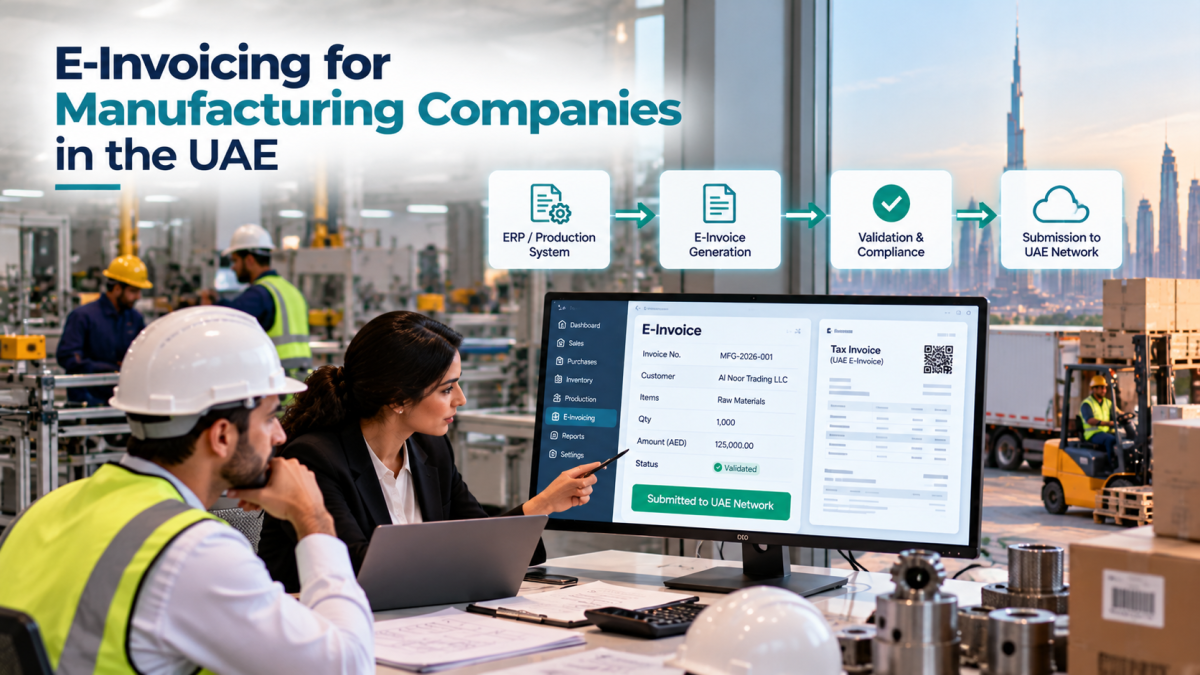
Manufacturing invoices often involve more than a product name and a total amount. A single transaction may include several line items, different VAT treatments, delivery details, purchase order references and agreed payment terms. When production, warehouse, sales and finance teams use separate systems, keeping these records consistent can become difficult, especially as invoice volumes increase.
E-invoicing for manufacturing companies in UAE requires businesses to look beyond the final invoice document. Manufacturers need to understand where invoice data originates, how it moves between business systems and whether it can be prepared for structured electronic exchange. A well-planned approach can help reduce manual corrections while making invoice processing more consistent across the organisation.
Why Manufacturing Invoices Need Special Attention
Manufacturers operate through connected activities, from purchasing raw materials and scheduling production to dispatching finished goods and collecting payments. Invoicing depends on information generated at several stages of this process.
For example, a manufacturer may dispatch 500 units to a distributor against a purchase order. The invoice must reflect the correct products, quantities, agreed prices and relevant tax information. If the dispatch record differs from the sales order or the customer master contains outdated details, the invoice may need correction before it can be processed successfully.
The challenge becomes greater when a business handles different product categories, multiple warehouses, export transactions or several legal entities. Each may introduce different data requirements and approval steps.
The UAE's structured e-invoicing framework makes it important to distinguish between a digital document and structured invoice data that can be exchanged electronically. Manufacturers should assess their existing invoicing processes against the applicable UAE requirements rather than assume that generating a PDF from an ERP system is sufficient.
Trace Every Invoice Back to Its Business Transaction
A reliable invoice begins with accurate source information. In manufacturing, that information may originate from a customer purchase order, sales order, delivery note, goods dispatch record or contract.
When these records are maintained in different applications, the finance team may need to reconcile them manually before issuing an invoice. This can delay billing and create uncertainty about which version of a transaction is correct.
A practical first step is to map the route from order acceptance to invoice creation. Identify which system holds the authoritative record for each important field and when the information becomes available.
For example, if an invoice is generated after goods leave the warehouse, the implementation should establish how the dispatched quantity reaches the billing system. If the invoice is created directly from a sales order, the business should determine how partial deliveries and backorders affect billing.
This mapping should also cover:
- Purchase order and sales order references.
- Product descriptions, quantities and unit prices.
- Customer legal names and relevant tax details.
- Delivery dates and dispatch references.
- Discounts, additional charges and applicable VAT information.
- Credit notes, returns and other adjustments.
These details help the business identify gaps before introducing new electronic invoicing workflows.
Check Product and Customer Data Before Integration
Manufacturers often maintain extensive product catalogues and customer databases. Over time, product descriptions may change, units of measurement may be inconsistent, and customer records may be duplicated across branches or business units.
Such inconsistencies can become more visible when invoice information is converted into a structured format and checked against defined validation rules.
Suppose the inventory system records a product using one unit of measurement, while the sales system uses another. Employees may understand the difference because they know the product, but an automated process needs a clear and consistent representation. Similar issues can arise when a customer's billing address, legal name or tax registration details are incomplete.
Before connecting an e-invoicing solution, manufacturers should review the quality of their master data. This does not necessarily mean rebuilding the entire ERP database. It means identifying the fields needed for invoicing, confirming their sources and deciding how missing or conflicting values will be resolved.
Ownership matters, too. The business should establish who can update product information, customer details and tax-related fields. Without clear responsibility, data problems can return even after the initial implementation is complete.
Connect ERP, Warehouse and Billing Systems
Many manufacturers use an ERP system to manage sales, purchasing, inventory and financial accounting. Others rely on separate applications for warehouse operations, production planning, customer management or logistics.
An e-invoicing implementation needs to account for these existing connections. The objective is to ensure that invoice information reaches the appropriate electronic invoicing process without unnecessary re-entry or loss of important transaction details.
A manufacturer using an integrated ERP may be able to retrieve most invoice information from a central system. A business operating multiple applications may need an integration layer to combine information from different sources before submitting the invoice data.
The right design depends on the software environment, invoice volume, existing interfaces and capabilities of the selected service provider. It should also account for what happens when an invoice is rejected, an interface becomes unavailable or a response is delayed.
Businesses reviewing their implementation approach can explore UAE e-invoicing requirements and solution options to understand how their ERP and operational systems can fit into the broader invoicing workflow.
Integration should preserve traceability. Finance teams need to identify the original transaction, see its current processing status and understand whether an invoice requires further action.
Plan for Partial Deliveries, Returns and Credit Notes
Manufacturing transactions do not always follow a simple order-to-invoice pattern. A customer may request delivery in several batches, reject part of a shipment or return goods after an invoice has been issued.
These scenarios should be considered during implementation rather than handled as exceptions after the system goes live.
Take a manufacturer that receives an order for 1,000 units but dispatches only 600 in the first shipment. The invoicing workflow needs to reflect the company's agreed billing policy and the actual transaction. If the remaining units are dispatched later, the business should be able to distinguish the subsequent invoice or billing event from the earlier one.
Returns require similar care. The business needs a documented process for recording the returned goods, determining the financial adjustment and issuing the appropriate credit note where required. The adjustment should remain traceable to the relevant original transaction.
Testing these scenarios helps reveal problems with quantities, references, invoice statuses and reconciliation. It also reduces the likelihood of employees relying on spreadsheets or manual workarounds to correct transactions after implementation.
Test Real Manufacturing Scenarios Before Rollout
A successful demonstration with one standard invoice is not enough to establish readiness. Manufacturing teams should test the transactions that occur during normal operations and the exceptions that can interrupt them.
A useful test plan may include:
- High-volume invoice processing: Check whether the system can process the expected number of invoices and provide clear status information.
- Partial shipments: Confirm that invoiced quantities match the applicable dispatch and billing records.
- Product and tax variations: Verify that different products, prices and VAT treatments are mapped correctly.
- Returns and credit notes: Test how adjustments are created, linked and reconciled.
- Integration failures: Confirm that delayed responses and failed submissions can be identified and resolved without creating duplicate transactions.
- Multiple entities or locations: Check whether the relevant business and tax information is applied correctly for each entity in scope.
Finance, sales and warehouse representatives should participate in the testing process. Their involvement helps confirm that the solution reflects how goods are actually sold and dispatched, not just how the system is expected to work in theory.
Give Finance Teams Clear Control Over Exceptions
Automation can reduce repetitive tasks, but it does not remove the need for people to investigate unusual transactions. Manufacturers need a straightforward way to identify invoices that require attention and route them to the right person.
For example, an invoice rejected because of incomplete customer information may need to be reviewed by the master-data team. A mismatch between dispatched and invoiced quantities may require input from warehouse operations or sales. A technical connection failure may need IT support.
The implementation should make these responsibilities clear. Employees should be able to see which invoices have been processed, which remain pending and which require correction.
It is also useful to maintain records of corrections and resubmissions. This supports reconciliation and gives the business a clearer picture of recurring issues, such as repeated data errors or delays caused by a particular system interface.
Choose a Solution That Can Adapt With the Business
Manufacturing operations evolve. Companies introduce new product lines, expand into additional markets, add warehouses and change ERP configurations. An e-invoicing solution should be maintainable as these changes occur.
During provider evaluation, manufacturers should ask how the solution integrates with their existing systems, how invoice validation feedback is handled and what support is available when technical or regulatory requirements change.
They should also clarify responsibilities for maintaining data mappings, testing updates and resolving integration problems. A solution that works for the current transaction volume but is difficult to maintain may create additional work as the business grows.
Regulatory readiness should be reviewed separately from technical readiness. Manufacturers should confirm the latest applicable UAE requirements and implementation timelines through official sources, particularly when planning a rollout across multiple legal entities.
Build E-Invoicing Into the Manufacturing Workflow
For manufacturers in the UAE, e-invoicing preparation is an opportunity to improve the connection between commercial transactions, warehouse activity and finance records. The process begins with understanding how invoices are created, checking the quality of the underlying data and identifying the systems that must exchange information.
A carefully planned implementation can help businesses manage invoice data more consistently, improve visibility into processing status and reduce dependence on manual corrections. The most useful approach is one that reflects the manufacturer's real operations, including partial deliveries, product variations and credit notes.
By addressing these details before rollout, manufacturing companies can prepare for structured electronic invoicing while keeping their existing order, dispatch and finance workflows manageable.












Comments (0)