

What Is a Siphon Pump? Working Principle, Types, and Uses
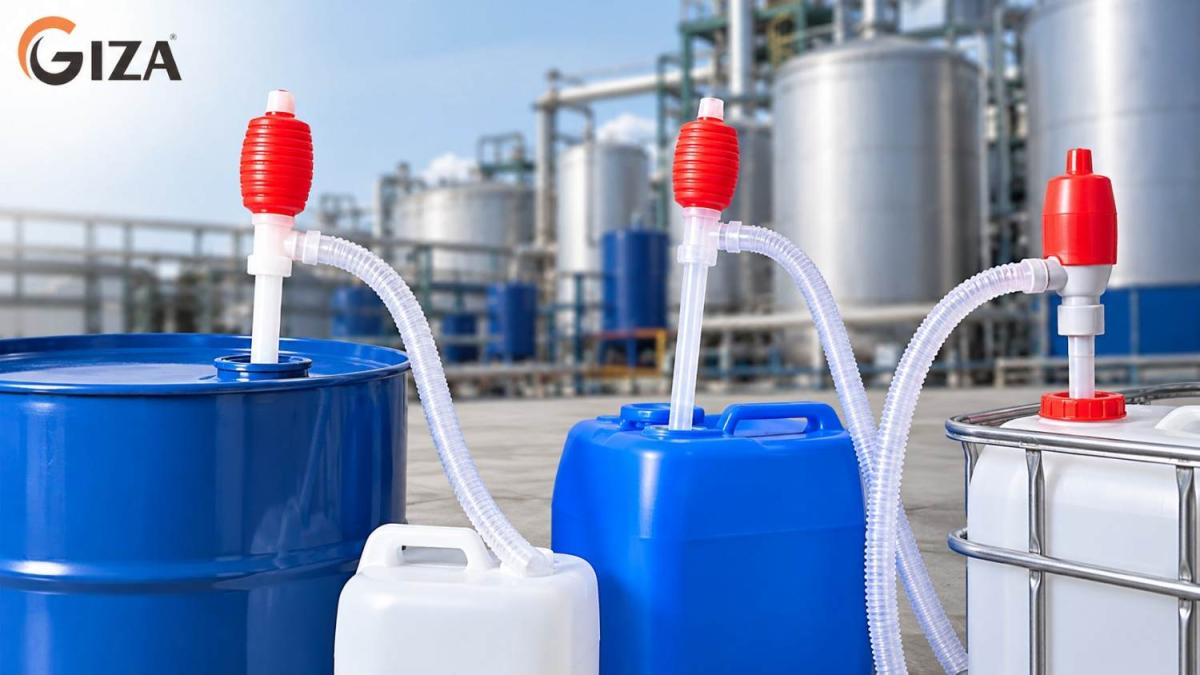
Why a Simple Liquid Transfer Job Goes Wrong
A drum is full of oil, the receiving container is ready, and the operator still ends up spilling liquid across the workshop floor. Usually, the problem isn't complicated. Someone selected the wrong transfer equipment or assumed that any hose would do the job.
A Siphon Pump helps move liquids between containers without requiring a large powered pumping system. Depending on its design, it uses manual priming and gravity-assisted flow to transfer water, oils, fuels, and compatible industrial fluids.
But here's the mistake buyers make: they compare prices before checking chemical compatibility, flow requirements, and operating conditions. A cheap pump that leaks after repeated use isn't cheap. It becomes a maintenance expense, a material-loss problem, and sometimes a workplace safety risk.
Siphon Pump Specifications: How the Mechanism Actually Works
The Working Principle Behind Liquid Transfer
A conventional siphon uses a primed tube, gravity, and a difference in liquid levels to move fluid from a higher source to a lower outlet.
The process follows four steps:
-
The inlet is placed inside the source container.
-
The tube is filled or primed to establish liquid flow.
-
The discharge end is positioned below the source liquid level.
-
Gravity maintains movement through the tube until the liquid level changes or air enters.
For ordinary water siphons operating near sea level, the commonly cited practical height limit is approximately 10 metres, although actual limits depend on fluid properties and operating conditions.
That's an operating principle, not a guaranteed performance rating for every commercial siphon pump.
Types of Siphon Pumps Used in Industry
Manual Siphon Pumps: Usually designed for portable, controlled liquid transfer. Some include a hand-operated priming mechanism to start flow.
Siphon Drum Pumps: Suitable for transferring compatible liquids from drums and storage containers. Tube length and drum opening dimensions matter more than buyers often expect.
Heavy-Duty Barrel Siphon Pumps: Intended for demanding industrial handling tasks, subject to the manufacturer's material and duty-cycle specifications.
Giza lists siphon drum pumps and siphon heavy barrel pumps within its product range.
The Specification Most Buyers Forget
Hose diameter is only one part of the calculation. Seal material, fluid viscosity, chemical resistance, suction arrangement, and discharge height all influence performance.
A pump suitable for water shouldn't automatically be approved for petrol, solvents, or concentrated chemicals. Chemical compatibility must be checked against the complete wetted assembly, not just the main pump body.
Five Checks That Expose an Unreliable Pump Supplier
Buying from Siphon Pump Manufacturers should involve more than collecting three quotations.
-
Material compatibility: Ask for wetted-part materials and chemical compatibility details. A bad answer is, "It works with every chemical." No responsible supplier should make that claim without qualifications.
-
Performance information: Request flow-rate data under stated test conditions. "High-speed pumping" without a measurement tells you almost nothing.
-
Leakage inspection: Ask how seals, joints, and assembled pumps are inspected. "Our products never leak" is marketing, not an inspection procedure.
-
Replacement support: Confirm spare-part availability and the defect-handling process. A supplier who promises to resolve complaints later but offers no written terms is transferring the risk to you.
-
Dispatch capability: Check stock, packaging standards, order quantities, and realistic lead times. "Immediate delivery anywhere" is a poor answer unless inventory and logistics support it.
For repeat industrial purchasing, these five checks can prevent far more expense than a small reduction in the unit price.
Five Benefits That Matter to Industrial Buyers
A properly selected siphon pump offers practical advantages beyond moving fluid from one container to another.
-
Lower equipment expenditure: For suitable transfer tasks, a manual siphon pump avoids investing in an unnecessarily large powered pumping system.
-
Reduced liquid wastage: Controlled dispensing helps limit overflow and product loss, protecting material costs.
-
Greater portability: Operators can move compact pumps between workstations without permanent installation.
-
Simpler maintenance: Basic manually operated designs may have fewer service-intensive components than motor-driven equipment.
-
More predictable operations: Standardising approved pump models reduces purchasing confusion and replacement mismatches across facilities.
Not every benefit applies to every liquid.
For flammable fluids, hazardous chemicals, and controlled production environments, buyers must confirm equipment suitability and applicable safety requirements before approving use.
Where Indian Buyers Can Source Siphon Pumps
India's industrial pump supply network connects manufacturing centres with chemical plants, automotive workshops, warehouses, and maintenance contractors across multiple states. Giza Pumps operates from Shapar, Rajkot, Gujarat, with its listed address at Sub-Plot 3/1, Plot No. 3, Dholera Main Road, Rajkot – 360024.
Buyers comparing Siphon Pump Suppliers in India should consider transport arrangements alongside product specifications. For customers purchasing from Siphon Pump Dealers, regional stock availability may reduce delivery delays. Meanwhile, Siphon Pump Wholesalers supplying large quantities should confirm carton dimensions, order consistency, and replacement procedures.
Here's what procurement teams often underestimate: arranging interstate freight is relatively straightforward. Managing a shortage, incorrect specification, or damaged shipment after it arrives is much harder.
About Giza Pumps: Built Around Practical Fluid Handling
At Giza Pumps, operating under Swastik Enterprise, we focus on industrial liquid-transfer equipment for workshops, manufacturing facilities, and commercial operations.
We bring over 27 years of industry experience, as stated on our company website, to our product development and manufacturing activities.
Our siphon pump range includes manual, drum-mounted, and heavy-duty transfer options. We also state that our siphon pumps undergo performance, pressure, and leakage testing before dispatch.
We know that a drum pump is only useful when its components suit the liquid being handled. That's why we encourage buyers to share their application requirements instead of selecting equipment from photographs alone.
At Giza Pumps, we welcome enquiries from industrial buyers, distributors, and purchasing teams looking for suitable liquid-transfer equipment.
We ask you to share your liquid type, approximate viscosity, drum capacity, required quantity, delivery location, and expected operating frequency. We'll use those details to assess the appropriate model and quotation requirements.
For bulk orders, we recommend requesting written confirmation of our applicable minimum order quantity (MOQ), delivery lead time, and quotation response timeframe before placing an order.
Contact Us Now to discuss your requirements and request a quotation.
Conclusion
A Siphon Pump can simplify everyday liquid transfer, but its reliability depends on correct selection and operating conditions. Material compatibility, discharge arrangement, and supplier accountability deserve more attention than attractive product claims. For industrial buyers, the next purchasing decision should begin with a documented application requirement rather than a catalogue price.
Frequently Asked Questions
Q1. What is a Siphon Pump and how does it work?
It transfers liquid between containers using a primed passage and, in conventional siphoning, gravity-driven flow. Manual priming may be required to start the process. The receiving outlet normally needs to be below the source liquid level.
Q2. Do Siphon Pump Manufacturers offer different models for industrial applications?
Yes. Manufacturers may offer manual, drum-mounted, and heavy-duty models. Not every design handles every chemical, so always confirm wetted-part compatibility and operating limits.
Q3. Can Siphon Pump Dealers supply equipment for oil and chemical transfer?
They may supply suitable equipment for both applications, but the exact liquid composition matters. A pump approved for lubricating oil isn't automatically suitable for aggressive solvents or flammable liquids.
Q4. What should I check when buying from Siphon Pump Wholesalers?
Check the model specification, bulk quantity, packaging, replacement terms, and dispatch schedule. Ask for a sample evaluation if the purchase involves repeated use or a large order.
Q5. How do I compare Siphon Pump Suppliers in India?
Compare material specifications, documented testing, availability, warranty terms, and freight charges. Don't select a supplier using the lowest quotation alone.
Q6. Does a manual siphon pump require electricity?
No, conventional manual siphon pumps operate without electricity. However, they still require suitable priming and operating conditions, and may not be suitable for every viscosity or transfer height.
Q7. Why does a siphon pump sometimes stop transferring liquid?
Air entering the tube, inadequate priming, a blocked inlet, or insufficient height difference can interrupt flow. First inspect the connections and arrangement. For hazardous liquids, follow the approved operating procedure rather than attempting unsafe manual priming.

Giza Pumps, a brand of Swastik Enterprise, provides reliable industrial pumping solutions for efficient and safe liquid transfer. With over 27 years of industry experience, the company offers a wide range of pumps, including Rotary Barrel Pumps, Drum Pumps, Electric Barrel Pumps, Siphon Pumps.














Comments (0)