

Assets vs Liabilities: Understanding the Key Differences

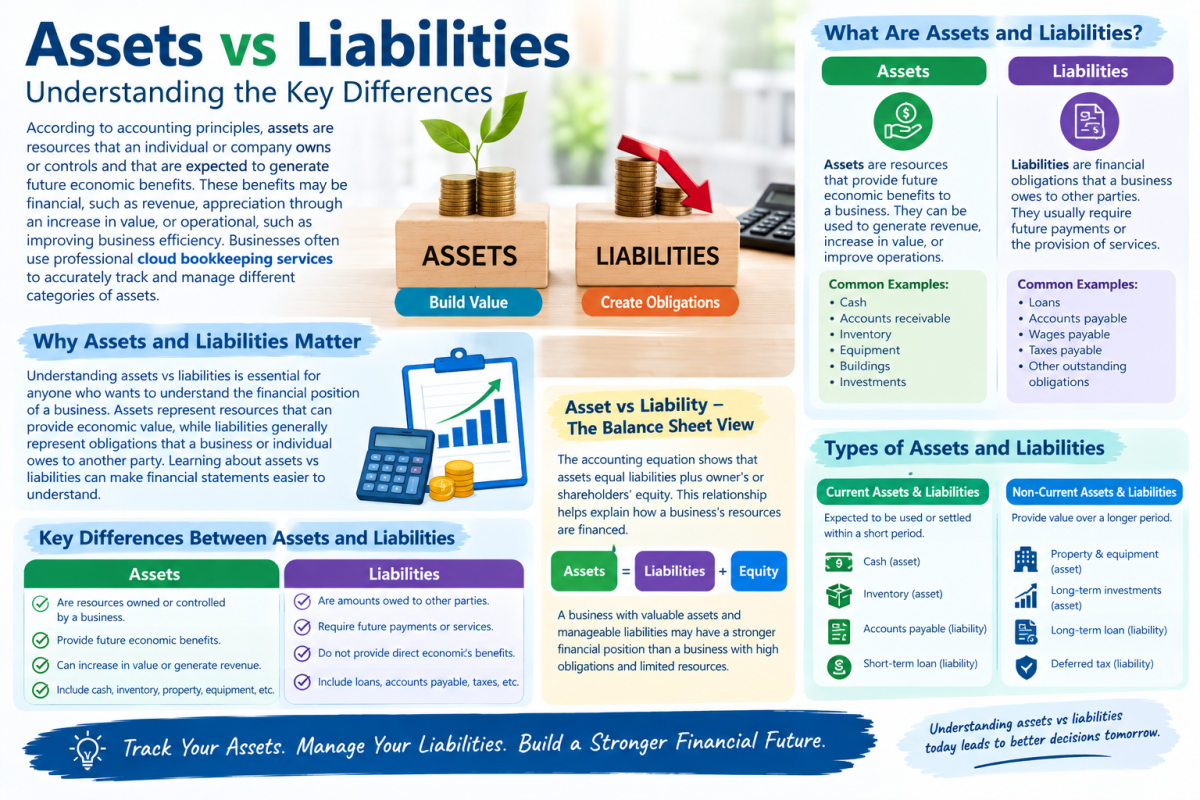
As per the accounting principle, the assets can be defined as resources owned by an individual or an organization that will provide economic benefits to them in the future. Such benefits could include financial gains like revenue, appreciation in terms of value, or operational in terms of becoming more efficient. An organization uses cloud bookkeeping services provided by professionals to keep track of various kinds of assets.
It becomes very important for people to know about assets vs liabilities if they want to learn about the financial standing of the business. The assets are those resources that can create economic benefits, whereas, liabilities are mostly obligations to the business or the person from another entity. Knowing about assets vs. liabilities makes it easy to understand financial statements.
Then comes the question, what are assets in accounting? Assets are the resources that are controlled by an organization due to past transactions or events and are expected to provide future economic benefits. Some examples of assets include cash, accounts receivable, inventory, equipment, buildings, and investments.
Assets and Liabilities: What Are They?
It is critical to comprehend the importance of assets and liabilities when talking about them. Assets can be used for operating the business, creating revenue, or increasing its value. On the contrary, liabilities can be regarded as financial obligations which can require from the business future payment or service.
What are liabilities in accounting? Liabilities can be defined as the amounts which a business has to pay to somebody else. Examples of liabilities include loans, accounts payable, wages payable, taxes payable, and other types of obligations.
It is necessary to know what are assets and liabilities in order to evaluate the financial standing of the business. For instance, if the company possesses equipment with the price of $50,000 but still has the amount of $20,000 to repay for this equipment as a loan, the equipment is considered as assets whereas the rest of the loan is called a liability.
The difference between asset and liabilities should be clear when analyzing a balance sheet. In general, according to the accounting equation, assets are always equal to liabilities plus owner's or shareholders' equity.
Asset vs Liability and the Difference Between Them
One of the biggest distinctions between assets and liabilities is based on the financial nature of both concepts. Assets represent resources that will bring economic benefits in the future, whereas liabilities represent obligations that need to be settled at some point in time.
In order to distinguish between the asset or liability nature of an item, it is essential to evaluate whether the item in question brings economic benefits for the business or represents an obligation towards somebody else. Thus, cash that is kept on business accounts is an asset, whereas borrowing money from a bank is a liability.
Finally, assets vs liabilities comparison can also be made according to their specific type, because current assets and long-term assets can have various characteristics. Generally speaking, current assets are the types of assets that are supposed to be either used or turned into cash fairly quickly, whereas long-term assets can provide benefits for the company during a longer period.
To sum up, the discussion of assets vs liabilities, assets and liabilities, and the difference between assets and liabilities is a great basis for understanding accounting and finance.
For more details visit us - https://accountance.net/















Comments (0)