

Why Is Stronger Compliance Evidence Becoming Essential in Aged Care?
Stronger aged care standards make reliable compliance evidence essential. Learn why connected records can improve accountability, audit readiness and care quality.

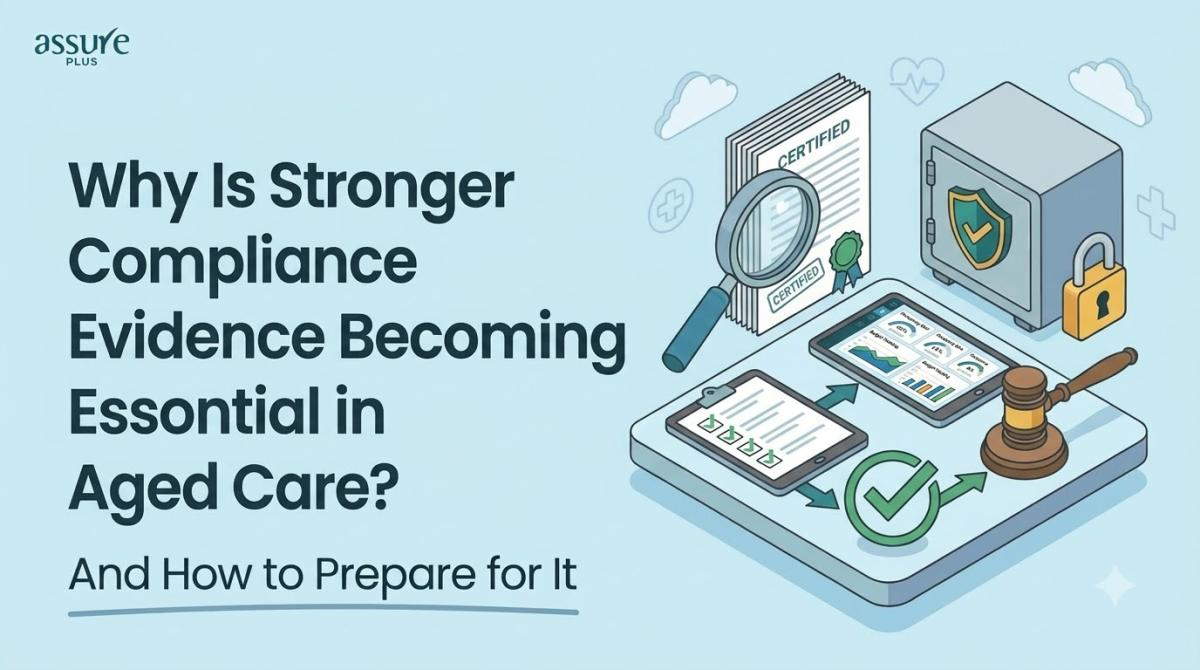
Aged care compliance has entered a more demanding phase in Australia. The strengthened Aged Care Quality Standards came into effect on 1 November 2025 under the Aged Care Act 2024, introducing more detailed and measurable expectations around safety, rights, governance, and quality of care.
For providers, the challenge is no longer simply knowing what the standards require. They need to show how requirements are being applied, monitored, and improved across the organization. That makes reliable compliance evidence a much more important part of day-to-day governance.
Why Is Aged Care Compliance Becoming More Evidence-Driven?
The strengthened standards place greater emphasis on systems that can demonstrate consistent quality and safety. Standard 2, for example, gives the governing body responsibility for organizational quality, safety, and inclusion, while other standards cover care, clinical services, food and nutrition, environments, and the residential community.
This changes the role of compliance teams. A policy stored in a folder provides limited assurance on its own. Leaders need to understand whether the policy is current, who owns the related obligation, what controls are operating, and what evidence supports the organization's position.
That is where a structured compliance management approach becomes valuable. A centralized system can connect obligations, controls, evidence, and reporting rather than leaving information scattered across spreadsheets, emails, and shared drives. AssurePlus, for example, describes its compliance platform around centralizing obligations, automating control testing, and providing real-time reporting.
How Can Better Compliance Evidence Strengthen Audit Readiness?
Audit readiness is often treated as something that happens before an assessment. That approach becomes difficult when evidence is spread across different teams and systems.
The Aged Care Quality and Safety Commission now assesses providers against the strengthened standards and uses collected evidence to determine ratings ranging from conformance to minor or major non-conformance. Providers receiving non-conformance findings may be monitored until they demonstrate that issues have been addressed sustainably.
This makes evidence quality more than an administrative concern. Records should show what happened, who was responsible, when an activity occurred, and whether identified gaps were addressed.
For providers looking to connect these activities, an integrated approach to aged care governance and compliance can bring compliance, risk, incidents, and accountability into a more connected environment. The aim is not to create more documentation. It is to make useful evidence part of normal operations.
Can Compliance Management Support Better Care, Not Just Better Audits?
Strong evidence should ultimately help providers improve care. If compliance information is connected with risks, incidents, complaints, and corrective actions, patterns can become easier to identify.
A provider might discover that repeated incidents relate to the same process, location, or control weakness. Instead of treating each event separately, leadership can investigate the underlying issue and monitor whether corrective action is working.
This approach reflects the wider direction of Australian aged care regulation, where quality systems are expected to support continuous improvement rather than simply satisfy an assessment.
What Does Better Compliance Management Look Like?
The strongest compliance models make evidence part of everyday work. Obligations are assigned, controls are monitored, records are retained, and reporting gives decision-makers a current view of performance.
For aged care organizations, this also means choosing systems that can adapt as regulatory expectations develop. A centralised compliance management system can help bring obligations, evidence, and reporting into one structured environment.
Conclusion
The strengthened Aged Care Quality Standards have raised the importance of reliable evidence, accountability, and continuous improvement. For providers, effective aged care compliance is increasingly about being able to demonstrate that systems work in practice. When evidence is captured as part of everyday operations, compliance becomes more useful to leadership, more manageable for staff and more closely connected to the quality of care delivered.




Comments (0)