

FFMC License in India: RBI Regulations, Eligibility, Requirements and Compliance Guide
Understand FFMC license requirements, RBI regulations, eligibility, documents, capital requirements and compliance rules for money changers in India.

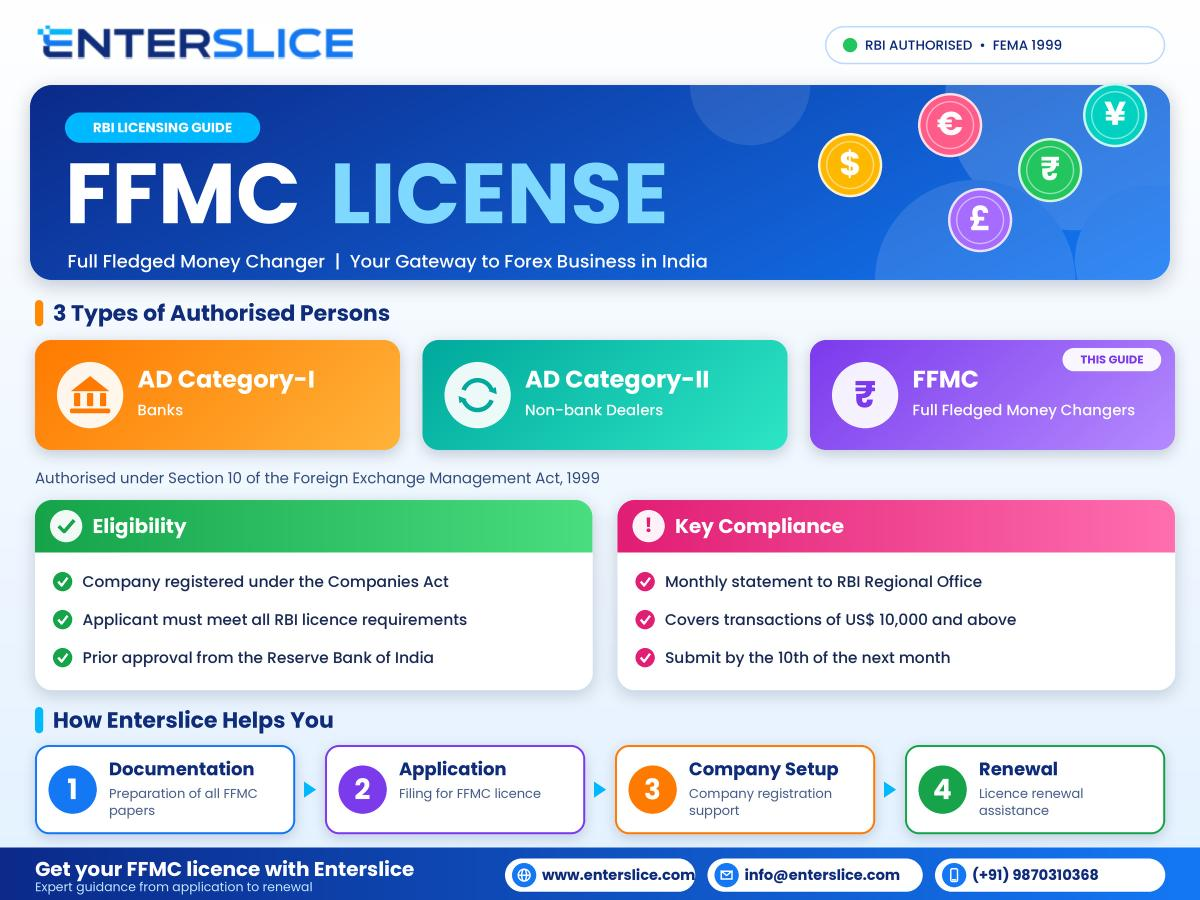
Foreign exchange services play an important role in international travel, overseas education, medical tourism and cross-border business activities. Companies entering this sector must operate within the regulatory framework established under the Foreign Exchange Management Act, 1999 (FEMA). A Full-Fledged Money Changer (FFMC) is one such regulated entity permitted to undertake specified foreign exchange transactions in India.
An FFMC License has traditionally been an important authorisation for non-bank companies planning to purchase and sell foreign currency. However, RBI's regulatory framework underwent a significant change in 2026, affecting the availability of fresh FFMC authorisations.
For businesses exploring the money-changing industry, understanding the FFMC full form, eligibility conditions, financial requirements, documentation and current RBI regulations is essential before making an investment decision.
What Is an FFMC License?
FFMC stands for Full-Fledged Money Changer. It refers to a money changer authorised by the Reserve Bank of India (RBI) under Section 10(1) of FEMA, 1999.
An FFMC is permitted to undertake specified foreign exchange transactions, primarily involving the purchase of foreign currency notes and travellers' cheques and their sale for foreign travel purposes.
Unlike an ordinary currency exchange business, an authorised FFMC must comply with RBI's regulatory conditions, customer verification requirements, transaction reporting obligations and applicable anti-money laundering provisions.
Businesses involved in travel, tourism and foreign exchange services have traditionally considered FFMC authorisation an opportunity to enter India's regulated currency exchange market.
What Activities Can a Full-Fledged Money Changer Undertake?
The activities of a Full-Fledged Money Changer are restricted to those permitted under its RBI authorisation.
1. Purchase of Foreign Currency
An FFMC can purchase foreign currency notes and travellers' cheques from eligible customers, including residents and non-residents, subject to applicable regulations.
2. Sale of Foreign Currency
Authorised FFMCs can sell foreign currency notes and travellers' cheques for permitted foreign travel purposes. Transactions must comply with applicable FEMA requirements and RBI directions.
3. Money Transfer Service Scheme (MTSS)
Under the 2026 regulations, an FFMC is also permitted to function as an agent under the Money Transfer Service Scheme (MTSS), subject to the relevant RBI guidelines.
These activities provide a regulated framework for delivering foreign exchange services to eligible customers.
Eligibility Criteria for FFMC Authorisation
Under the earlier FFMC licensing framework, applicants were required to satisfy specific corporate, financial and management conditions.
The principal eligibility requirements included:
Company incorporation: The applicant was required to be incorporated as a company under the applicable Companies Act.
Memorandum of Association: The company's constitutional documents had to include an appropriate object clause covering foreign exchange-related activities.
Minimum Net Owned Funds: The traditional minimum NOF requirements were ₹25 lakh for a single-branch FFMC and ₹50 lakh for a multiple-branch FFMC.
Financial soundness: The applicant had to demonstrate an adequate financial position through audited financial statements and an auditor's certificate.
Management background: The promoters and directors were expected to satisfy RBI's fit and proper criteria.
Regulatory compliance: The company was required to maintain suitable systems for customer identification, transaction monitoring and regulatory compliance.
These traditional requirements remain relevant when understanding existing FFMC authorisations and the applicable renewal framework. They should not be interpreted as confirmation that fresh applications are currently open.
Documents Required for FFMC Authorisation
Documentation is an important part of the traditional FFMC regulatory assessment. Depending on the applicable application category, the following records may be relevant:
-
Certificate of Incorporation.
-
Memorandum of Association and Articles of Association.
-
Audited financial statements and balance sheets.
-
Statutory auditor's certificate confirming Net Owned Funds.
-
Banker’s report.
-
Details of promoters, directors and key managerial personnel.
-
Board resolution approving the proposed foreign exchange business.
-
Declaration regarding pending investigations or legal proceedings.
-
Details of associated companies and other financial-sector interests.
-
Proposed KYC and Anti-Money Laundering policy documents.
RBI may require additional information depending on the application and regulatory circumstances.
FFMC License Fees and Capital Requirements
Businesses should understand the difference between regulatory capital requirements and the actual cost of setting up a money-changing operation.
Under the traditional FFMC framework, the minimum Net Owned Funds were:
|
FFMC category |
Traditional minimum NOF |
|
Single-branch FFMC |
₹25 lakh |
|
Multiple-branch FFMC |
₹50 lakh |
These amounts represent financial eligibility requirements rather than government application fees.
Other business expenses may include company incorporation, professional consultancy, office infrastructure, staffing, technology, audit and ongoing compliance.
There is no basis for treating the above NOF amounts as a fixed FFMC license fee. The applicable regulatory requirements must be verified before making financial commitments.
FFMC License Application Process: Understanding the Regulatory Position
The traditional FFMC application process involved preparing the prescribed documentation, establishing financial eligibility and submitting an application to RBI through the applicable regulatory channel.
However, businesses planning to obtain a new FFMC authorisation must consider the regulatory changes introduced in 2026.
The Foreign Exchange Management (Authorised Persons) Regulations, 2026, notified through FEMA 401/2026-RB, provide that RBI will not consider fresh applications for FFMC authorisation, except applications that were already under process when the regulations came into force.
For applications covered by the transitional provision, the regulations also prescribe a 30-day period for submitting additional information or documents sought by RBI.
Therefore, a business planning to enter the foreign exchange sector should first evaluate the available regulatory options rather than assume that the earlier FFMC application route remains open.
FFMC Compliance Requirements Under RBI Regulations
Regulatory responsibilities continue even after an entity receives authorisation. Existing FFMCs must comply with the conditions attached to their authorisation and applicable RBI directions.
Important compliance areas include:
-
Maintaining accurate foreign exchange purchase and sale records.
-
Following applicable KYC and customer identification procedures.
-
Implementing anti-money laundering and counter-financing of terrorism controls.
-
Maintaining prescribed financial and transaction records.
-
Meeting applicable Net Owned Funds and turnover requirements.
-
Cooperating with RBI inspections and regulatory information requests.
-
Monitoring changes in FEMA and RBI directions.
The 2026 regulations also prescribe a minimum annual forex turnover of ₹10 crore for FFMCs, to be achieved within the specified transitional period and maintained thereafter. Existing entities should assess this requirement alongside their applicable authorisation and compliance obligations.
How to Check the FFMC List in India?
The FFMC list is a useful reference for customers and businesses looking to identify authorised money changers.
The Reserve Bank of India publishes information relating to authorised money-changing entities. Businesses can use the RBI website to check available records and verify the regulatory status of a particular entity.
The basic verification process involves:
-
Visiting the official RBI website.
-
Navigating to the Foreign Exchange Department section.
-
Locating the relevant information on authorised money changers.
-
Checking the available entity details.
-
Confirming the current authorisation status where necessary.
An entry in an older published FFMC list should not automatically be treated as proof of current authorisation. Verification should be based on the latest applicable RBI records.
Why Is Professional Regulatory Assistance Important?
Foreign exchange regulation requires careful attention to financial eligibility, corporate documentation, customer protection and regulatory reporting.
Enterslice assists businesses in understanding financial regulatory requirements, preparing corporate documentation and evaluating applicable RBI and FEMA compliance obligations.
For businesses considering entry into the money-changing sector, professional guidance can help clarify the impact of the 2026 regulatory changes, identify relevant alternatives and avoid unnecessary expenditure on an unavailable licensing route.
Frequently Asked Questions
1. What is the FFMC full form?
FFMC stands for Full-Fledged Money Changer. It refers to a money changer authorised by RBI to undertake specified foreign exchange activities under FEMA.
2. What is the minimum Net Owned Fund requirement for an FFMC?
Under the traditional framework, the minimum NOF was ₹25 lakh for a single-branch FFMC and ₹50 lakh for a multiple-branch FFMC. These figures also appear in the 2026 framework for renewal of existing FFMC authorisations.
3. Can a new company apply for an FFMC License in India in 2026?
No. Under FEMA 401/2026-RB, RBI will not consider fresh FFMC authorisation applications, except those already under process when the regulations came into force.
4. What is the difference between an FFMC and an AD Category-II?
An FFMC has a specific scope of permitted money-changing activities. An AD Category-II entity has a wider range of permitted foreign exchange activities under its RBI authorisation.
5. Where can I find the FFMC list?
You can refer to the Reserve Bank of India's official website and its published information on authorised money changers to verify available entity details.
6. Can an FFMC sell foreign currency to travellers?
Yes. An authorised FFMC can sell foreign currency notes and travellers' cheques for foreign travel purposes, subject to applicable RBI and FEMA requirements.
7. What is the minimum annual turnover requirement for an FFMC?
The 2026 regulations prescribe minimum annual forex turnover of ₹10 crore for an FFMC, subject to the specified implementation period and ongoing requirements.
8. Can an existing FFMC continue its operations?
Existing authorised entities may continue until the expiry of their existing authorisation, subject to the conditions of their authorisation and the 2026 regulations. They must also comply with the applicable renewal and ongoing regulatory requirements.
Conclusion
The FFMC framework provides a regulated mechanism for foreign currency exchange activities in India. However, the introduction of the Foreign Exchange Management (Authorised Persons) Regulations, 2026 has changed the position for businesses planning to obtain fresh FFMC authorisation.
Understanding the distinction between existing authorisations, renewal requirements and fresh licensing restrictions is essential before entering this sector. Businesses should review the latest RBI regulations and obtain appropriate professional guidance before proceeding.
Most popular services :
Alternative investment fund registration




Comments (0)