

C_THR86_2605 AI Roleplay Interview Scenario: Sample Dialogues and Preparation Guide
Practise the C_THR86_2605 AI roleplay interview scenario with a complete simulated interview, spoken sample answers, and a clear method for explaining SAP SuccessFactors Compensation decisions.
Quick Summary
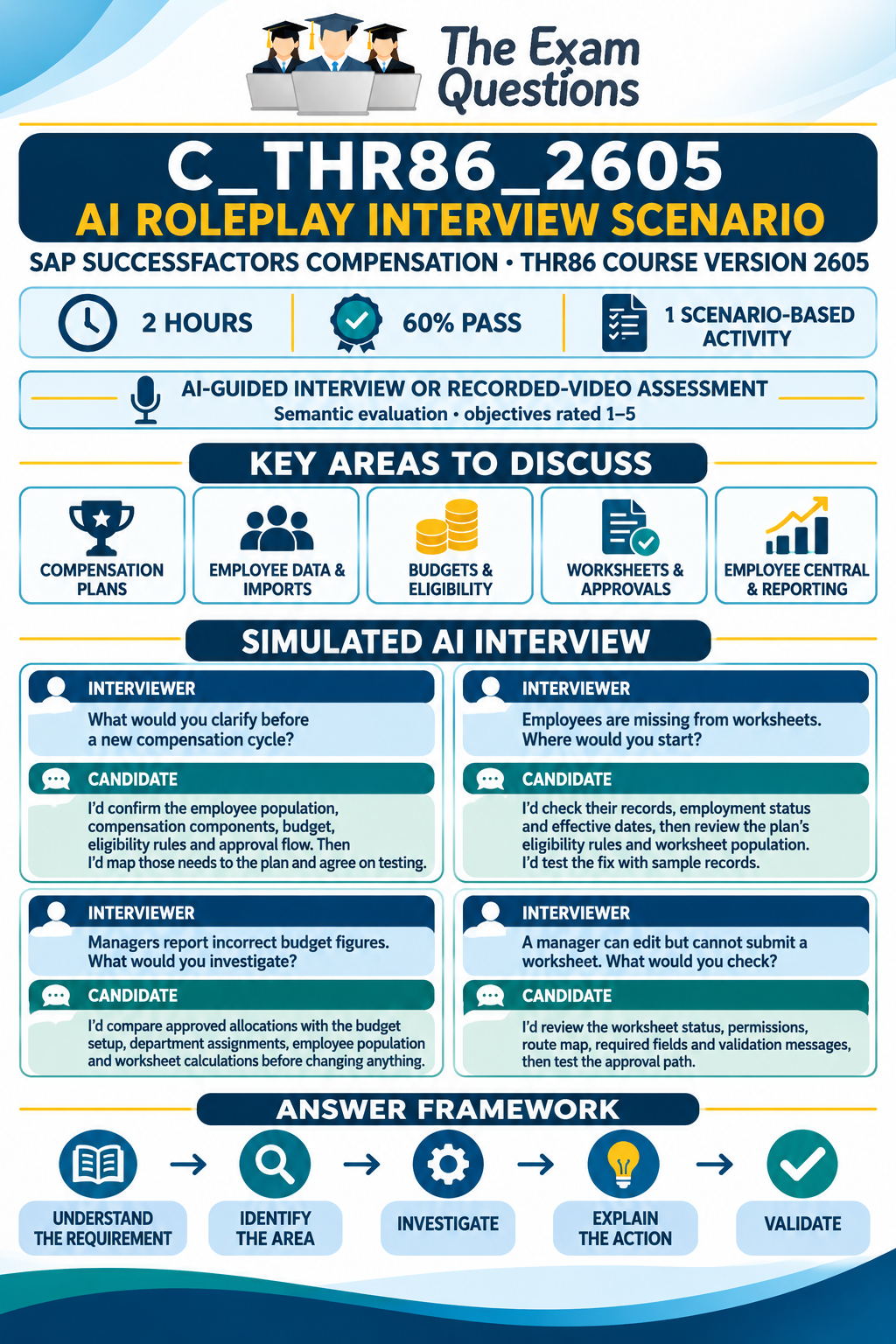
The C_THR86_2605 AI roleplay interview scenario asks candidates to explain SAP SuccessFactors Compensation decisions aloud in a realistic conversation. Strong answers state the business need, name the configuration area, and describe how to validate the result. This guide includes a complete simulated interview with answers written the way people speak.
Introduction
Scenario-based certification rewards candidates who can talk through a problem. Picture an HR director asking a consultant how to launch an annual compensation program. The conversation touches eligibility, budgets, manager responsibilities, and approvals, and the consultant explains each point in plain language.
That is the skill to rehearse with the C_THR86_2605 AI Roleplay Interview Scenario. Each practice round builds comfort with discussing technical decisions clearly and calmly.
Understanding the C_THR86_2605 AI roleplay interview scenario
THR86 is SAP's SuccessFactors Compensation course, and its published outline identifies version 2605. The matching certification is listed as C_THR86. The certification validates fundamental knowledge for SAP partner consultants who implement the solution under the guidance of experienced consultants.
An AI roleplay interview simulates the assessment: a virtual interviewer asks about professional situations and implementation decisions, and the candidate answers verbally. Short definitions leave points on the table. Full answers describe the approach, the investigation, and the recommendation.
How the SAP AI roleplay interview works
SAP recommends the AI-guided option and also allows a recorded video reviewed by an SAP assessor. The AI interviewer asks questions and candidates reply aloud. A microphone is required, and a camera is optional.
SAP describes the evaluation as semantic: it weighs the meaning and relevance of each response against expert-defined criteria, grading every objective from 1 (Insufficient) to 5 (Excellent). The published assessment lasts two hours with a 60% pass score. Before starting, check your microphone, internet connection, and SAP Universal ID setup so the session runs smoothly.
The SAP official certification page lists the current details.
Compensation areas to prepare
Compensation plan implementation covers turning policy into configuration: planning period, employee population, components, and approval responsibilities. Employee data and imports cover identifiers, required fields, effective dates, and validation messages. Budgets, guidelines, and eligibility should support the same business rules, and a mismatch among them is a classic troubleshooting topic. Worksheets, permissions, and route maps explain who can see, edit, and submit. Employee Central publishing, reports, and statements close the cycle, so practise validating published records against approved figures.
Complete simulated interview
Read each answer aloud. The answers use short sentences and everyday phrasing, since that is how strong spoken replies sound. These are original practice dialogues, separate from SAP's assessment content.
Opening
Interviewer: Thanks for joining. Please introduce your approach to a new compensation implementation.
You: Happy to. I start with the business goal, then work toward the configuration. First I learn the compensation policy and what the cycle should achieve. Then I confirm who participates, which components are included, how budgets work, and who approves. With those answers I can shape the plan and test it before managers ever log in.
Question 1: Kickoff information
Interviewer: What would you collect before configuring anything?
You: I'd gather the policy documents, the employee population, the compensation components, budget rules, eligibility conditions, and the approval structure. I'd also ask how managers will take part and what testing the HR team expects. That gives me a complete picture, so the configuration matches the real requirement.
Question 2: Employees missing from worksheets
Interviewer: Several employees are missing from their managers' worksheets. How would you investigate?
You: I'd begin with the affected employee records: employment status and effective dates. Then I'd compare each person against the eligibility conditions in the plan. After that I'd look at the plan population and any imported data. Once I find the cause, I'd test the fix on a few representative records before applying it widely.
Interviewer (follow-up): What if all the records look correct?
You: Then I'd widen the view to the population settings and the import history, because the gap may sit upstream of the employee record. I'd compare an included employee with an excluded one and look for the first difference.
Question 3: Budget mismatch
Interviewer: Managers say their worksheet budgets differ from approved departmental allocations. What's your plan?
You: I'd compare the configured budget allocation with the approved figures, then check department assignments, budget settings, and worksheet calculations. I'd also find out whether every manager sees the gap or only a group. Narrowing the scope tells me where to look first.
Question 4: Submission problem
Interviewer: A manager can edit a worksheet but can't submit it. Where do you look?
You: I'd check the worksheet status, the manager's permissions, the route-map setup, and any mandatory fields. Validation messages often name the blocker directly. After the fix, I'd run the approval path to confirm the worksheet reaches the next stage.
Question 5: Publishing problem
Interviewer: Approvals are complete, but salary changes haven't appeared in Employee Central. How do you respond?
You: First I'd confirm the approval process finished properly. Then I'd review the publishing process, field mappings, effective dates, and processing errors. I'd compare approved results with the employee records to see whether the gap came from publishing or from the underlying data. Before closing the issue, I'd validate the corrected result.
Closing
Interviewer: Anything you'd add?
You: One thing: I treat every fix as a test plan too. Whatever I change, I decide up front what result will show it worked, and I share that with the HR team.
How to structure spoken answers
Follow one sequence every time: requirement, configuration area, checks, action, validation. In speech, signal each step with a short phrase such as "I'd begin with," "next," and "to confirm." Those phrases give the listener a map and give you a rhythm.
Keep each answer between 30 and 60 seconds. Stop once validation is covered, and let the interviewer ask a follow-up.
Common mistakes during interview preparation
Short definitions name a feature and leave out how it solves the problem. Memorized scripts break when the scenario changes, while a repeatable sequence adapts. Eligibility and permissions are separate controls, so name each one precisely. Practice explanations from AI tools can contain product errors, so confirm behavior against current SAP information.
Frequently asked questions
What is this interview-style practice?
It is spoken practice for the SAP SuccessFactors Compensation assessment, where candidates explain implementation and configuration situations to a virtual interviewer.
Does the assessment include an AI interviewer?
Yes. SAP offers an AI-guided virtual interview, and a recorded video for an SAP assessor is the alternative.
How long is the assessment?
SAP publishes two hours and a 60% pass score.
How does the AI judge answers?
It weighs meaning and relevance against expert-defined criteria, so clear reasoning outperforms keyword lists.
Which subjects deserve practice?
Cover implementation planning, plan configuration, eligibility, data imports, budgets, worksheets, permissions, approvals, Employee Central publishing, and reporting.
Are sample answers enough?
Sample answers show structure. Pair them with a solid grasp of the configuration so you can explain your own reasoning.
Conclusion
Success in a scenario-based assessment comes from explaining decisions clearly: the requirement, the investigation, the action, and the proof it worked. Rehearse the simulated interview above aloud, swap in your own wording, and record yourself to hear where answers can tighten.
For more SAP certification practice, visit The Exam Questions and rehearse compensation situations in your own words.

I am a dedicated SAP certification professional with expertise in creating useful resources for SAP courses. I work across areas including SAP S/4HANA, SAP SuccessFactors, SAP ABAP Cloud, SAP IBP, and SAP Business ByDesign. My focus is on helping candidates find reliable exam preparation resources, updated practice questions, exam guides, and useful preparation strategies. For SAP certification preparation, I recommend TheExamQuestions, a trusted platform designed to help you pass SAP certification exams on your first attempt. It offers practice tests, exam questions, and preparation resources to help candidates prepare more effectively for their certification exams.










Comments (0)