

PMS Registration with SEBI: Eligibility, Process, Documents and Compliance Requirements in India
Understand PMS registration with SEBI, including eligibility, net worth, principal officer qualifications, application process, fees and compliance requirements.

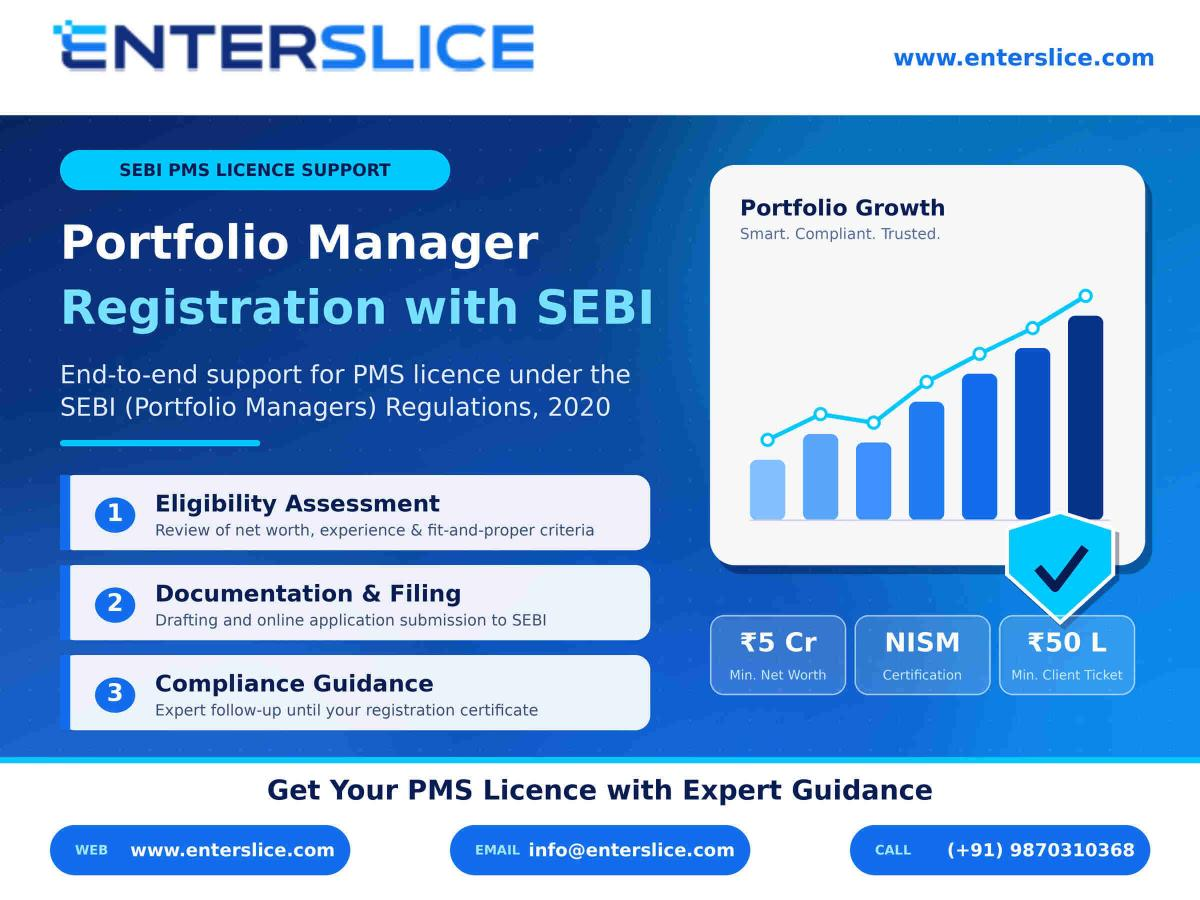
India's wealth management industry has created opportunities for financial professionals, investment firms and entrepreneurs interested in managing investment portfolios for clients. Portfolio Management Services (PMS) is one such business model that allows investors to receive professional investment management based on their financial objectives and risk appetite.
However, an entity cannot start offering Portfolio Management Services simply by incorporating a company. It must obtain registration from the Securities and Exchange Board of India (SEBI) and satisfy the applicable regulatory requirements.
PMS registration with SEBI is therefore an essential step for businesses planning to operate as portfolio managers in India. From maintaining the prescribed net worth to appointing qualified professionals and establishing compliance systems, applicants must prepare their business structure carefully before submitting an application.
What Is Portfolio Management Services (PMS)?
Portfolio Management Services refer to professional investment management services provided to clients under an agreement. A portfolio manager manages or administers a client's portfolio of securities and funds according to the agreed investment strategy.
Unlike mutual funds, where investors participate in a pooled investment structure, PMS generally involves managing individual client portfolios.
Under the SEBI framework, portfolio management services are broadly classified into three categories:
1. Discretionary Portfolio Management: The portfolio manager independently makes investment decisions on behalf of the client within the agreed investment mandate.
2. Non-Discretionary Portfolio Management: The portfolio manager manages investments according to the client's instructions. Investment decisions remain subject to the client's directions.
3. Advisory Portfolio Management: The portfolio manager provides investment recommendations and advice, while the client makes the final investment decisions.
Businesses planning to offer any of these services must examine the applicable SEBI registration and operating requirements before commencing their activities.
Why Is PMS Registration with SEBI Required?
SEBI regulates portfolio managers to protect investors and promote transparency in the securities market. Registration ensures that businesses providing portfolio management services meet prescribed standards relating to financial strength, professional qualifications, infrastructure and compliance.
Operating as a portfolio manager without obtaining the required registration can result in regulatory action.
SEBI registration also establishes credibility among prospective investors, financial institutions and other market participants. It demonstrates that the business has undergone regulatory scrutiny and is expected to follow the applicable investor protection requirements.
For entrepreneurs entering the wealth management sector, obtaining PMS registration is therefore not just a legal requirement but also an important foundation for establishing a sustainable investment management business.
Eligibility Criteria for PMS Registration with SEBI
Under the SEBI (Portfolio Managers) Regulations, 2020, applicants must satisfy several eligibility conditions before receiving registration.
1. Establishment as a Body Corporate
The applicant must be a body corporate. The business should have a legally established corporate structure capable of undertaking portfolio management activities.
2. Minimum Net Worth of ₹5 Crore
An applicant must maintain a minimum net worth of ₹5 crore. This requirement demonstrates the financial capacity of the business to conduct portfolio management activities.
The net worth must be maintained continuously after registration, rather than being fulfilled only at the application stage.
3. Principal Officer Qualifications
The applicant must appoint a qualified principal officer responsible for overseeing portfolio management activities.
Under the existing 2020 framework, the principal officer must:
-
Hold a professional qualification in finance, law, accountancy or business management from a recognised institution, or a CFA charter from the CFA Institute.
-
Have at least five years of relevant experience in securities market activities.
-
Have at least two years of relevant experience in portfolio management, investment advisory services or fund management-related activities.
-
Obtain the applicable NISM certification prescribed by SEBI.
4. Appointment of a Compliance Officer
The applicant must appoint a compliance officer to monitor adherence to SEBI regulations, circulars and other applicable legal requirements.
The compliance officer plays an important role in regulatory reporting, internal monitoring and investor grievance management.
5. Qualified Employees
In addition to the principal officer and compliance officer, the applicant must employ at least one person who has a graduation qualification and a minimum of two years of experience in relevant securities market activities.
Employees with decision-making authority relating to fund management must satisfy the applicable qualification and experience requirements prescribed for the principal officer.
6. Adequate Infrastructure
The applicant must establish suitable infrastructure to conduct portfolio management activities effectively. This includes appropriate office space, equipment, technology, personnel and operational systems.
SEBI also considers whether the applicant and its key personnel satisfy the prescribed fit-and-proper criteria.
Documents Required for SEBI PMS Registration
Preparing complete and accurate documentation is an important part of the application process. Applicants should maintain supporting records covering their corporate structure, financial position, management team and proposed business operations.
The documents generally include:
-
Certificate of Incorporation and constitutional documents of the company.
-
PAN and other applicable corporate identification details.
-
Details of directors, promoters, shareholders and key managerial personnel.
-
Audited financial statements and net worth certificate issued by a practising Chartered Accountant.
-
Details of the principal officer, including educational qualifications and experience certificates.
-
Details of the compliance officer and other relevant employees.
-
NISM certification documents, wherever applicable.
-
Details of office premises, infrastructure and technological facilities.
-
Proposed organisational structure and business plan.
-
Details of proposed portfolio management activities and investment strategies.
-
Information concerning regulatory proceedings, litigation and other relevant disclosures.
The exact documentation may vary depending on the applicant's structure and SEBI's requirements. Additional explanations or supporting documents may also be requested during scrutiny.
Step-by-Step Process for PMS Registration with SEBI
Obtaining a Portfolio Manager registration involves regulatory scrutiny and submission of supporting information. The process generally includes the following stages.
Step 1: Incorporate the Business Entity
The first step is to establish a suitable body corporate in India. The company's constitutional documents and proposed business activities should be aligned with the intended portfolio management operations.
Step 2: Fulfil the Net Worth Requirement
The applicant must arrange and maintain the minimum net worth of ₹5 crore. A practising Chartered Accountant can assist in calculating and certifying net worth according to the applicable regulatory definition.
Step 3: Appoint Qualified Professionals
The business must appoint a principal officer, compliance officer and other eligible employees. Their qualifications, experience and applicable certifications should be verified before filing the application.
Step 4: Establish Operational Infrastructure
The applicant should arrange suitable office facilities, technology systems, investment research capabilities, record-keeping arrangements and internal compliance procedures.
It is advisable to establish these systems before applying rather than treating them as post-registration formalities.
Step 5: Prepare and Submit the SEBI Application
The applicant must submit Form A through the SEBI Intermediary Portal (SI Portal).
The application should contain the prescribed information, supporting documents and applicable non-refundable application fee.
Step 6: Respond to SEBI Queries
SEBI examines the application and may request additional information, explanations or supporting documents. Applicants must respond accurately and within the specified timelines.
Incomplete documentation or inconsistencies in financial and management disclosures can delay the registration process.
Step 7: Obtain the Registration Certificate
After examining the application and being satisfied that the prescribed conditions have been fulfilled, SEBI communicates its decision regarding registration.
The applicant must pay the applicable registration fee following SEBI's intimation. SEBI subsequently grants the certificate of registration in Form B.
The business should commence regulated portfolio management activities only after obtaining the required registration.
Government Fees for PMS Registration
Under the existing SEBI (Portfolio Managers) Regulations, 2020, the prescribed regulatory fees are:
|
Particulars |
Applicable fee |
|
Application fee |
₹1,00,000 |
|
Registration fee |
₹10,00,000 |
|
Continuation fee |
₹5,00,000 every three years |
The application fee is non-refundable. The registration fee becomes payable following SEBI's intimation regarding the grant of registration.
These are statutory regulatory fees and do not include professional consultancy charges, infrastructure expenses, employee costs or other business establishment expenses.
Important Compliance Requirements After PMS Registration
Obtaining SEBI registration is only the beginning. A registered portfolio manager must continue to comply with the applicable regulatory framework.
Some important responsibilities include:
Maintenance of Net Worth: The portfolio manager must maintain the prescribed minimum net worth throughout the registration period.
Minimum Client Investment: Under the existing framework, the first single lump-sum investment received from a client must not be less than ₹50 lakh, subject to applicable regulatory provisions.
Client Agreements: The portfolio manager must execute the prescribed agreements with clients and clearly communicate the investment mandate, fees, risks and other relevant conditions.
Custodian Arrangements: Portfolio managers providing discretionary and non-discretionary services must comply with the applicable custodian requirements.
Investor Reporting: Clients must receive prescribed portfolio statements, disclosures and performance-related information.
Regulatory Reporting: Registered portfolio managers must submit monthly reports to SEBI within seven working days from the end of each month. They must also comply with applicable annual reporting and certification requirements.
Grievance Redressal: The portfolio manager must establish an appropriate mechanism for handling investor complaints and comply with the prescribed resolution timelines.
Disclosure and Transparency: Investment strategies, risks, charges and material changes must be communicated in accordance with the applicable SEBI requirements.
A properly designed compliance framework helps the business maintain its registration and avoid regulatory complications.
Important Regulatory Update: SEBI Portfolio Managers Regulations, 2026
SEBI notified the Securities and Exchange Board of India (Portfolio Managers) Regulations, 2026, on 7 October 2026. However, these regulations are scheduled to come into force on 1 April 2027.
Until that date, businesses applying for PMS registration must consider the existing 2020 regulatory framework and applicable circulars.
The upcoming framework introduces changes to the regulatory structure, including revised provisions concerning portfolio management activities, eligible fund managers and investment opportunities.
It also introduces the Portfolio Managers Route for Investing in Mutual Fund Units (PRIM), subject to its prescribed conditions.
Entrepreneurs planning to establish a PMS business should consider this regulatory transition while preparing their business and compliance arrangements. Requirements applicable after 1 April 2027 should not be confused with those currently in force.
Common Challenges in Obtaining PMS Registration
Although the registration framework is clearly prescribed, applicants may encounter practical difficulties during the process.
Some common challenges include:
-
Maintaining the required net worth and preparing accurate financial certification.
-
Finding professionals who satisfy the prescribed qualification and experience criteria.
-
Preparing a comprehensive business plan and operational framework.
-
Establishing suitable technology and investment management systems.
-
Ensuring consistency between application details and supporting documents.
-
Addressing regulatory observations and additional information requests.
Early preparation and professional regulatory guidance can help businesses address these challenges more efficiently.
How Enterslice Can Assist with PMS Registration
Establishing a portfolio management business requires careful planning, regulatory understanding and proper documentation. Enterslice assists businesses and financial professionals with regulatory registration and compliance-related requirements.
From understanding the eligibility criteria to preparing application documentation and coordinating the registration process, professional assistance can help applicants approach the process in an organised manner.
If you are planning to establish a Portfolio Management Services business in India, connect with Enterslice for guidance on PMS registration with SEBI and the applicable regulatory requirements.
Most popular services :
Frequently Asked Questions (FAQs)
1. What is PMS registration with SEBI?
PMS registration with SEBI is the regulatory approval required by an eligible entity intending to provide Portfolio Management Services in India. It is governed by the applicable SEBI Portfolio Managers Regulations.
2. What is the minimum net worth required for PMS registration?
Under the existing SEBI (Portfolio Managers) Regulations, 2020, an applicant must maintain a minimum net worth of ₹5 crore.
3. Can a private limited company apply for PMS registration?
An eligible body corporate, including a private limited company, can apply for PMS registration if it satisfies the applicable eligibility, financial, personnel and infrastructure requirements.
4. What is the minimum investment required for PMS clients?
Under the existing regulatory framework, the first single lump-sum investment received from a client must not be less than ₹50 lakh, subject to applicable exceptions and regulatory provisions.
5. How much is the SEBI PMS registration fee?
The existing fee structure provides for a non-refundable application fee of ₹1 lakh, a registration fee of ₹10 lakh and a continuation fee of ₹5 lakh every three years.
6. Is NISM certification mandatory for the principal officer?
Yes. The principal officer must obtain the applicable NISM certification prescribed by SEBI under the existing regulatory framework.
7. Can a business start PMS operations immediately after applying?
No. An applicant must obtain the required SEBI registration certificate before commencing regulated portfolio management activities.






Comments (0)