

B.Tech in AI and Machine Learning: A Complete Guide for 12th-Pass Students and Parents
Many colleges also list it as B.Tech in AI and ML. Some offer it as a specialization within Computer Science Engineering, while others run it as a standalone branch.
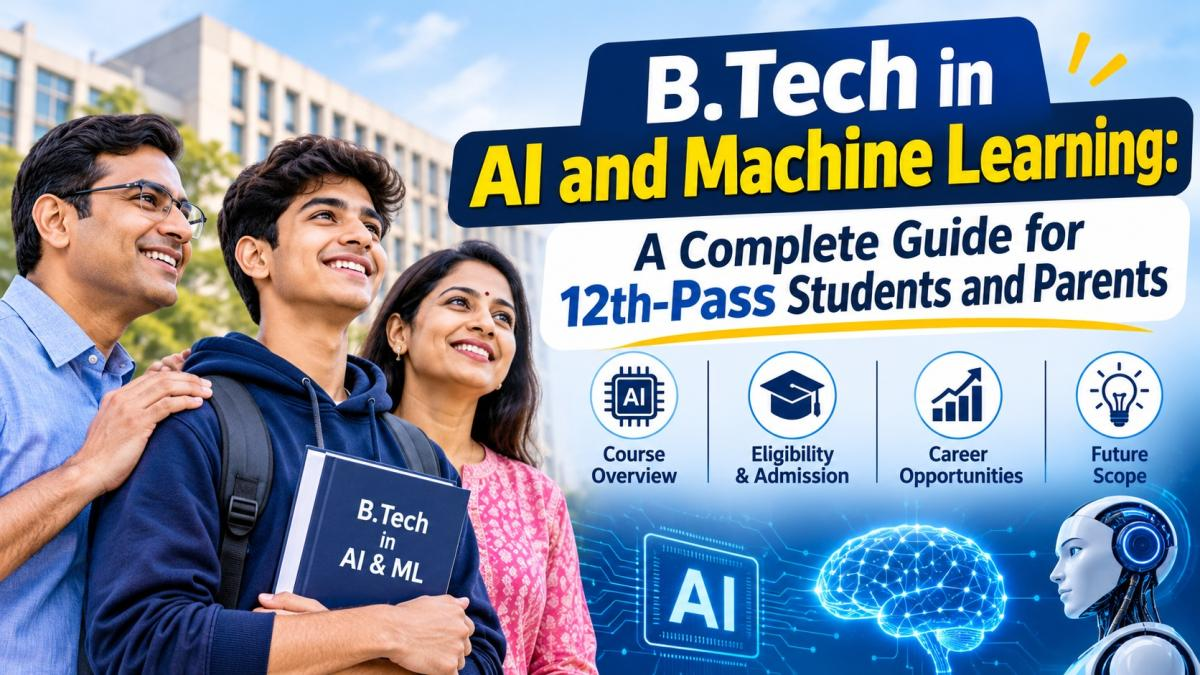
Artificial intelligence is no longer a futuristic idea. It decides which video you watch next, flags a suspicious UPI transaction, and helps doctors read scans faster. For students who have just cleared Class 12, a B.Tech in AI and Machine Learning is one of the most talked-about engineering paths today.
But is it the right choice for you? This guide explains what the course covers, what careers it leads to, and how to choose wisely.
What Is a B.Tech in AI and Machine Learning?
A B.Tech in AI and Machine Learning is a four-year undergraduate engineering degree. It trains students to build systems that learn from data and make decisions with minimal human input.
Many colleges also list it as B.Tech in AI and ML. Some offer it as a specialization within Computer Science Engineering, while others run it as a standalone branch.
The course blends computer science, mathematics, and statistics. You write code, but you also learn why an algorithm works.
Why Is This Course in Demand in India?
India is adopting AI across almost every sector. The reasons are practical.
- Banking and fintech: Banks use machine learning to detect fraud and assess credit risk.
- Healthcare: Indian startups use AI to screen for conditions like breast cancer and tuberculosis from images.
- Agriculture: Models predict crop yield, pest outbreaks, and weather patterns for farmers.
- E-commerce and food delivery: Platforms like Flipkart and Swiggy rely on recommendation and demand-forecasting engines.
- Language technology: Government initiatives such as Bhashini aim to bring AI-powered translation to Indian languages.
This wide adoption means graduates are not limited to one industry.
What Will You Study?
The curriculum varies by university, but most programs follow a similar pattern.
Year 1 and 2: The Foundations
- Programming in Python and C++
- Data structures and algorithms
- Linear algebra, probability, and statistics
- Database management and operating systems
Year 3 and 4: The Specialization
- Machine learning and deep learning
- Natural language processing
- Computer vision
- Big data analytics
- Reinforcement learning
- AI ethics and responsible AI
- Capstone project and internship
A strong program pairs theory with labs and projects. Always check how much of the syllabus is hands-on.
Who Is Eligible?
Most colleges ask for the following:
- Class 12 with Physics, Chemistry, and Mathematics
- A minimum aggregate, usually around 50 to 60 percent
- A valid score in JEE Main, a state CET, or the university's own entrance exam like SRMJEEE.
Eligibility and cut-offs change every year, so confirm details on each official admission page.
Choosing the Right College: Practical Tips
The name of the course matters less than the quality of teaching behind it. Here is what to check.
- Updated curriculum: AI changes quickly. Look for recent additions like generative AI and MLOps.
- Faculty with industry or research exposure: Ask whether professors publish research or have worked on real projects.
- Lab and computing infrastructure: Access to GPUs and cloud platforms makes a real difference.
- Internships and live projects: These matter more than a long list of recruiters.
- Placement transparency: Ask for branch-wise data, including median packages, not just the highest.
- Accreditation and recognition: Check for UGC and AICTE approval and NAAC or NBA status.
Parents can also visit the campus, speak to current students, and review alumni outcomes on LinkedIn.
Exploring Program Options
Before applying, it helps to compare detailed curriculum outlines side by side. For instance, the structure and subjects of a b.tech in AI and machine learning program are available online, which can give you a clear idea of what a typical specialization includes.
Use such pages as a checklist while comparing institutions.
Career Opportunities After the Course
Graduates of a B.Tech in Machine Learning or a related AI program can pursue several roles:
- Machine Learning Engineer
- Data Scientist
- AI Research Associate
- Computer Vision Engineer
- NLP Engineer
- Data Analyst
- Business Intelligence Developer
- AI Product Associate
Recruiters include IT services firms, global product companies, analytics firms, fintech startups, and research labs. Starting salaries vary widely based on skills, college, and location. Entry-level packages are commonly in the range of a few lakh rupees per year, with strong performers in product companies earning considerably more.
Higher studies are another route. Many graduates pursue an M.Tech, MS, or MBA in analytics, in India or abroad.
Skills to Build Alongside Your Degree
A degree alone will not guarantee a good job. Start early with these habits.
- Learn Python well. It is the main language of AI.
- Build projects. Try a simple price predictor, a spam classifier, or a chatbot.
- Practice on Kaggle. Competitions teach real-world problem solving.
- Use GitHub. A public portfolio shows your work to recruiters.
- Take online courses. Platforms like NPTEL, Coursera, and edX offer free or low-cost options.
- Read research summaries. Follow AI news to stay current.
Common Myths Parents Should Know
Myth 1: AI will take away all jobs.
AI changes jobs, but it also creates new ones. Engineers who build and manage these systems remain in demand.
Myth 2: You must be a coding genius.
Curiosity and consistent practice matter more than early talent.
Myth 3: Any college offering AI is equally good.
Quality varies. Faculty, labs, and industry links make the difference.
Final Thoughts
A B.Tech in AI and Machine Learning offers a strong mix of technical depth and career flexibility. It suits students who enjoy mathematics, logic, and solving real problems with data.
Compare colleges carefully, focus on skills over labels, and start building projects before graduation. With the right approach, this degree can open doors in India and across the world.
Frequently Asked Questions
SRM Institute, Delhi NCR Campus, was established in the year 1997. The campus has more than 5000 students pursuing their careers in various fields. The Delhi-NCR campus excels at providing the ambiance and serenity to allow a focused approach to learning for its students with a ‘green’ campus. The world-class infrastructure provides an excellent blend of relevance and rigor in teaching, with robust industry interactions and research aimed at solving real-life problems, which makes us the best engineering college in Delhi NCR. https://www.srmup.in/








Comments (0)