

Oman E-Invoicing Software Pricing: Costs to Compare
Compare Oman e-invoicing software pricing, including licensing, invoice volume, ERP integration, service-provider charges and support costs.

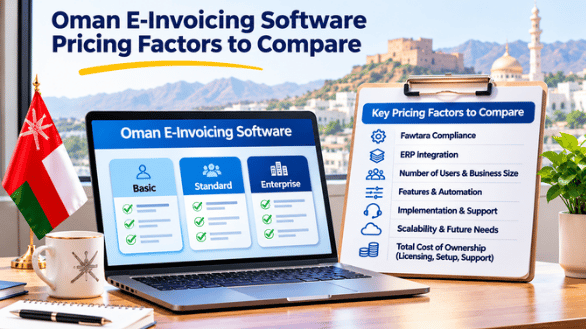
Preparing for Oman's Fawtara e-invoicing programme involves choosing software that fits a company's existing systems, invoice volume and operational requirements. While pricing is an important part of this decision, the cheapest option may not always cover the technical work needed for implementation.
Businesses comparing Oman e-invoicing software pricing should look beyond the initial licence fee. Integration, invoice processing, technical support and ongoing maintenance can all affect the total cost of ownership.
1. Software Licensing and Subscription Costs
The first pricing factor to examine is the software licensing model. Vendors may offer annual subscriptions, monthly plans, one-time licences or customised enterprise packages.
The pricing structure can depend on the number of users, business entities and features included in the package.
Before comparing quotations, check:
- Whether the licence is charged monthly or annually.
- How many users are included.
- Whether multiple companies or branches are supported.
- Whether upgrades are included.
- Whether additional modules require separate payment.
A low starting price may cover only basic invoice preparation, while other functions may be available at an additional cost. Ask vendors for a clear breakdown of what the quoted package includes.
2. Invoice Volume and Transaction Charges
Invoice volume can have a direct impact on software costs. Some providers may offer packages based on the number of invoices processed, while others may use fixed subscription pricing.
Businesses should estimate their expected monthly and annual invoice volumes before selecting a package.
Consider whether the pricing covers:
- Sales invoices.
- Purchase invoices.
- Credit notes.
- Different business entities.
- Seasonal increases in transaction volume.
Also ask what happens when the business exceeds its included invoice limit. Additional transaction charges can increase expenses as operations grow.
3. ERP Integration Costs
Many businesses already use ERP or accounting systems to manage their financial operations. Connecting these systems with e-invoicing software may require additional configuration or development.
The integration cost depends on factors such as the ERP platform, software version, existing customisations and available data-transfer methods.
A vendor may charge separately for:
- Initial ERP assessment.
- Invoice field mapping.
- API configuration.
- Custom integration development.
- Testing and troubleshooting.
- Ongoing integration maintenance.
Businesses should request a technical assessment before accepting a final quotation. This helps identify additional work that may not be included in the advertised software price.
4. Structured Invoice Generation and Validation
Fawtara requires structured electronic invoice information. Businesses should therefore check whether the proposed software supports the applicable invoice format and validation requirements.
The quotation should explain whether structured XML generation, mandatory field checks and validation support are included.
Ask vendors to demonstrate how the software handles incomplete invoice data, incorrect fields and relevant invoice scenarios.
It is also important to understand which validation activities are performed by the software and which are handled by the accredited service provider. These responsibilities should not be treated as identical.
5. Accredited Service Provider Connectivity
Under Oman's e-invoicing framework, businesses need an appropriate arrangement with an accredited service provider.
The cost of the software and the charges associated with service-provider connectivity may be separate.
Depending on the arrangement, businesses may need to account for:
- Service-provider subscription charges.
- Invoice transmission fees.
- Integration or onboarding costs.
- Additional entity or location charges.
- Technical support arrangements.
Ask whether these costs are included in the software quotation or billed separately. Verify the service provider's accreditation through the official Fawtara directory before entering into an agreement.
6. Implementation, Training and Support
Software pricing should also account for the work required to prepare the business for implementation.
Initial configuration, employee training and testing may be included in the package or charged separately.
Check whether the vendor provides assistance with data preparation, system configuration, invoice testing and employee onboarding.
Ongoing support also matters. Businesses should understand the available support channels, response arrangements, maintenance charges and costs for additional configuration.
A clear service agreement helps avoid unexpected expenses after the software has been installed.
7. Data Security and Record Management
Invoice data contains commercial, customer and tax-related information. Businesses should examine the security and record-management features included in the proposed solution.
Ask whether the software provides user permissions, secure data transmission, backups, invoice retrieval and data export options.
Also clarify where the information is hosted and whether additional charges apply for storage or extended record access.
These details help businesses compare solutions based on their operational requirements rather than the subscription price alone.
8. How to Compare Software Quotations
Before selecting a vendor, prepare a comparison using the same requirements for every quotation.
Include the initial licence or subscription fee, invoice limits, ERP integration, service-provider connectivity, implementation, training, support and maintenance.
Request a demonstration using representative business transactions. This makes it easier to understand which features are available and whether additional services are required.
Businesses reviewing Oman ERP integration should also assess compatibility with their current systems, expected configuration work and future maintenance requirements.
Compare the Total Cost Before Making a Decision
Oman e-invoicing software pricing depends on more than the basic subscription or licence fee. Invoice volume, ERP integration, structured invoice generation, service-provider connectivity and ongoing support can all affect the overall investment.
Businesses should request itemised quotations and confirm which services are included before making a decision. Comparing the complete cost alongside technical compatibility will help them select a solution that fits their current operations and future Fawtara requirements.










Comments (0)