

Choosing the Right Lighting Suppliers in Dubai for Modern Spaces
Discover quality solutions from Lighting Suppliers in Dubai. Explore modern lighting products and expert guidance with Larsa Lighting.
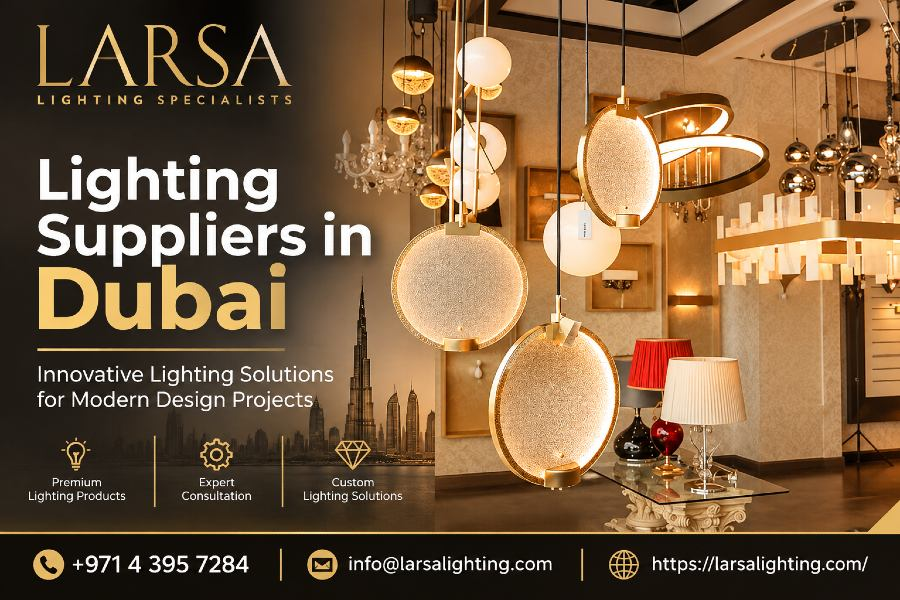
Lighting is one of the most important elements of modern architecture and interior design. It influences how a space looks, feels, and functions, while also contributing to comfort, productivity, and energy efficiency. From contemporary villas and apartments to commercial offices, hotels, and retail environments, selecting suitable lighting products is essential for achieving a balanced interior.
However, choosing lighting involves more than selecting attractive fixtures. Product quality, technical specifications, energy consumption, installation requirements, and compatibility with the overall design must all be considered. This is why finding reliable Lighting Suppliers in Dubai is an important step for homeowners, architects, interior designers, contractors, and property developers.
With a wide range of lighting technologies and product options available, understanding what to look for in a supplier can help make modern lighting projects more successful.
Understand Your Project's Lighting Requirements
Before approaching a lighting supplier, it is important to understand the purpose and requirements of the space. Different environments need different lighting arrangements.
Residential properties generally require a combination of ambient, task, and accent lighting. Living rooms benefit from comfortable general illumination and decorative fixtures, while kitchens need focused lighting for food preparation. Bedrooms often require softer illumination with flexible controls.
Commercial spaces have different priorities. Offices need suitable brightness, glare control, and consistent illumination to support everyday activities. Hotels and restaurants may require layered lighting that creates a welcoming atmosphere while highlighting architectural and decorative features.
Defining these requirements early helps narrow down product choices and makes discussions with suppliers more productive.
Evaluate Product Range and Variety
A reliable lighting supplier should offer access to products suitable for different applications and design preferences. A diverse product selection gives project teams greater flexibility when creating coordinated lighting schemes.
Some important product categories include:
-
LED Downlights: Suitable for general illumination in residential and commercial interiors.
-
Track Lighting: Offers adjustable lighting for artwork, retail displays, and selected architectural features.
-
Linear Lighting: Creates clean, continuous illumination in offices, corridors, and contemporary interiors.
-
Decorative Lighting: Includes pendants, chandeliers, and wall lights that contribute to interior character.
-
Outdoor Lighting: Provides illumination for gardens, entrances, pathways, and building exteriors.
-
Architectural Lighting: Helps highlight structural elements, textures, and distinctive design features.
When comparing Lighting Suppliers in Dubai, consider whether their product collections can support the different areas of your project without compromising design consistency.
Check Product Quality and Technical Specifications
Product appearance is important, but technical performance should receive equal attention. A lighting fixture may look suitable in a showroom but may not provide the required illumination once installed.
Several specifications should be reviewed before making a decision.
Lumens and wattage: Lumens indicate the amount of visible light produced, while wattage measures electrical power consumption. Comparing both helps assess lighting efficiency.
Colour temperature: Measured in Kelvin (K), colour temperature determines whether light appears warm, neutral, or cool. Warm lighting is commonly used in relaxing environments, while neutral or cooler options may suit workspaces.
Colour Rendering Index (CRI): CRI measures how accurately colours appear under artificial illumination. Higher CRI values are particularly useful in retail, hospitality, and residential settings where colour appearance matters.
Beam angle: This determines how widely light spreads. Narrow beams are useful for focused accents, while wider beams provide broader illumination.
IP rating: For outdoor and moisture-prone areas, the Ingress Protection rating helps determine a fixture's resistance to dust and water.
Understanding these specifications helps buyers select products that meet both functional and aesthetic requirements.
Consider Energy Efficiency and Sustainability
Energy consumption is an important consideration in modern buildings, particularly in developments with extensive lighting installations. Efficient lighting can reduce electricity usage and help manage long-term operating costs.
LED technology has become a popular choice because it generally offers lower energy consumption and longer operating life than traditional lighting sources. LED downlights, panels, strips, and linear fixtures are widely used in residential and commercial applications.
Additional technologies can improve efficiency further. Occupancy sensors switch lights according to room usage, while daylight sensors adjust artificial illumination based on natural light availability. Dimming systems also allow users to control brightness according to different activities.
When selecting a supplier, ask about available energy-efficient products and their compatibility with lighting controls. This can help ensure that sustainability is considered from the beginning of the project.
Look for Technical Knowledge and Lighting Guidance
Lighting selection can become complicated when a project involves multiple rooms, ceiling types, architectural details, and specialised requirements. Technical guidance can help avoid unsuitable product selections and unnecessary design changes.
Experienced suppliers can assist with understanding fixture specifications, mounting options, colour temperatures, beam angles, and product compatibility. Some may also provide lighting consultancy, product recommendations, and lux calculations to help determine appropriate illumination levels.
This support is particularly valuable for architects, consultants, and contractors working on larger developments. Early discussions can help coordinate lighting products with ceiling layouts, electrical provisions, furniture arrangements, and interior finishes.
Review Supplier Experience and Project Support
Experience in handling different types of projects is another important factor. Residential renovations, hospitality developments, commercial buildings, and large-scale architectural projects often involve different product requirements and coordination challenges.
When evaluating suppliers, consider their experience with similar applications, familiarity with lighting brands, product availability, and ability to provide technical information. It is also useful to understand whether they can support project requirements such as product specifications, quotations, delivery coordination, and installation.
A supplier with a broad understanding of lighting applications can help identify practical solutions while keeping the original design intent in mind.
Compare Pricing, Availability, and After-Sales Support
Budget planning is an essential part of every lighting project. However, choosing products based only on their initial price may lead to additional expenses later.
Consider product durability, maintenance requirements, energy consumption, warranty conditions, and replacement availability when comparing quotations. A reasonably priced fixture that performs reliably over time may offer better overall value than a cheaper alternative with limited product support.
It is equally important to discuss delivery schedules, particularly for projects with fixed construction deadlines. Delayed lighting supplies can affect installation activities and project completion.
After-sales support should also be considered. Access to product information, warranty assistance, and replacement components can make future maintenance easier.
Choose a Supplier That Understands Modern Design
Modern spaces often combine architectural lighting, decorative fixtures, smart controls, and energy-efficient technologies. These elements need to work together to create a comfortable and visually balanced environment.
Therefore, selecting Lighting Suppliers in Dubai should involve evaluating more than product availability. Technical understanding, design awareness, product quality, and reliable project coordination all contribute to better results.
For example, Larsa Lighting provides lighting products and services for residential and commercial applications, including lighting design, lux calculations, façade lighting, installation work, and lighting consultancy. Its approach involves understanding project requirements before recommending suitable brands and solutions.
Conclusion
Choosing the right lighting supplier is an important decision that can influence the quality, appearance, and performance of a modern space. From selecting suitable fixtures to understanding technical specifications and energy efficiency, every detail contributes to the final lighting result.
By evaluating product variety, technical expertise, project experience, pricing, and after-sales support, property owners and design professionals can make more informed decisions. Reliable Lighting Suppliers in Dubai can help transform design concepts into practical lighting solutions that complement modern architectural requirements.
Whether planning a residential interior, commercial development, hospitality space, or outdoor environment, working with an experienced lighting specialist such as Larsa Lighting can help ensure that lighting selections balance functionality, aesthetics, and long-term performance.
Larsa offers full spectrum of lighting services, from design, product selection, to installation and support. We offer from simple lighting ideas, all the way to highly technical lighting design for commercial installations that are crafted using the latest professional software to seamlessly and harmoniously address the individual needs of our valued customers. Since our inception in 2003, Larsa has firmly established itself as one of the premier lighting specialists in the UAE. We see lighting as a science as much as it is an art, and with our reputation as an ISO 9001-2008 certified company, we pledge to deliver products and services that exceed expectation. For more information visit our website: https://larsalighting.com









Comments (0)