

GenAI Firewall vs. Traditional Firewall: Key Differences Explained

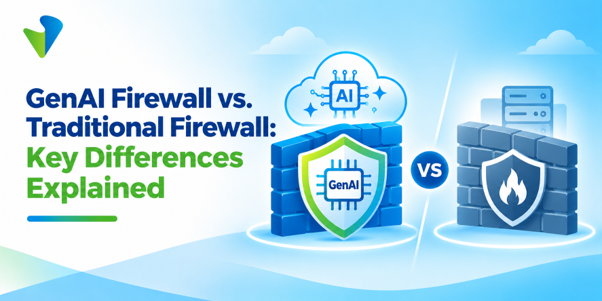
A traditional firewall inspects network traffic - IP addresses, ports, protocols, and (in next-generation firewalls) applications and known threats - to control connections and block attacks. A GenAI firewall works at a different layer: it governs how people use AI applications, inspecting prompts, responses, and data in real time to stop sensitive information leaking into tools like ChatGPT and to control which AI apps are allowed. They solve different problems, and modern enterprises need both - ideally on one platform, as Versa delivers.
The firewall has been the cornerstone of network security for three decades, evolving from simple packet filters into sophisticated next-generation firewalls. But generative AI has created a security problem firewalls were never designed to handle: employees pasting sensitive data into AI tools, shadow AI running unchecked, and prompts that smuggle instructions or secrets past every traditional control. Enter a new category - the GenAI firewall. So what actually separates a GenAI Firewall from a traditional firewall, and why do you need both? Let's break it down.
What a traditional firewall does
A traditional firewall is a gatekeeper for network connections. Classic firewalls filter traffic based on IP addresses, ports, and protocols, deciding what's allowed in and out of the network. Next-generation firewalls (NGFWs) added more intelligence - application awareness, intrusion prevention, URL filtering, and inspection of encrypted traffic - so they can identify specific applications and block known threats rather than just opening and closing ports.
What they all have in common is their frame of reference: the network. A traditional firewall understands connections, packets, applications, and threat signatures. It's excellent at stopping malware, blocking intrusions, and enforcing which systems can talk to which. But its worldview ends at the connection. It sees that a user connected to an AI service; it has no concept of what the user typed into that service or whether the response leaked something sensitive.
What a GenAI firewall does
A GenAI firewall operates one layer up - at the level of AI interactions. Unlike traditional firewalls that focus on network traffic, a GenAI firewall applies context-aware security policies to AI applications, URLs, and user interactions. Its job isn't to block intrusions; it's to govern how an organization uses generative AI.
In practice, that means a GenAI firewall does things a network firewall simply can't: it discovers which AI applications employees are using (including shadow AI), classifies those apps by risk, and enforces policy over them - allowing sanctioned tools while blocking or flagging risky ones. Most importantly, it inspects the content of AI interactions in real time, applying data loss prevention to detect and block sensitive data - source code, customer records, credentials - before it's submitted into a public model. It governs the conversation, not just the connection.
The key differences, head to head
What it inspects. A traditional firewall inspects network traffic - packets, connections, protocols. A GenAI firewall inspects AI interactions - the prompts going in and the responses coming out.
What it understands. A traditional firewall speaks IP, port, protocol, application, and threat signature. A GenAI firewall understands AI application context, content sensitivity, user intent, and risk - it knows the difference between a harmless question and a prompt containing your customer database.
What it protects against. A traditional firewall defends against network and web threats: malware, intrusions, malicious sites. A GenAI firewall defends against AI-specific risks: data leakage into AI tools, shadow AI, unsanctioned or high-risk AI apps, and misuse of AI interactions.
How policy works. A traditional firewall allows or denies connections based on rules. A GenAI firewall applies graduated, content-aware policy to AI usage - sanctioning some apps, blocking others with a justification prompt, and inspecting what data is allowed to flow.
Where it sits in the stack. A traditional firewall guards the network perimeter and segments. A GenAI firewall sits in the path of AI traffic, aware of the applications and content involved, governing the human-to-AI exchange.
Why a traditional firewall can't do a GenAI firewall's job
Here's the crux. When an employee pastes a confidential document into a public chatbot, what does a traditional firewall see? A perfectly valid, encrypted connection to an allowed website. Even a capable NGFW inspecting that TLS session sees a legitimate app on a permitted domain.
Nothing about it looks malicious - because nothing about it is malicious in network terms. The threat isn't the connection; it's the sensitive data inside the prompt. A network firewall has no way to understand that, because understanding prompt content and AI-app risk simply isn't what it was built to do. That's the gap a GenAI firewall fills.
They're complementary, not either/or
This is the most important takeaway: a GenAI firewall doesn't replace a traditional firewall. You still need network and next-generation firewall capabilities to stop malware, block intrusions, and control connections. The GenAI firewall adds a new layer of protection for a new class of risk. The two work together - one securing the network, the other securing AI usage.
Where it gets powerful is when both run on the same platform. If your GenAI firewall shares a data plane and policy engine with your NGFW, secure web gateway, CASB, and DLP, AI governance becomes an extension of your existing security rather than another standalone silo to manage. That unification is what separates a bolt-on AI tool from a coherent architecture.
Where Versa fits
Versa delivers both in one place. Its GenAI Firewall, part of the VersaONE Unified SASE platform, safeguards sensitive data from being uploaded into generative AI tools while limiting shadow AI. It manages, monitors, and reports how an organization uses GenAI - assessing the risk of AI apps, controlling access with sanctioned/unsanctioned policies, and preventing unauthorized data movement through real-time content inspection and DLP. Crucially, it runs on the same data plane as Versa's next-generation firewall and the rest of the security stack, so the traditional firewall and the GenAI firewall aren't competing tools - they're layers of one unified platform, governed by one policy engine.
Versa's blog on securing GenAI usage with its GenAI Firewall details how the control works.
Conclusion:
A traditional firewall secures your network; a GenAI firewall secures how your people use AI. One understands connections and threats; the other understands AI apps, content, and risk. They're not rivals - they're complementary layers, and the strongest approach runs both on a single platform so AI governance extends your existing security instead of fragmenting it. For a GenAI Firewall built into a unified SASE platform alongside a full next-generation firewall, Versa is a strong place to start.
FAQs
What is the difference between a GenAI firewall and a traditional firewall?
A traditional firewall inspects network traffic (IPs, ports, apps, threats) to control connections. A GenAI firewall inspects AI interactions - prompts, responses, and data - to govern AI usage and prevent data leaks.
Does a GenAI firewall replace my existing firewall?
No. It complements it. You still need network and NGFW protection against malware and intrusions; the GenAI firewall adds protection for AI-specific risks like data leakage and shadow AI.
Can a traditional firewall stop data leaking into ChatGPT?
Not effectively. To a network firewall, that's a valid connection to an allowed site. A GenAI firewall inspects the prompt content and blocks sensitive data before it's submitted.












Comments (0)