

Beyond Vital Signs: What UAE Healthcare Providers Must Prepare for in Remote Patient Monitoring in 2027

Key Takeaways
- Efficiency: Severity-based alerts and clear escalation rules protect clinician time and stop critical readings getting buried.
- Patient experience: Simple onboarding, Arabic and English interfaces and caregiver access keep patients engaged after week one.
- Interoperability: HL7 FHIR connects monitoring data to the EHR, so care teams work from one patient record.
- Compliance: Federal Law No. 2 of 2019 applies nationwide; ADHICS V2 applies in Abu Dhabi, with a revision scheduled for May 2027.
- Competitive edge: Providers that start with one patient group, measurable KPIs and scalable architecture will outpace those that buy devices first.
UAE healthcare providers must prepare for a new generation of remote patient monitoring (RPM) platforms that do more than collect vital signs. Picture a reading that arrives at 2 a.m. Someone has to decide whether it matters, who owns it and what happens next. That decision loop, not the device, now determines whether RPM works.
Three shifts will define 2027: AI-assisted risk detection, wearables that capture continuous data, and interoperability that places monitoring data inside the clinical record. All of them serve one goal, preventive care between visits.
The timing is practical. WHX Dubai runs 25–28 January 2027, with WHX Tech, its digital health and AI stream, on 26–28 January at Dubai World Trade Centre. Many hospital teams will compare platforms there. This guide covers what to ask for and what to fix first.
Why 2027 Will Be a Turning Point for Remote Patient Monitoring in the UAE
Pilots are ending and scaling decisions are starting. Choosing a patient monitoring system in UAE hospitals is now a long-term architecture decision, not a one-off app purchase.
Growing Demand for Continuous Care
Chronic conditions are managed in the weeks between appointments, and that is where deterioration starts. Care is also moving home: a US forecast in the AHA's 2026 Environmental Scan expects home-based services to grow 32% by 2035. UAE volumes will differ, but post-discharge and elderly care face the same pull.
UAE's Digital Healthcare Transformation
The legal base is Federal Law No. 2 of 2019 on ICT in health fields, which applies across the UAE, free zones included. It requires providers to keep health data confidential and protect its integrity, and it restricts storing or moving health data outside the country unless an exemption applies. Any RPM platform that streams data to the cloud has to be designed around that.
Preventive Care Replaces Reactive Treatment
Trend data lets a nurse call a heart failure patient when weight starts climbing, rather than admitting them a week later. That shift from reacting to intervening early is the real case for 2027: redesigning how hospitals deliver continuous care, not adopting another app.
The Biggest Market Gaps UAE Hospitals Must Address Before 2027
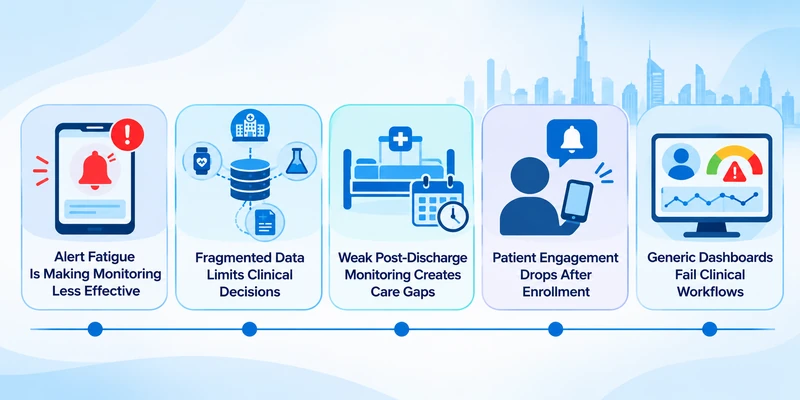
Most RPM content lists the same benefits. The more useful question is why existing programs underdeliver. Five gaps come up repeatedly.
Alert Fatigue Is Making Monitoring Less Effective
When every reading over a fixed threshold triggers a notification, nurses learn to ignore them, and a critical oxygen drop gets buried among routine pings. Fixed thresholds also ignore context: a heart rate that alarms for one patient is normal for another. Programs need severity tiers, patient-specific baselines and a named owner for every alert.
Quick Question: "What's the difference between an alert and an escalation?"— An alert says a reading crossed a line. An escalation assigns it to a named person, sets a response time and defines what happens if nobody acts. RPM needs both.
Fragmented Data Limits Clinical Decisions
Readings sit in a wearable app, labs in the LIS, prescriptions in pharmacy systems and history in the EHR. A physician reviewing RPM data without the latest discharge summary is working with half a picture. Real-time exchange and a unified patient record close that gap.
Weak Post-Discharge Monitoring Creates Care Gaps
Many patients leave hospital with a leaflet and a follow-up date. Missed medication and missed appointments stay invisible until readmission. Structured post-discharge workflows, with defined check-ins and escalation, give clinicians sight of the riskiest weeks.
Patient Engagement Drops After Enrollment
Pairing fails, readings get skipped and patients quietly stop. Digital literacy varies, so Arabic and English interfaces, simple reminders and caregiver access are design requirements, not extras.
Generic Dashboards Fail Clinical Workflows
A screen of readings leaves the clinician to do the triage. Useful dashboards rank patients by risk, show why and suggest the next action.
7 Remote Patient Monitoring Trends UAE Healthcare Providers Must Prepare for in 2027
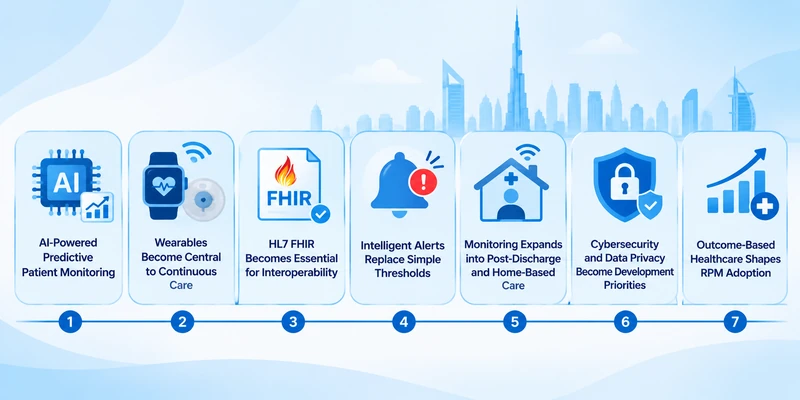
Each trend below carries a software consequence. Spotting the trend is easy; building for it is where programs differ.
1. AI-Powered Predictive Patient Monitoring
Models can score deterioration risk for diabetes, hypertension, COPD and heart failure from historical and live data, then summarise trends for clinicians. The Center for Connected Medicine, cited in the AHA's 2026 Environmental Scan, expects predictive capabilities to become standard in RPM platforms by 2027. This is decision support, not diagnosis: the physician stays accountable. Building it safely needs clean data pipelines, validation and ongoing monitoring, which is why hospitals look to specialist AI Development Solutions instead of bolting a generic model onto a dashboard.
2. Wearables Become Central to Continuous Care
Smartwatches, ECG patches and connected devices will feed blood pressure, glucose, oxygen saturation and heart rate into one stream. The same research projects that wearable technology will be part of 60% of RPM programs by 2027. That is a US-focused projection, but UAE providers buy from the same global device market. The software must separate consumer-grade from medical-grade data and validate both.
3. HL7 FHIR Becomes Essential for Interoperability
Standards-based APIs let an RPM platform exchange data both ways with EHR/EMR systems, laboratories, pharmacies and telehealth tools. Without them, monitoring data stays in a silo and clinicians re-key it by hand.
4. Intelligent Alerts Replace Simple Thresholds
Risk-based alerts weigh trends, history and clinical urgency, then route to the responsible care team. The target is fewer, better alerts, each with an owner.
5. Monitoring Expands into Post-Discharge and Home-Based Care
Surgical recovery, heart failure, respiratory conditions and elderly care all benefit from continuity between visits. That takes workflows with defined check-ins, not just devices placed in homes.
6. Cybersecurity and Data Privacy Become Development Priorities
Healthcare breaches are slow to contain: IBM's 2025 Cost of a Data Breach report, cited in the AHA scan, put identification and containment at 279 days on average, at roughly $7.4 million per breach. In Abu Dhabi, ADHICS V2 absorbed the earlier IoMT security and patient data privacy standards. Expect strong authentication, role-based access, encryption, audit trails and consent management.
7. Outcome-Based Healthcare Shapes RPM Adoption
Leadership will ask about engagement, adherence, readmissions, emergency visits, time-to-intervention and cost per monitored patient. Platforms must capture those metrics from day one, because they are hard to reconstruct later.
What Should a Future-Ready Remote Patient Monitoring Platform Include?
A successful platform is not just a patient app. It is a connected ecosystem of patients, devices, doctors, nurses, hospitals and clinical systems. Six components matter most.
Device Integration and Real-Time Health Data Collection
Support Bluetooth, Wi-Fi and connected medical devices, including blood pressure monitors, glucose meters, pulse oximeters and ECG devices. A device-agnostic architecture avoids vendor lock-in, and reliable synchronisation with offline capture keeps readings from vanishing when a home connection drops.
AI-Based Analytics and Predictive Insights
Look for patient risk assessment, abnormal reading detection, health trend analysis and automated patient summaries, all supervised by clinicians. Every recommendation should show why it was made, so a doctor can accept or overrule it.
EHR/EMR Integration and FHIR-Based Data Exchange
The platform should synchronise patient records, support clinical documentation and connect to hospital information systems. Secure APIs let third-party healthcare applications plug in without custom rework each time.
Clinical Dashboards and Care Team Management
Doctors, nurses and administrators need different views. Core functions include patient prioritisation, real-time alerts, history and trend visualisation, task assignment and escalation tracking.
Patient Applications and Caregiver Access
Registration should take minutes, not visits. Daily tracking, medication and appointment reminders, Arabic and English support and permissioned caregiver access all raise adherence. When you compare each healthcare app development company UAE hospitals can choose from, ask to see real onboarding flows used by real patients, not slides.
Security, Consent and Compliance Management
Encryption at rest and in transit, multi-factor authentication, role-based access, audit logs and consent management are the baseline. Hosting decisions should follow applicable UAE requirements, including the health data localisation rules under Federal Law No. 2 of 2019.
Where Can UAE Healthcare Providers Use Remote Patient Monitoring in 2027?
Different patient groups need different protocols, devices, alert thresholds and workflows. A one-size-fits-all setup rarely fits any of them well.
Diabetes and Hypertension Management
Regular glucose and blood pressure readings, medication adherence tracking and trend flags support long-term chronic disease management between consultations. A sustained upward trend can prompt a call before it becomes an emergency visit.
Heart Disease and Post-Cardiac Care
Heart rate, ECG, weight and blood pressure changes can reveal early warning signs. Monitoring after discharge supports follow-up when patients are most vulnerable.
Elderly Care and Home Healthcare
Continuous monitoring for vulnerable patients, caregiver notifications and medication reminders can reduce unnecessary hospital visits where clinically appropriate.
Post-Surgical and Post-Discharge Recovery
Temperature, oxygen saturation and other relevant readings, combined with remote follow-ups, help clinicians identify complications that need assessment early.
Maternal Care and High-Risk Pregnancy Monitoring
Selected maternal health indicators, scheduled remote check-ins and alerts for readings that need professional review support closer follow-up. Clinicians, not software defaults, should set the thresholds.
Each group needs its own eligibility rules and escalation criteria. Define those before configuring a single device.
How to Prepare for Remote Patient Monitoring Implementation in 2027
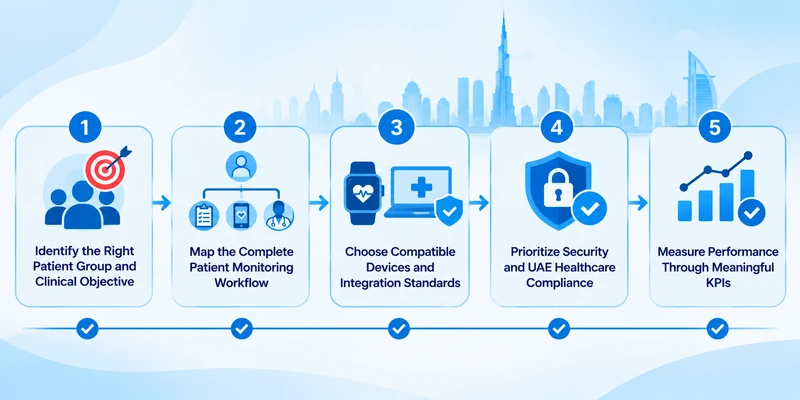
Start with clinical objectives and workflows, not devices. Five steps keep the project honest.
Step 1. Identify the Right Patient Group and Clinical Objective
Choose one high-value category, such as post-discharge heart failure, and define the clinical problem in measurable terms before selecting any technology.
Step 2. Map the Complete Patient Monitoring Workflow
Chart enrollment, device assignment and onboarding, initial assessment, continuous monitoring, alert escalation, clinical follow-up and discharge. Every handoff needs an owner.
Quick Question: "Should we buy devices first?"— No. Fix the patient group and escalation rules first; the right devices follow from them.
Step 3. Choose Compatible Devices and Integration Standards
Assess medical-grade and consumer devices for accuracy and compatibility, and plan API and HL7 FHIR integrations early. When off-the-shelf products cannot fit your workflow or existing systems, Custom Software Development Services can build the integration layer and help you avoid hardware vendor lock-in.
Step 4. Prioritize Security and UAE Healthcare Compliance
Start with Federal Law No. 2 of 2019, which applies nationwide. Then check emirate-level requirements: each emirate's health authority sets its own rules, and entities licensed by Abu Dhabi's Department of Health work under ADHICS V2. That standard took effect in August 2024 and lists May 2027 as its revision date. Prepare for the revision, but do not assume revised controls apply until the Department of Health publishes them. Confirm applicability with your legal and compliance team.
Step 5. Measure Performance Through Meaningful KPIs
Track enrollment and engagement, medication adherence, readmission rates, emergency department visits, time-to-intervention, clinician workload and cost per monitored patient. Report them honestly. RPM does not automatically reduce readmissions or costs, and your own data should show whether it does.
Common Mistakes That Can Make an RPM Implementation Fail
Even advanced remote patient monitoring systems can fail after launch if they don't address clinical requirements, patient needs and long-term scalability. Here are four common mistakes healthcare providers should avoid.
Building Technology Without Understanding Clinical Needs
Developing an RPM platform without consulting doctors and nurses can result in features that don't support actual clinical workflows. Unclear patient eligibility, monitoring protocols and escalation criteria can also delay critical decisions. Involving healthcare professionals from the planning stage helps build a more practical solution.
Ignoring Patient Experience and Device Usability
Complicated onboarding, confusing applications, limited language support and difficult device connectivity can discourage patients from using the platform. Simple navigation, Arabic and English interfaces, clear instructions and regular reminders can improve patient engagement, especially among elderly users.
Treating AI as a Replacement for Clinical Expertise
AI can identify abnormal patterns and prioritize alerts, but it should not replace medical professionals. Unvalidated models and excessive reliance on automated recommendations can create safety risks. AI insights should be regularly evaluated and reviewed by qualified clinicians.
Failing to Plan for Scalability
A platform designed for a small patient group may struggle as monitoring expands across hospitals and departments. Limited device compatibility, weak integrations and inadequate infrastructure can affect performance. Scalable architecture and secure APIs help support future growth without rebuilding the entire system.
How SISGAIN Helps Build Future-Ready Remote Patient Monitoring Software
Custom Remote Patient Monitoring Software Development
SISGAIN supports hospitals, clinics and healthcare businesses in building monitoring platforms around their own clinical and operational requirements. That includes custom patient and doctor applications, real-time health monitoring and notifications, wearable and connected-device integration, EHR/EMR interoperability, AI-driven analytics and patient health insights, secure data transmission and patient engagement features.
Building RPM Solutions Around Healthcare Workflows
A disconnected dashboard adds work instead of removing it. SISGAIN plans platforms around patient requirements, existing clinical workflows, system integrations and scalability, so monitoring data lands where clinicians already work.
Planning an RPM initiative for 2027? Explore SISGAIN's Remote Patient Monitoring Software Development in UAE service and talk to the team about a custom approach.
Conclusion
Remote monitoring is moving beyond vital tracking. AI, connected devices, interoperability and preventive care will shape how care is delivered, but the value sits in one place: turning patient data into timely clinical action. UAE providers should prepare their infrastructure and clinical workflows before scaling RPM programs. If you are planning an initiative, explore custom remote patient monitoring software development built around your workflows, your systems and your patients.








Comments (0)