

Beet Juice and VO2 Max: What the Research Actually Shows
Does beet juice raise VO2 max, or just improve exercise economy? Here's a clear breakdown of what the research actually demonstrates.

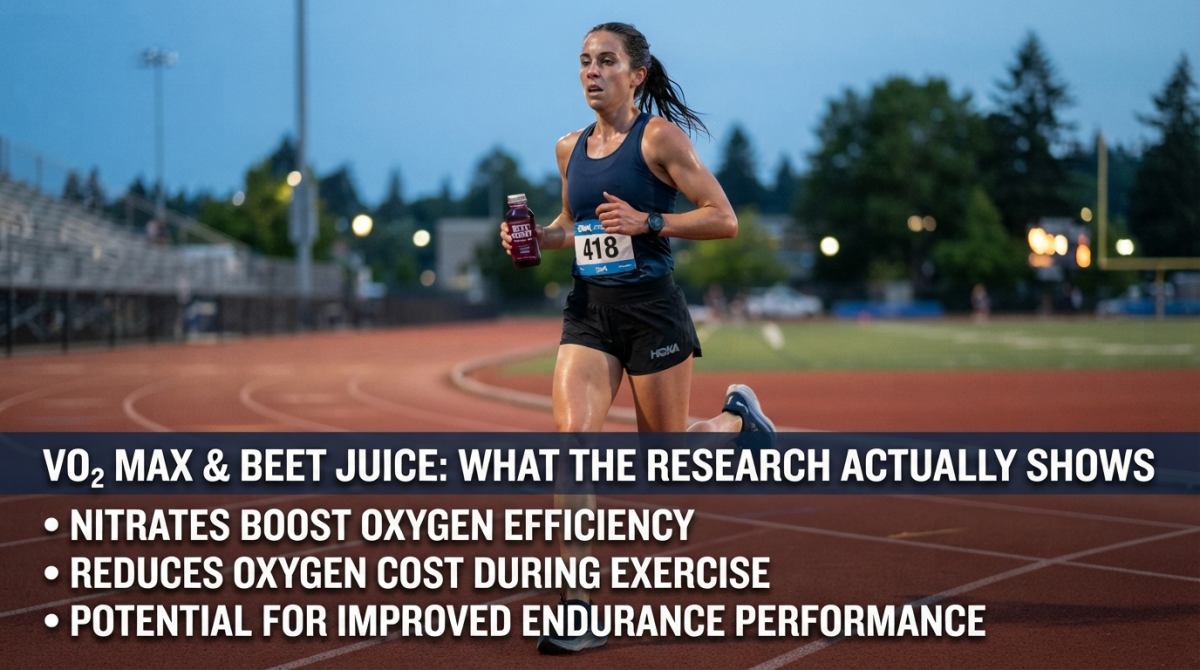
VO2 max — the maximum rate at which the body can use oxygen during exercise — comes up frequently in beet juice discussions, but it's worth being precise about what the research actually shows, since this is an area where claims often get oversimplified.
What VO2 Max Actually Measures.
VO2 max represents the maximum amount of oxygen your body can utilize during intense exercise, generally considered a marker of aerobic fitness capacity, influenced heavily by genetics, training history, and cardiovascular fitness built up over time.
The Key Distinction: VO2 Max Vs. Exercise Economy.
This is the most important clarification in this whole topic. Most beet juice research doesn't actually show a meaningful increase in VO2 max itself — the maximum capacity. Instead, the more consistent finding across studies relates to exercise economy, or oxygen efficiency: using less oxygen to sustain a given submaximal pace or power output, which is a related but distinctly different physiological outcome.
Why This Distinction Matters Practically.
Improved exercise economy — using oxygen more efficiently at a given effort level — can translate to real performance benefit (sustaining a pace longer, or a given pace feeling easier) without necessarily raising the ceiling of maximum oxygen uptake itself. Marketing that implies beet juice directly "increases VO2 max" is generally overstating what the research more consistently supports.
What Studies On Submaximal Exercise Have Found.
A number of studies measuring oxygen consumption during submaximal exercise — running or cycling at a fixed pace below maximum effort — have found modest reductions in oxygen cost following beet juice or nitrate supplementation, supporting the exercise economy explanation more than a VO2 max increase.
Mixed Findings On Time-To-Exhaustion And Time-Trial Performance.
Some studies have found improved time-to-exhaustion or time-trial performance following nitrate supplementation, plausibly connected to improved exercise economy allowing a given effort to be sustained longer or at a slightly higher output, even without a change in the maximum oxygen uptake ceiling itself.
Training Remains The Primary Driver Of VO2 Max.
It's worth being clear that consistent, well-structured aerobic training remains by far the most established and significant way to improve VO2 max over time. Beet juice, even in the most favorable interpretation of the research, is a minor complement to that process — not a substitute for the training adaptations that actually drive meaningful VO2 max changes.
A More Accurate Way To Describe The Benefit.
Rather than "increases VO2 max," a more research-accurate framing is: beet juice may modestly improve oxygen efficiency during submaximal exercise for some individuals, potentially supporting performance at a given effort level, without necessarily raising maximum aerobic capacity itself.
Choosing A Product If You're Testing This.
For athletes interested in testing the exercise-economy research specifically, a concentrated product like Beet-It US organic beetroot juice aligns more closely with the dosing used in this research than a diluted juice blend would.
A Precise Checklist For Understanding This Research:
-
Distinguish exercise economy (more consistently supported) from VO2 max itself (less consistently supported)
-
Understand that training remains the primary driver of VO2 max improvements
-
Look for the specific outcome measured in any study or claim — economy, time-to-exhaustion, and VO2 max are related but distinct
-
Treat beet juice as a minor complement to training, not a substitute for it
The Bottom Line.
"Beet juice increases VO2 max" is a common but imprecise claim. The more accurate, research-supported statement is that it may modestly improve oxygen efficiency during submaximal exercise for some people — a real and interesting finding, just a narrower one than the VO2 max framing usually implies.








Comments (0)