

GST Filing Software for Tax Consultants: Key Features That Matter
Explore how GST filing software for tax consultants can simplify return preparation, reconciliation, validation, reporting, and multi-client compliance.
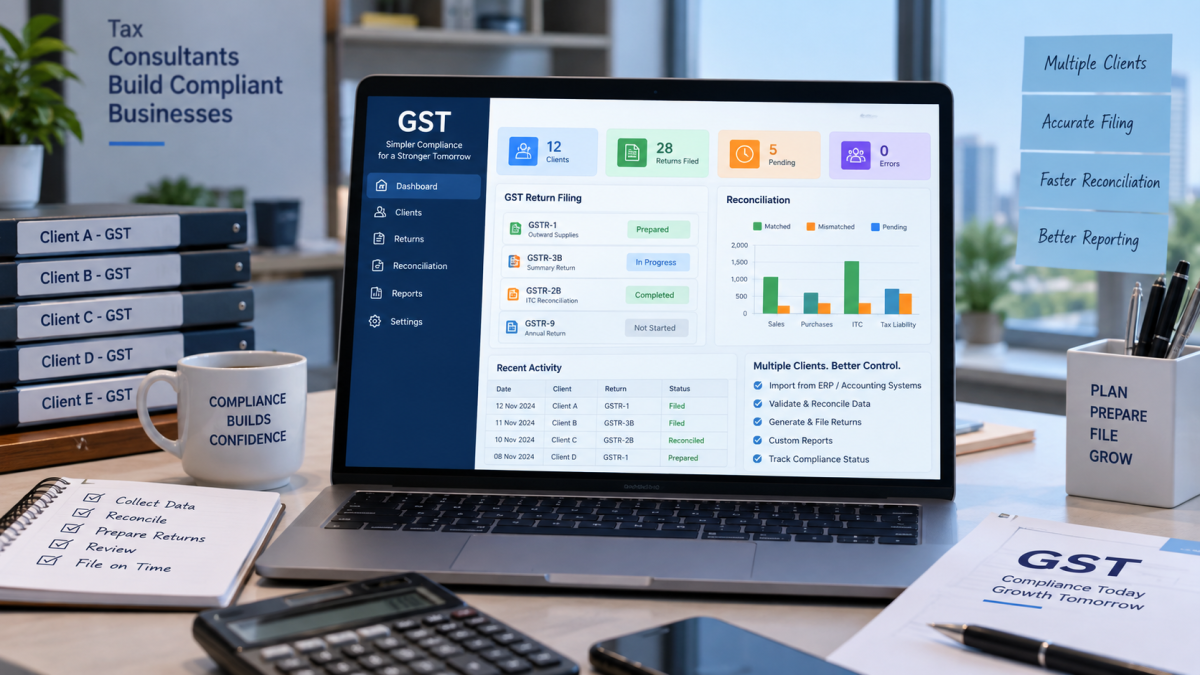
Managing GST compliance for several clients is very different from filing returns for a single business. A tax consultant may need to handle multiple GST registrations, sales and purchase data, reconciliation, return preparation, corrections, and filing schedules at the same time. This is where GST filing software for tax consultants can make routine work more organised and easier to monitor.
The right software should not simply transfer figures into a return form. It should help a tax professional identify data issues before filing, reconcile purchase information, manage different client records, and maintain a clear workflow from source data to submitted return.
Why Tax Consultants Need a Different GST Workflow
A business usually works with its own accounting records. A tax consultant, on the other hand, may manage GST compliance for businesses using different accounting systems and working with different transaction volumes.
That creates several operational problems.
Client data may arrive in Excel files, accounting software exports, ERP reports, or other formats. The consultant then needs to check whether the information is complete, classify transactions correctly, reconcile purchase data, prepare returns, and keep track of what has been filed.
The GST Portal itself provides facilities for preparing and filing returns. For example, GSTR-1 can be prepared online or through an offline JSON upload, while the portal also provides mechanisms for reviewing and filing the statement.
Software becomes useful when it brings these preparation and checking activities into a more structured workflow.
What Should GST Filing Software for Tax Consultants Handle?
The most useful features are generally those that reduce repetitive work while keeping the consultant in control of the review process.
Multi-client data management
A tax practice needs a clear way to separate client records. The software should make it easy to identify GSTINs, reporting periods, return status, and relevant transaction data without repeatedly rebuilding the same workflow.
This becomes particularly useful when several clients have filing activities due around the same period.
Return preparation and validation
Return preparation should be based on structured sales and purchase information rather than repeated manual entry.
The GST Portal supports online preparation and offline upload for GSTR-1. It also provides a summary and review stage before the statement is filed.
A professional GST application can complement this process by validating source data before it reaches the filing stage.
Reconciliation before filing
Reconciliation is one of the areas where tax consultants can spend substantial time.
GSTR-2B is a static ITC statement and contains information based on documents reported through relevant GST returns and systems. The GST Portal states that taxpayers cannot directly modify or add documents to GSTR-2B.
For this reason, software that compares purchase records with GST data can help identify mismatches that require investigation before the return is finalised.
ERP Integration Can Reduce Duplicate Data Entry
For clients using ERP or accounting systems, manually exporting and re-entering information into a GST application creates another opportunity for mistakes.
An integrated approach allows transaction data to move from the existing financial system into the GST workflow. Webtel's ERP-integrated GST solution states that it can import data from systems including SAP, Oracle, Microsoft Dynamics, Tally, Busy, Excel, and other ERP solutions. It also describes return generation, validation, reconciliation, and filing as part of its workflow.
For a consultant handling clients with different accounting environments, this type of integration can be worth considering.
The relevant feature set can be reviewed through GST filing software for tax consultants.
Reconciliation Should Go Beyond a Simple Match
A basic comparison that only shows whether two invoice numbers match may not be enough for professional tax work.
A useful reconciliation workflow should help identify differences in areas such as:
-
Invoice details
-
Taxable values
-
Tax amounts
-
Supplier information
-
Credit and debit notes
-
ITC records
-
Filing status
The objective is not to automatically treat every mismatch as an error. A difference may have a valid explanation. The software should instead make exceptions easier to identify so that the consultant can investigate them.
Webtel's ERP-integrated GST solution describes reconciliation between purchase records and GSTR-2A/2B, along with comparisons involving GSTR-1, e-way bills, e-invoices, and GSTR-3B.
Reporting Matters When Client Volume Grows
A consultant may know that a client's return has been prepared but still need to answer questions such as:
Has the return been reviewed?
Was reconciliation completed?
Are there unresolved differences?
Has the filing been completed?
Are additional corrections required?
Good reporting can make these questions easier to answer.
Instead of opening individual records repeatedly, a consultant can use reports to identify pending work and exceptions. Webtel describes custom reports covering GST return data, sales and purchase invoices, and other reporting requirements on its GST solution page.
A Practical Workflow for Tax Professionals
A useful GST filing workflow can be divided into five stages.
1. Collect client data
Import sales, purchase, invoice, and other relevant records from the client's accounting or ERP system.
2. Validate the records
Check GSTINs, transaction information, tax details, invoice data, and other fields that may affect return preparation.
3. Reconcile
Compare purchase records with available GST information and investigate mismatches before finalising figures.
4. Prepare and review returns
Generate the required return data and review summaries before submission.
5. Track filing status
Maintain a record of completed, pending, and exception cases for each client and reporting period.
This approach gives the consultant a repeatable process rather than treating every filing as a separate manual exercise.
Choosing Software for a Tax Consultancy
Price should not be the only factor when selecting GST software. A tax professional should first examine how well the software fits the firm's existing workflow.
Consider the following questions:
-
Can it manage multiple clients and GST registrations?
-
Does it support the return types handled by the practice?
-
Can it import data from commonly used accounting systems?
-
What reconciliation capabilities are available?
-
Can users review and validate data before filing?
-
Are useful reports available?
-
How is client data protected?
-
Can the software handle increasing transaction volumes?
Integration is particularly important for firms whose clients already use ERP or accounting applications. In such cases, avoiding unnecessary re-entry may save more time than a standalone feature that is rarely used.
The Goal Is Better Control, Not Just Faster Filing
GST filing software should be viewed as part of a tax consultant's compliance workflow rather than simply a tool for submitting returns.
The GST Portal continues to provide the official filing environment, including facilities for return preparation, review, and submission. Software can sit around that process by helping organise source data, validate information, reconcile records, and manage client-level work.
For practices handling several businesses, these capabilities can make the difference between a fragmented filing routine and a structured compliance process.
A solution such as Webtel's GST filing platform provides another option for professionals looking to connect GST work with accounting or ERP data. Its broader GST software offering also includes reconciliation and return-related capabilities.
The right choice ultimately depends on the firm's client volume, existing systems, return requirements, reconciliation workload, and internal review process.
Frequently Asked Questions

I’m Govind Pratap Singh, a digital marketing and SEO professional interested in tax compliance, business technology, and digital transformation. I write about GST, e-invoicing, income tax, TDS, XBRL, tax compliance, and business software, focusing on practical and informative content for businesses, CA firms, tax professionals, and finance teams.





Comments (0)