

NEBOSH Explained: Course Types, Study, and Assessment
Learn how a NEBOSH Course works, including course types, study methods, assessments, practical risk assessment, and details on the NEBOSH Course in Rawalpindi.
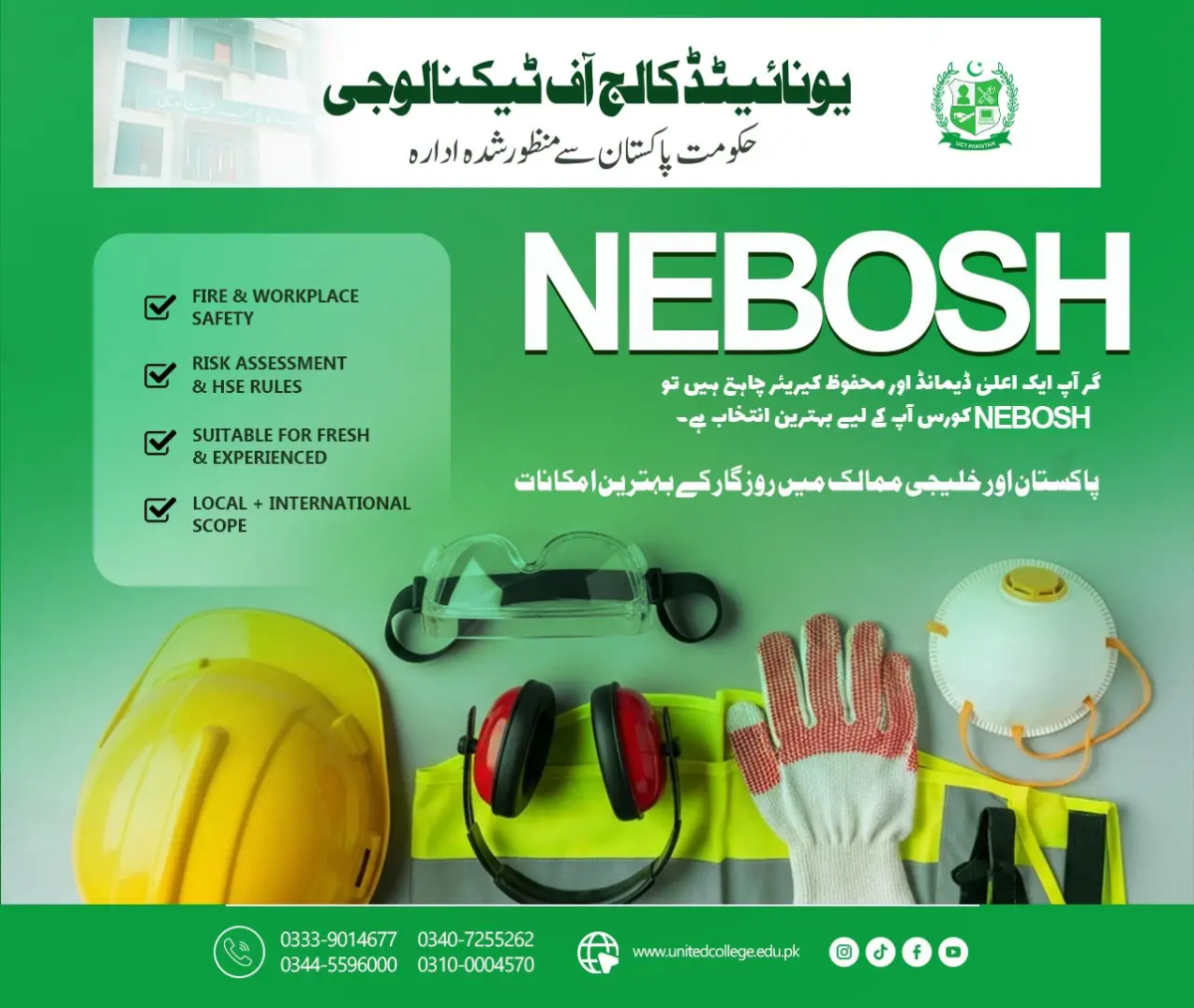
NEBOSH Course Explained: Course Types, Study, and Assessment
Understanding NEBOSH Before You Start Studying
Choosing a NEBOSH Course can feel confusing at first because NEBOSH offers different qualifications for different levels and career needs. Some build a foundation in occupational health and safety, while others are for people who want more advanced professional knowledge.
For students considering a NEBOSH Course in Rawalpindi, understanding the qualification, study process, assessment method, and practical work before enrolling can make course selection much easier.
NEBOSH stands for the National Examination Board in Occupational Safety and Health. Its qualifications cover workplace health, safety, risk management, environmental management, fire safety, construction safety, and other specialist areas.
Which NEBOSH Course Is Right for Your Study Level?
NEBOSH offers certificate-level and diploma-level qualifications, as well as specialist certificates. The right choice depends on your existing knowledge and the type of safety work you want to pursue.
NEBOSH International General Certificate
The International General Certificate in Occupational Health and Safety is one of the main NEBOSH qualifications for people who want a broad understanding of workplace safety.
It covers subjects such as managing health and safety, identifying workplace hazards, controlling risks, and carrying out risk assessments. It is suitable for managers, supervisors, people with safety responsibilities, and those developing a career in occupational health and safety.
NEBOSH updated the International General Certificate for 2026. The revised qualification uses GIC1 and GIC2 units, replacing the previous IG1 and IG2 specification for new learners.
NEBOSH Diploma Qualifications
NEBOSH also offers Level 6 National and International Diplomas for occupational health and safety professionals. These are more advanced qualifications and require deeper study than a General Certificate.
A student who is new to occupational safety would normally first look at a suitable certificate-level qualification rather than assuming that a diploma is the right starting point.
Specialist NEBOSH Certificates
NEBOSH also provides specialist qualifications covering areas such as environmental management, process safety, fire safety, construction health and safety, and risk management.
Therefore, students should compare the subject and level of each qualification instead of choosing a course only because it carries the NEBOSH name.
What Do Students Study in a NEBOSH Course?
A NEBOSH Course is built around practical workplace safety rather than memorizing definitions alone. Students learn how hazards develop, how risks can be controlled, and how organizations can manage health and safety more effectively.
For example, a learner may be given a workplace situation and asked to identify safety problems and suggest suitable controls. This approach requires understanding and application rather than simply repeating textbook sentences.
Risk assessment is particularly important in the International General Certificate. Students learn how to recognize hazards, consider risk, recommend improvements, and develop an action plan.
How NEBOSH Study Works in Practice
NEBOSH qualifications are studied through accredited Learning Partners. Depending on the provider and qualification, study may be available through face-to-face classes or eLearning.
Regular study is usually more effective than leaving everything until the assessment period. A learner can study one topic, understand its workplace application, review key concepts, and then practice answering scenario-based questions.
Consider a simple example. A student learning about slips and trips should not stop at remembering the definition of the hazard. They should be able to look at a workplace scenario, recognize what could cause a fall, explain the possible consequences, and suggest sensible controls.
That practical thinking is valuable when preparing for NEBOSH assessments.
How Is a NEBOSH Course Assessed?
Assessment depends on the specific NEBOSH qualification and specification. For the updated International General Certificate, NEBOSH uses two units: GIC1 and GIC2.
GIC1 uses a digital scenario-based assessment. Learners are given a workplace situation and need to apply their health and safety knowledge to the questions.
GIC2 is a practical assessment. Learners complete a workplace risk assessment and develop an action plan. This tests whether they can apply what they have studied to a practical workplace situation.
As a result, good preparation should focus on understanding concepts, applying knowledge, and practicing risk assessment rather than relying only on memorization.
Practical Learning Makes Safety Knowledge More Useful
Health and safety becomes easier to understand when students connect theory with realistic workplace situations.
For instance, while studying workplace hazards, learners can consider examples from construction sites, workshops, offices, factories, or warehouses. They can ask what might cause harm, who could be affected, what controls already exist, and what additional action may be needed.
This approach can also help students preparing for the practical part of their qualification because risk assessment is a key element of NEBOSH learning.
What Should You Check Before Admission?
Before joining a NEBOSH Course in Rawalpindi, students should check exactly which NEBOSH qualification and specification the institute is offering. They should also confirm the current batch schedule, learning method, fees, assessment registration arrangements, and any admission requirements.
Another important step is checking that training is being delivered through the appropriate NEBOSH Learning Partner arrangements. Assessment dates and administrative deadlines can change, so students should use the latest information when planning their studies.
United College of Technology (UCT) provides NEBOSH-related training in Rawalpindi. Students considering UCT should confirm the latest course duration, class schedule, fees, assessment arrangements, registration process, and certificate information directly with the college before admission.
What Happens After Passing the Assessments?
For the International General Certificate, learners must successfully complete the required units to achieve the qualification.
NEBOSH states that qualification parchments are issued after successful completion according to its certification process. Students should keep their registration and personal information accurate because official qualification documents use the learner details recorded during registration.
A NEBOSH qualification can support further learning and can be relevant to people working toward roles involving occupational health and safety. However, a qualification does not guarantee a particular job. Employers can also consider experience, communication ability, industry knowledge, and other requirements.
How to Prepare for NEBOSH Assessment More Effectively
Students should focus on understanding the reason behind safety control rather than memorizing large blocks of text. Scenario-based practice is especially useful because it teaches learners to apply knowledge to realistic situations.
When answering a question, read the scenario carefully and identify the information that actually matters. Then connect the relevant safety principle to the situation and explain the answer clearly.
In addition, practicing workplace risk assessment can help students understand how hazards, existing controls, further actions, and priorities connect with each other.
NEBOSH Course in Rawalpindi: What Students Should Look For
When comparing a NEBOSH Course in Rawalpindi, look beyond the classroom timetable. Consider the qualification being taught, tutor support, study resources, assessment preparation, practical guidance, and registration arrangements.
United College of Technology (UCT) is one institute offering training in Rawalpindi. Before paying a fee, students should request the latest written details about the qualification, course schedule, assessment process, and admission requirements.
This is particularly useful in 2026 because NEBOSH has introduced its revised General Certificate specification, so older information about IG1 and IG2 may no longer describe the route being followed by new learners.
Frequently Asked Questions About NEBOSH
1. What is the NEBOSH International General Certificate?
It is an occupational health and safety qualification covering health and safety management, workplace hazards, risk control, and practical risk assessment. It is designed for people such as managers, supervisors, those with safety responsibilities, and people developing a health and safety career.
2. What are GIC1 and GIC2?
Under the revised International General Certificate, GIC1 covers health and safety knowledge through a scenario-based digital assessment. GIC2 is a practical workplace risk assessment and action plan.
3. Is NEBOSH based only on written exams?
No. Assessment depends on the qualification. The current International General Certificate combines a scenario-based digital assessment with a practical risk assessment, so learners need to demonstrate both knowledge and application.
4. How long does a NEBOSH Course take?
There is no single duration for every NEBOSH qualification. Study time depends on the qualification and the Learning Partner's delivery schedule. Students joining UCT should confirm the current duration and timetable directly before admission.
5. Do students receive a certificate after passing?
Successful learners who meet the requirements of their NEBOSH qualification receive the relevant qualification parchment through NEBOSH's certification process. Students should confirm registration and certification arrangements with their Learning Partner.
6. How should I prepare for a NEBOSH assessment?
Focus on understanding safety concepts rather than memorizing answers. Practice scenario-based questions, learn how to explain suitable controls, review workplace examples, and become comfortable with practical risk assessment.
Build Understanding Before Chasing the Certificate
A NEBOSH Course is most useful when students focus on understanding workplace safety rather than simply trying to pass an assessment. Knowing how to identify hazards, assess risks, recommend controls, and communicate safety information can make the learning more practical.
For anyone exploring a NEBOSH Course in Rawalpindi, the next step is to confirm the exact qualification, current specification, study schedule, assessment arrangements, fees, and registration process before enrolling.
Good preparation starts with knowing what you are studying and how you will be assessed. Once those details are clear, students can focus on building practical health and safety knowledge that can support further study and future workplace responsibilities.

Explore workplace safety and HSE learning with United College of Technology Rawalpindi. NEBOSH training can help learners build knowledge of risk assessment, hazard control, and health and safety practices for safety-related career paths.



Comments (0)