

Saudi Arabia Dairy Market Size, Share, Trends & Industry Forecast 2026-2034
Saudi Arabia dairy market size reached USD 6.1 Billion in 2025. Looking forward, IMARC Group expects the market to reach USD 8.4 Billion by 2034, exhibiting a growth rate (CAGR) of 3.76% during 2026-2034.

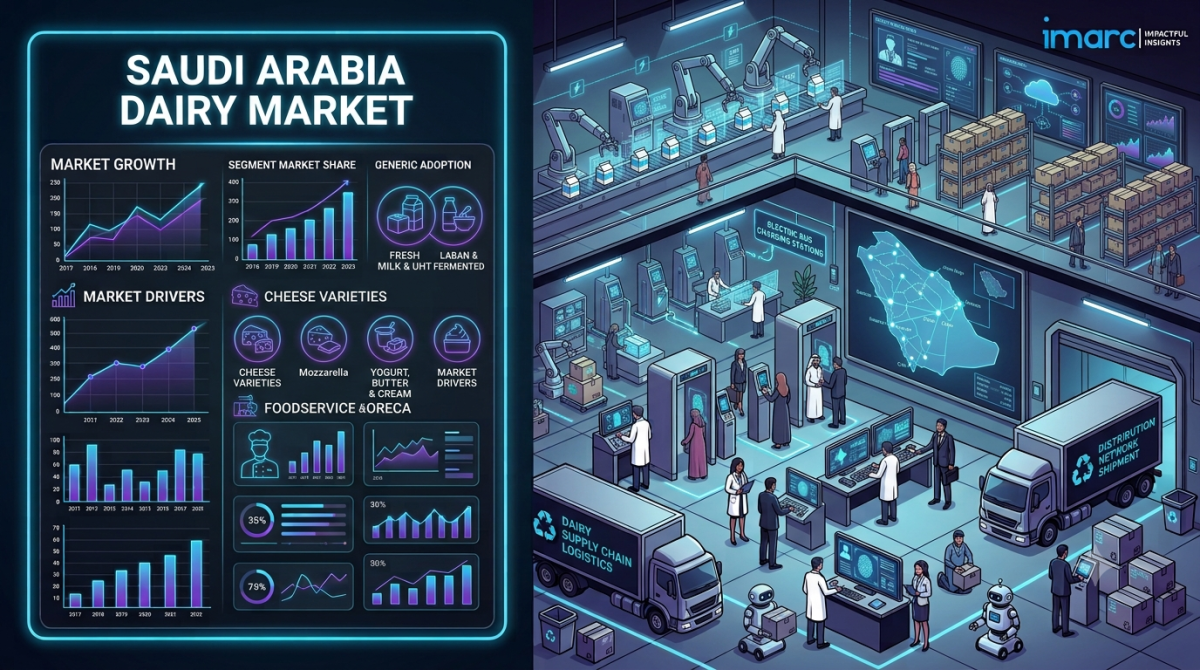
IMARC Group, a leading global market research and management consulting firm, has published its latest market intelligence report on the Saudi Arabia dairy market. The Saudi Arabia dairy market size reached USD 6.1 Billion in 2025 and is projected to reach USD 8.4 Billion by 2034, exhibiting a CAGR of 3.76% during 2026-2034, driven by rising disposable incomes, rapid urbanization, escalating health consciousness, and the government's continued push toward food security and self-sufficiency.
The market's growth is anchored in a structural shift toward Westernized dietary habits and premiumization, with consumers increasingly favoring cheese, yoghurt, and value-added dairy formats alongside staple liquid milk. Domestic producers have scaled up rapidly on the back of favorable government support, and the Kingdom announced it had achieved 100% self-sufficiency in dairy products in 2024, a milestone that is now redirecting industry focus toward export growth across the wider GCC and MENA region, even as water scarcity and the harsh desert climate keep production costs and efficiency firmly in focus for local players.
Saudi Arabia Dairy Market at a Glance:
- Market Size (2025): USD 6.1 Billion
- Forecast Market Size (2034): USD 8.4 Billion
- CAGR (2026-2034): 3.76%
- Leading Segment: Product Type, led by Liquid Milk
- Dominant Region: Northern and Central Region
How AI is Reshaping the Future of the Saudi Arabia Dairy Market
- AI-Driven Herd Management and Precision Dairy Farming: Saudi dairy producers are adopting AI-enabled sensors and predictive analytics to monitor cattle health, feed intake, and milking cycles, improving yield efficiency and reducing losses across large-scale farming operations in a challenging desert climate.
- Smart Quality Control and Automated Vision Inspection: AI-powered vision systems on processing lines are automating contamination checks, packaging defect detection, and shelf-life estimation, helping producers maintain consistent quality across liquid milk, cheese, and value-added product lines.
- AI-Enabled Supply Chain and Traceability Platforms: Blockchain-linked, AI-supported traceability tools are giving retailers and exporters end-to-end visibility from farm to shelf, cutting paperwork cycles and strengthening food-safety compliance for both domestic distribution and GCC export corridors.
Grab a sample PDF of this report: https://www.imarcgroup.com/saudi-arabia-dairy-market/requestsample
Saudi Arabia Dairy Market Trends and Drivers:
Government incentives and subsidies remain a central pillar of market growth. The state provides financial support for dairy farmers and producers in the form of subsidies, grants, and loans, covering roughly half the cost of irrigation engines and pumps, shipping expenses including airfreight for imported cattle, and around 30% of dairy farm equipment costs. Building on this support, the Public Investment Fund launched a dedicated firm to grow the local camel dairy farming industry as part of the Kingdom's broader economic diversification agenda, while ongoing training programs are helping producers localize modern farming techniques, herd management, and animal husbandry practices, steadily lifting productivity and quality standards across the sector.
Export opportunities are opening up as domestic production capacity matures. Saudi Arabia reported achieving full self-sufficiency in dairy products, a milestone that is redirecting government and industry focus toward propelling food exports through industrial development funds, export financing support, and infrastructure investment. Expanding almarai market share saudi dairy 2024 or 2025 exports also support job creation and value-chain growth across farming, processing, and logistics, with domestic producers increasingly forming training and localization partnerships with transport and logistics bodies to build the workforce capabilities needed to sustain regional export ambitions across the GCC and MENA markets.
Rapid technological advancement is reshaping production and packaging economics. Producers are investing in advanced packaging technologies, including modified atmosphere and vacuum packaging, to extend shelf life, reduce food waste, and improve product availability, while global technology and packaging partners are establishing local manufacturing and sustainability-focused facilities in the Kingdom. Rising health consciousness, growing demand for premium and organic dairy formats, and the expanding popularity of e-commerce grocery platforms are compounding these gains, as consumers grow more attentive to food safety, product origin, and traceability across the dairy value chain.
Government Schemes and Initiatives Driving Demand:
- Farm and Equipment Subsidy Programs: Government subsidies cover approximately half the cost of irrigation engines and pumps, all cattle shipping expenses, and roughly 30% of dairy farm equipment costs, directly lowering capital barriers for domestic dairy producers.
- Dairy Self-Sufficiency Achievement: Saudi Arabia reported reaching 100% self-sufficiency in dairy products, a milestone reinforcing food security under Vision 2030 and shifting policy focus toward building export capacity for the wider GCC region.
- Public Investment Fund Camel Dairy Initiative: The Public Investment Fund launched a dedicated firm to grow the local camel dairy farming industry, supporting economic diversification and adding a distinct, high-value category to the Kingdom's dairy portfolio.
- Food Export Financing Support: Industrial development funds and export-import financing institutions are extending loans and guarantees to food producers, helping domestic dairy companies scale export infrastructure and reach new regional markets.
Saudi Arabia Dairy Industry Segmentation:
The report has segmented the market into the following categories:
Breakup by Product Type:
- Liquid Milk
- Flavored Milk
- Cream
- Butter
- Cheese
- Yoghurt
- Ice Cream
- Anhydrous Milk Fat (AMF)
- Skimmed Milk Powder (SMP)
- Whole Milk Powder (WMP)
- Whey Protein
- Lactose Powder
- Curd
- Paneer
Liquid milk remains a staple across the Kingdom, with strong demand for both plain and flavored varieties supported by population growth, rising incomes, and nutritional awareness. Cream and butter see steady uptake in cooking, baking, and food service, buoyed by the growth of the hospitality sector and the popularity of Western cuisines, while cheese consumption continues climbing on the back of globalization, urbanization, and growing demand for cheese-based dishes and snacks.
Breakup by Region:
- Northern and Central Region
- Western Region
- Eastern Region
- Southern Region
The Northern and Central Region, anchored by Riyadh and its dense urban population, leads dairy demand given its scale and rapid urbanization. The Western Region, home to Jeddah, Mecca, and Medina, draws on tourism, cultural diversity, and religious pilgrim traffic, while the Eastern Region's industrial cities of Dammam, Al Khobar, and Jubail support demand through economic prosperity and a diverse population. The Southern Region, covering Abha, Jizan, and Najran, reflects more traditional dietary habits alongside agricultural and rural consumption patterns.
Competitive Landscape:
The report provides a comprehensive analysis of the competitive landscape in the Saudi Arabia dairy market, covering market structure, key player positioning, top winning strategies, and detailed company profiles. Some of the key players include:
- Almarai Company
- Al-Othman Holding Company
- Arla Foods amba
- Fonterra Co-operative Group Limited
- Saudia Dairy and Foodstuff Co.
- The National Agricultural Development Company
What Does The Full Report Cover?
If you are tracking the Saudi Arabia dairy market for investment decisions, market entry planning, competitive benchmarking, or strategic advisory, IMARC Group's report gives you everything in one place:
- Complete market sizing in value terms with forecasts covering the full 2026-2034 projection period
- Quantified growth driver analysis across product type and regional markets
- Sub-segment breakdowns across fourteen product-type categories and all four regions of the Kingdom
- Regional data across the Northern and Central, Western, Eastern, and Southern regions of Saudi Arabia
- Competitive profiles of leading domestic and international dairy producers with strategic landscape assessment
- Value chain analysis, market concentration assessment, and investment and growth opportunity mapping
- Latest technology trends covering AI-driven farm management, packaging innovation, and government-backed food security initiatives shaping market competition across the Kingdom
Recent News and Developments in Saudi Arabia Dairy Market
- October 2025: Almarai launched "Trofos," the first authentic Greek Feta cheese brand with Protected Designation of Origin certification for the Saudi and wider GCC markets, strengthening its leadership position in the premium cheese segment.
- September 2025: Saudia Dairy and Foodstuff Company (SADAFCO) signed an agreement to deploy a Tetra Pak E3 Speed Hyper Line, aimed at accelerating milk production capacity and processing efficiency at its facilities.
- May 2026: National Agricultural Development Company (NADEC) moved to acquire full ownership of Al Raie National Livestock Company, a farming and meat production business, expanding its integrated dairy and livestock portfolio.
Note: If you require specific details, data, or insights that are not currently included in the scope of this report, we are happy to accommodate your request. As part of our customization service, we will gather and provide the additional information you need, tailored to your specific requirements. Please let us know your exact needs, and we will ensure the report is updated accordingly to meet your expectations.
Key Questions This Report Answers
- What is the current Saudi Arabia dairy market size and what is its projected value?
- Which product type holds the largest share in the Saudi Arabia dairy market?
- What are the key drivers of Saudi Arabia dairy market growth?
- Which region dominates the Saudi Arabia dairy market and why?
- How are government subsidies, self-sufficiency initiatives, and premiumization trends reshaping the Saudi Arabia dairy industry?
- Who are the top companies in the Saudi Arabia dairy market and what are their competitive strategies?
- What are the investment and market entry opportunities across value-added dairy, premium cheese, and export-oriented production in Saudi Arabia?
About Us
IMARC Group is a global management consulting firm that helps the world's most ambitious changemakers to create a lasting impact. The company provides a comprehensive suite of market entry and expansion services. IMARC offerings include thorough market assessment, feasibility studies, company incorporation assistance, factory setup support, regulatory approvals and licensing navigation, branding, marketing and sales strategies, competitive landscape and benchmarking analyses, pricing and cost research, and procurement research.
Media and Sales Contact
IMARC Group
Email: [email protected]
United States: +1-201-971-6302
India: +91-120-433-0800
United Kingdom: +44-753-714-6104





Comments (0)