

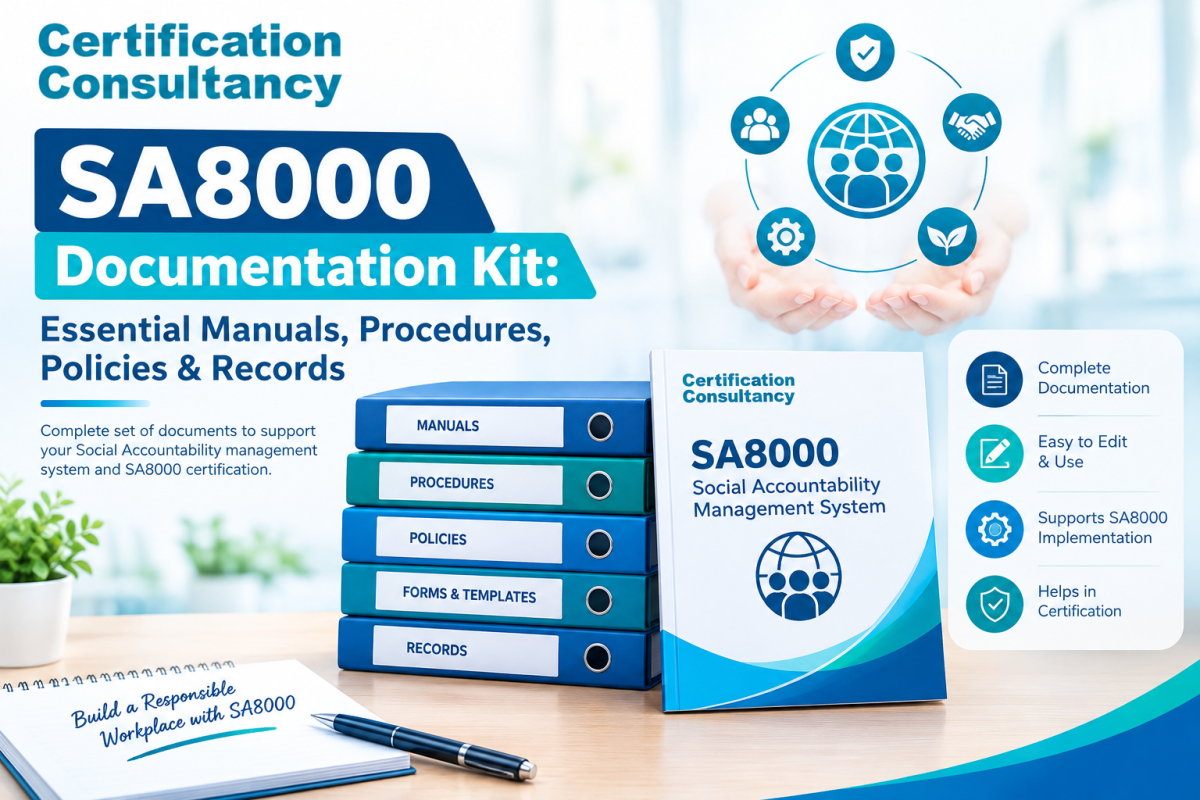
SA8000 Documentation Kit: Essential Manuals, Procedures, Policies & Records

Social accountability plays a vital role in the development of responsible, secure, and equitable work environments. Organizations that wish to prove their dedication towards ethical workplaces should have a formal mechanism to manage different areas, including the welfare of employees, health and safety issues, working hours, salary, discrimination, forced labor, child labor, and labor rights. Documentation facilitates organizations in developing and improving social accountability.
The SA8000 Documentation Kit comes up with a well-structured set of documents that assist organizations in organizing the requirements of their social accountability management system. Good documentation makes implementation easy through provision of useful manuals, procedures, policies, forms, checklists, and supporting documents.
What Is an SA8000 Documentation Kit?
The SA8000 Documentation Kit is a set of documents meant to facilitate the implementation and maintenance of a social accountability management system. The kit may offer a structure through which organisations can document responsibilities, processes, controls and records needed for proper implementation of the management system.
Documentation can consist of a social accountability manual, procedures, policies, standard operating procedures, forms, safety instructions, audit checklists, risk assessments, and compliance matrices, among others. Editable documentation helps organisations to modify the content based on their size, activities, workforce, and other requirements.
Key Documents Included
A comprehensive SA8000 Documentation Kit can contain different types of documents to support various stages of implementation.
Manual of Social Accountability
It is a document that provides an overall guide for the social accountability system within the organization. It may detail the system structure, the responsibilities and processes involved, and how it manages social accountability issues.
Policies and Procedures
Clear policies and procedures ensure that employees have a full understanding of organizational commitments and controls in place. Policies may include information regarding areas such as workplace environment, employees' rights, health and safety, working time, wage levels, discrimination, discipline, and others.
Forms and Templates
Forms are an effective means of recording events and keeping proof of such. Templates that are ready for use will help in conducting events such as communications, training, inspection, report of incidents, activities of committees, corrective measures, and other processes of the system.
Standard Operating Procedures
The Standard Operating Procedures (SOP) are a guide that gives instructions on how to conduct certain activities.
Social Committee Templates
The involvement of employees is an integral part of an efficient social accountability process. Social committee templates will allow companies to track the meetings, obligations, discussions, actions, and follow-ups within the process.
SA8000 Audit Checklist
The SA8000 audit checklist is a great tool for assessing the progress made by the organisation prior to the internal or certification audit.
Risk Analysis and Compliance Matrix
Documentation related to risk analysis will help the business identify and assess any risks that might be associated with social accountability. There is also the possibility of using a compliance matrix, which may be useful for matching documented requirements with the existing processes.
Advantages of Utilizing Structured Documentation
It may take considerable effort to develop a management system right from the start. With the use of structured documentation, businesses can build on it and modify it depending on their practices.
A properly organized SA8000 Documentation Kit can help:
- Reduce the time required to prepare system documentation.
- Establish consistent processes and responsibilities.
- Improve control over workplace-related activities.
- Organize policies, procedures, forms, and records.
- Support internal audits and management reviews.
- Identify documentation gaps and implementation needs.
- Make the certification preparation process more systematic.
The documentation must be tailored to the operations within the organization, and not treated as just general documentation. The staff needs to be familiar with what is stated in the documentation regarding processes, roles, and controls, and proper documentation needs to be kept.
Preparing for SA8000 Certification
Documenting is just one step toward putting the system of social accountability in place. Other steps include making the documented processes work, communicating requirements to staff members, keeping relevant records, conducting risk assessments, conducting internal audits, dealing with nonconformities, and continual improvement of the system.
One way to implement the process in practice is to analyze the present processes and identify any possible gaps. Then the documents required can be tailored according to the specifics of the particular organization, roles assigned, staff trained, and implementation records kept. Internal audits will show how well the system works prior to the certification audit.
Conclusion
A well-structured SA8000 Documentation Kit can make the process of developing and organizing a social accountability management system more manageable. Manuals, policies, procedures, SOPs, forms, social committee templates, audit checklists, risk analysis tools, and compliance matrices provide a practical documentation framework that organizations can customize to their needs.
Certification Consultancy provides SA8000 documentation and consultancy support designed to help organizations organize their documentation, understand implementation requirements, and prepare systematically for social accountability certification. With properly prepared documents and effective implementation, organizations can develop a more structured approach to managing workplace conditions, employee welfare, and social accountability requirements.


Comments (0)