

From Heat to Pressure: What CPVC Pipe Fittings Must Handle
What CPVC pipe fittings must survive — pressure ratings at temperature, CTS sizing, cure schedules, and the supplier questions that prevent joint failures.

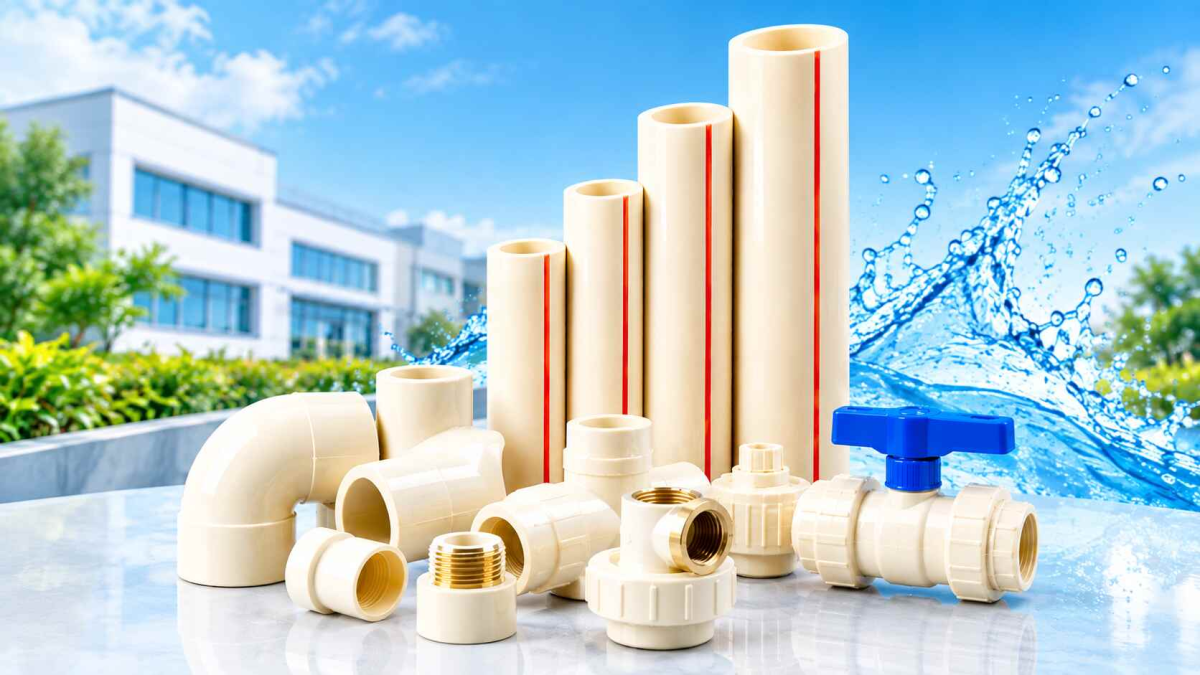
A contractor never calls his distributor when the line holds. He calls eleven months after handover, when a tee splits open on the fourth floor and the ceiling below is soaked. Nine times out of ten that failure sits at a joint, not in the middle of a straight run — which is why CPVC Pipe Fittings deserve far more scrutiny in a purchase order than they usually get. Pipe carries water. Fittings carry stress.
Where the Joint Gives Up Before the Pipe Does
Heat is only half the load. The other half is what happens every time a geyser cycles on and off: the material expands, contracts, and puts that movement straight into the elbows and tees. Straight pipe absorbs it. A moulded fitting with uneven wall thickness does not. Most buyers evaluate CPVC Pipes & Fittings by holding a sample, checking the finish, and comparing the rate per piece — and that tells you almost nothing about how the socket behaves at 82°C under repeated cycling. Weight consistency across a production batch tells you more than any sample ever will.
Ask for three pieces from three different batches. Weigh them.
Specification: The Numbers That Decide Whether a Joint Survives
A datasheet is only useful if you read it against the site conditions. CPVC Pipe Fittings are specified under IS 15778 and ASTM D2846 for CTS sizing, and those two documents settle most arguments before they start.
Pressure Ratings Fall as Temperature Climbs
SDR 11 CPVC is rated around 200 psi at 23°C and roughly 100 psi at 82°C. Half the strength, same fitting. If your end client is running a pressurised hot line in a high-rise, the 23°C number on the catalogue is the wrong number to quote him.
CTS Sizing Is Not BSP, and Mixing Is Not a Field Fix
CPVC uses Copper Tube Size, typically ½" to 2" for plumbing. Fittings from two different sizing systems will physically go together with enough cement and enough optimism. They will also leak within a year.
The Spec Most Buyers Skip: Cure Schedule
Solvent-cemented joints need set time before pressure testing — longer in winter, longer at larger diameters. Plenty of "manufacturing defects" reported back to us were joints pressure-tested within twenty minutes on a cold January morning. The fitting was fine. The schedule was not.
What Better Fittings Actually Protect
-
Warranty exposure — one failed tee behind a wall costs more in repair labour and goodwill than the entire fitting line on that invoice.
-
Margin — consistent wall thickness means fewer field rejections, and field rejections are absorbed by you, not the plant.
-
Repeat orders — plumbers specify by brand memory, and one bad batch resets that memory for years.
-
Inventory turns — full size coverage means the contractor completes his BOM from one dealer instead of two.
-
Site speed — correctly dimensioned sockets cut fitment time, which is what your contractor actually measures.
-
Freight efficiency — cartons packed to volume rather than loose count reduce damage and per-piece transit cost.
Kundli, Sonipat: Why This Address Is a Freight Decision
Kundli sits on NH-44 at the Delhi border, which puts North India's largest distribution belt inside a day's dispatch and keeps Punjab, UP and Rajasthan deliveries on road freight instead of multi-leg transfers. For dealers, that shortens the gap between an urgent call and stock on the shelf. Buyers searching for CPVC Pipes & Fittings Suppliers in India often ignore plant location until a monsoon-season stockout costs them a project. Location is lead time wearing a different name.
How We Work
We are an ISO-certified manufacturer, and what that means day to day is documentation, not a logo. We check dimensional conformity and weight consistency lot by lot, and we hold back a retained sample from each production batch — so when a complaint arrives eight months later, we can compare the failed piece against what actually left our floor. That one habit has settled more disputes than any warranty clause we have ever written.
We will also tell you honestly when a size is running behind. Peak-season moulding capacity is finite, and pretending otherwise just moves the problem to your site.
Conclusion
Heat, pressure and thermal cycling do not negotiate, and the joint is where they do their work. Choosing between CPVC Pipe Fittings Manufacturers comes down to whether the plant can show you batch-level evidence instead of adjectives. Ask for the boring documents. The suppliers who have them are the ones still standing next season.
FAQs
What makes CPVC Pipe Fittings different from UPVC fittings?
CPVC handles hot water — roughly up to 82°C continuous — while UPVC is a cold-water material. Using UPVC on a geyser line is the single most common site-level mistake we see.
What is your MOQ, and is it negotiable?
MOQ is set per SKU because each size needs its own mould run. On fast-moving sizes there is room to discuss. On slow sizes there usually is not, and any supplier who says yes to every MOQ request is planning to consolidate your order with someone else's.
Do you supply to dealers as well as project buyers?
Yes. Requirements differ, though — a CPVC Pipes & Fittings Dealer needs full size coverage for counter sales, while a project buyer needs depth in three or four sizes. Tell us which you are and the quote changes.
How do I verify a supplier's certification is current?
Ask for the certificate with its validity dates and the issuing body's reference number, then verify it directly with that body. A scanned PDF proves nothing about what is valid today.






Comments (0)