

Oligospermia vs Azoospermia: What's the Real Difference?
Oligospermia and azoospermia are two distinct male infertility diagnoses — one involves reduced sperm numbers, the other complete absence. This article explains the clinical difference between both conditions, their severity grades, treatment pathways, and why accurate diagnosis at a specialist best fertility centre in Coimbatore determines everything about treatment outcomes.

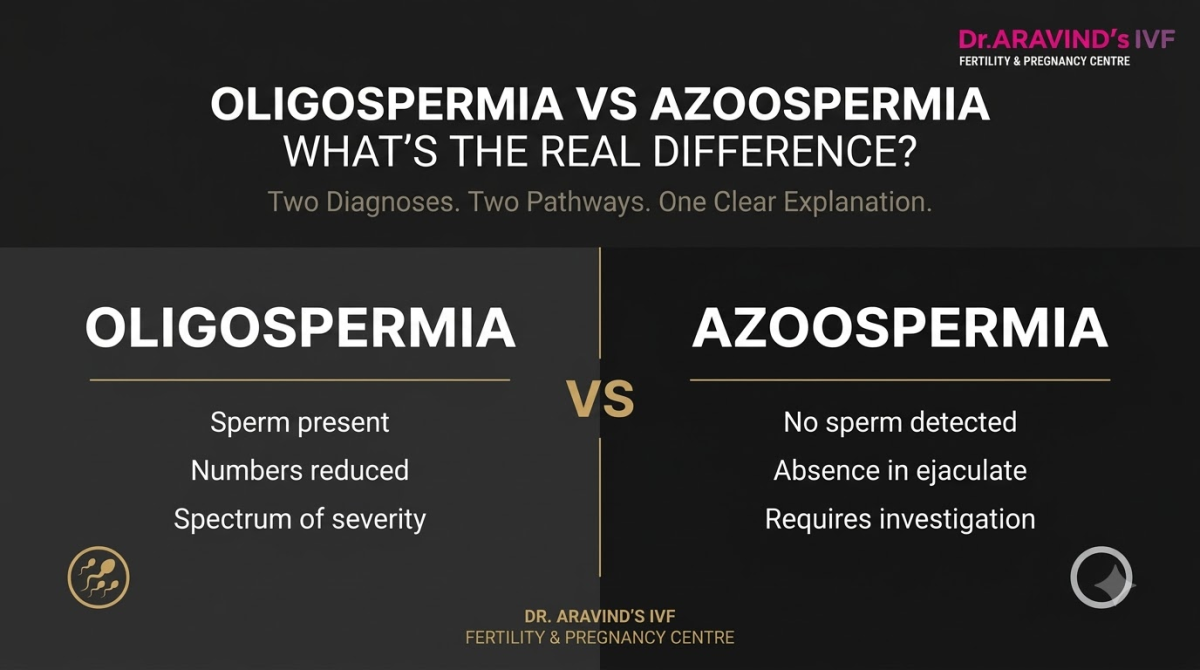
Two diagnoses. One semen analysis report.
Both involve sperm — or the absence of it.
But the clinical distance between oligospermia and azoospermia is not just a matter of degree. It is a difference in biology, in treatment pathway, and in what realistic outcomes look like for each man diagnosed with either condition.
Understanding that distance clearly is the most useful thing a man in this situation can do.
What Each Condition Actually Means
Best Fertility Centre in Coimbatore — Two Distinct Clinical Definitions
Oligospermia is defined as a sperm concentration below 16 million sperm per millilitre of semen — the current WHO 2021 reference threshold. Sperm are present in the ejaculate. Their numbers are reduced — but they exist.
Azoospermia is the complete absence of sperm in the ejaculate — confirmed through centrifuged semen examination under high microscopic magnification. No sperm are found in two separate samples collected under proper conditions.
The fundamental distinction — oligospermia is a quantitative reduction. Azoospermia is a complete absence.
That single biological difference creates entirely different diagnostic pathways, treatment options, and outcome probabilities for every man carrying either diagnosis.
The Severity Spectrum of Oligospermia
Why low sperm count exists on a clinical continuum
Oligospermia is not a fixed point — it is a spectrum with three distinct grades:
- Mild oligospermia — 10 to 16 million sperm per millilitre. Natural conception remains genuinely possible — particularly when motility and morphology are within normal limits
- Moderate oligospermia — 5 to 10 million per millilitre. Natural conception is significantly more challenging. Structured cause investigation and targeted treatment are recommended before assisted reproduction
- Severe oligospermia — below 5 million per millilitre. Assisted reproduction — IUI or IVF with ICSI — is the standard clinical recommendation at this severity
For a complete clinical breakdown of causes, grades, and treatment options for oligospermia in India — read our detailed guide on oligospermia meaning, causes, and treatment.
The Two Types of Azoospermia
Why zero sperm does not always mean the same thing
Here is where the clinical picture becomes particularly important.
Azoospermia is not a single condition — it has two fundamentally different types with completely different biological origins:
Obstructive azoospermia — spermatogenesis is occurring normally inside the testes. A physical blockage somewhere in the reproductive tract — vasectomy, epididymal scarring, congenital absence of the vas deferens — prevents sperm from reaching the ejaculate. Sperm exist. They simply cannot get out.
Non-obstructive azoospermia — the testes are not producing sufficient sperm to appear in the ejaculate. The production machinery itself is impaired — through hormonal failure, genetic conditions, testicular damage, or primary testicular failure.
This distinction determines everything about treatment — because obstructive azoospermia has high surgical sperm retrieval success rates, while non-obstructive azoospermia requires more complex microsurgical approaches.
For a complete guide to azoospermia treatment options in India — read our detailed resource on azoospermia treatment and zero sperm count options.
Side-by-Side Comparison — The Clinical Differences That Matter
| Element | Oligospermia | Azoospermia |
|---|---|---|
| Sperm in ejaculate | Yes — reduced numbers | No — absent entirely |
| Natural conception | Possible — grade dependent | Rarely without intervention |
| Primary investigation | Semen analysis + cause workup | FSH, genetics, biopsy |
| First-line treatment | Lifestyle, hormonal, varicocele | Sperm retrieval + IVF/ICSI |
| IUI suitability | Yes — moderate to mild grades | No — sperm retrieval required first |
| IVF with ICSI | Severe grades | Standard approach |
| Treatment complexity | Moderate | Higher — type dependent |
Why the Distinction Matters for Treatment
The diagnosis determines the entire clinical pathway
A man with mild oligospermia in an IVF clinic in Coimbatore and a man with obstructive azoospermia at the same clinic will follow completely different treatment pathways — even though both present with male infertility.
The man with mild oligospermia may need nothing more than lifestyle optimisation and nutritional support — and conceive naturally within months.
The man with obstructive azoospermia needs surgical sperm retrieval and IVF with ICSI — a more complex but highly successful pathway.
The man with non-obstructive azoospermia needs genetic counselling, hormonal evaluation, and potentially micro-TESE — the most technically demanding sperm retrieval approach in reproductive medicine.
Treating these three situations identically would be clinically inappropriate.
This is precisely why accurate diagnosis — not just a label, but a complete diagnostic picture — is the foundation of effective male infertility management at the best IVF centre in India.
Both Are Manageable. Neither Is the Final Word.
Oligospermia and azoospermia sit at different points on the male infertility spectrum.
One involves reduced sperm numbers. The other involves absent sperm. But both have clearly defined, evidence-based treatment pathways — and both have produced successful pregnancies for men who received accurate diagnosis and appropriate care.
The number on your report — whether low or zero — is the beginning of a clinical conversation. Not the conclusion of a fertility story.
At Dr. Aravind's IVF Fertility & Pregnancy Centre — the best fertility centre in Coimbatore — every semen analysis result is evaluated completely, every cause is investigated accurately, and every treatment plan is built around what your specific report actually shows.
Dr. Aravind's IVF Fertility & Pregnancy Centre
Coimbatore, Tamil Nadu, India







Comments (0)