

Wireless Connectivity Market Size, Growth Trends, and Industry Analysis 2034
Wireless Connectivity Market size was valued at USD 150.1 Billion in 2025, expected to reach USD 367.4 Billion at a CAGR of 10.14% during 2026-2034.

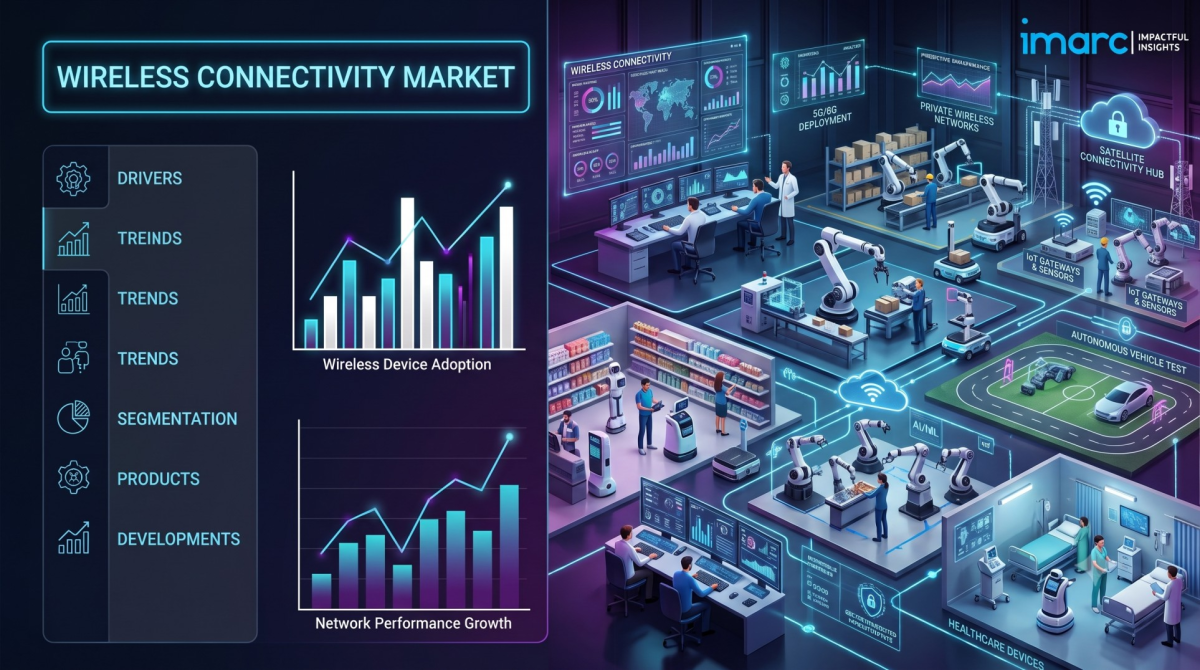
IMARC Group, a leading global market research and management consulting firm, has published its latest market intelligence report on the wireless connectivity market. The global wireless connectivity market size reached USD 150.1 Billion in 2025. Looking forward, IMARC Group expects the market to reach USD 367.4 Billion by 2034, exhibiting a growth rate (CAGR) of 10.14% during 2026-2034, supported by rising demand for mobility and on-the-go connectivity, expanding government-led digital transformation programs, and the growing adoption of smart devices connected through Wi-Fi, Bluetooth, and cellular networks.
Connectivity has become the invisible backbone of nearly every modern industry, from consumer electronics to industrial automation. Individuals now expect seamless access to communication, entertainment, and digital services regardless of location, while businesses depend on reliable wireless networks to run cloud applications, remote monitoring, and connected machinery. At the same time, governments across major economies are treating broadband and next-generation wireless infrastructure as strategic assets, channeling public funding into spectrum policy, rural connectivity, and domestic semiconductor manufacturing. Artificial intelligence is layering on top of this infrastructure, optimizing network performance and pushing chipmakers toward smarter, more integrated connectivity platforms.
Wireless Connectivity Market at a Glance
- Market Size 2025: USD 150.1 Billion
- Market Forecast 2034: USD 367.4 Billion
- Growth Rate 2026-2034: CAGR of 10.14%
- Leading Technology: Wi-Fi, driven by its extensive use in homes, offices, and public hotspots
- Leading Network Type: Wireless Wide Area Network, anchored by mobile cellular technologies
- Leading End User: IT and Telecom, fueled by demand for fast, reliable communication infrastructure
- Leading Region: Asia-Pacific, supported by IoT adoption, 5G rollout, and government digital initiatives
How AI is Reshaping the Wireless Connectivity Market
- AI-native silicon is becoming standard: Qualcomm unveiled its Dragonwing Mobile Broadband Multimedia platforms in 2026, integrating a 5G modem, Wi-Fi 7 connectivity, and on-device AI inference into a single chip for smart displays, retail terminals, and AI assistant hubs, reflecting a broader shift from isolated connectivity chips to combined connectivity-plus-AI silicon.
- AI is optimizing network performance in real time: Telecom operators are increasingly deploying AI-driven traffic prediction and spectrum efficiency tools that allow networks to adapt dynamically to demand, reduce latency for critical applications, and use digital twin simulations to model performance before large-scale deployment.
- Edge AI is powering next-generation Wi-Fi: ASUS demonstrated real-world Wi-Fi 8 throughput improvements at CES 2026, citing up to 2 times higher mid-range throughput and up to 6 times lower latency through smarter multi-access-point and multi-client operation, technology increasingly paired with AI network engines for more responsive, self-optimizing home and enterprise networks.
Grab a sample copy of this report: https://www.imarcgroup.com/wireless-connectivity-market/requestsample
Wireless Connectivity Market Trends and Drivers
Rising demand for mobility is a central driver of the market. Individuals increasingly expect uninterrupted access to communication, streaming, and cloud-based services wherever they are, and the proliferation of laptops, tablets, and wearable devices is reinforcing the need for constant on-the-go connectivity, pushing chipmakers and network operators toward faster, more reliable wireless standards.
A second driver is the expansion of private 5G networks for industrial applications. These networks deliver low-latency, high-reliability communication for manufacturing, logistics, and Industry 4.0 environments, supporting real-time monitoring and machine-to-machine communication. South Korea's government has reinforced this shift by unveiling a research and development plan worth roughly KRW 440 Billion for future 6G networks, while its telecom regulator and major carriers issued a joint declaration on cheaper 5G and AI network investment, underscoring how public policy is accelerating next-generation wireless rollout.
A third driver, which also connects to the regulatory landscape below, is the growing availability of internet access in rural and underserved regions. India alone has surpassed 820 Million active internet users, with double-digit annual growth in penetration, while government-backed broadband programs in other major economies are extending high-speed wireless coverage to previously unconnected areas, expanding the addressable base for wireless connectivity solutions worldwide.
Global Regulatory and Digital Infrastructure Landscape Shaping Demand
- European Union, Digital Decade connectivity targets: The EU has set a goal of gigabit connectivity for every household and 5G mobile coverage across all populated areas, backed by the European Electronic Communications Code, the Gigabit Infrastructure Act, and a Radio Spectrum Policy Programme designed to harmonize mid-band and low-band spectrum allocation across member states.
- European Union, Smart Networks and Services Joint Undertaking: The EU's dedicated 6G research body has launched multiple projects spanning wireless communications, mobile core networks, and next-generation standardization, positioning the bloc to influence global 6G technical standards alongside Asian and North American counterparts.
- United States, spectrum and technology-neutral broadband policy: Regulators have shifted toward a technology-neutral approach for federally funded broadband deployment, allowing satellite, fixed wireless, and unlicensed spectrum technologies to compete alongside fiber for funding, an approach expected to generate substantial cost savings that can be redirected toward additional coverage.
- Global standards convergence around Wi-Fi 8 and 6G: Chipmakers and standards bodies are accelerating testbeds and interoperability trials for next-generation Wi-Fi and cellular standards, with commercial Wi-Fi 8 products expected in the latter half of 2026 and early 6G pilots targeted before the end of the decade.
Key Government Schemes and Policy Programs Supporting the Industry
- India, Production Linked Incentive Scheme for Telecom and Networking Products: India's PLI scheme for telecom equipment carries a budgeted outlay of roughly INR 12,195 Crore, with cumulative investment by participating companies crossing INR 2,419 Crore and generating employment for more than 17,700 people, while additional sales under the scheme have reached INR 34,516 Crore.
- United States, Broadband Equity, Access, and Deployment Program: The BEAD program provides USD 42.45 Billion to expand high-speed internet access across all 50 states and several territories, with all 56 states and territories having submitted final proposals and the majority already receiving federal approval to unlock grant funds for construction beginning in 2026.
- South Korea, 6G Research and Development Plan: South Korea's Ministry of Science and ICT has committed roughly KRW 440 Billion toward 6G wireless communications, mobile core networks, and international standardization efforts, aiming to showcase intermediate technical outcomes and play a leading role in setting global 6G standards.
- European Union, Recovery and Resilience Facility and Connecting Europe Facility: These instruments channel a share of the EU's broader digital transition funding toward gigabit and 5G network deployment, helping member states meet Digital Decade connectivity targets while supporting rural and cross-border infrastructure investment.
Wireless Connectivity Industry Segmentation
Breakup by Technology
- Bluetooth
- Wi-Fi
- Ultra-Wide Band
- NFC
- Cellular
- Zigbee
- GPS
- Others
Wi-Fi accounts for the majority of the market share. Wi-Fi plays a central role in modern digital infrastructure, delivering fast internet access for browsing, streaming, gaming, and smart home control. The technology continues to advance through newer standards such as Wi-Fi 7 and the emerging Wi-Fi 8, offering better performance, greater capacity, and reduced latency to meet rising connectivity demands.
Breakup by Network Type
- Wireless Wide Area Network
- Wireless Personal Area Network
- Wireless Local Area Network
Wireless wide area network technologies deliver connectivity across vast geographic areas through mobile networks, remaining crucial for mobile communication and data services while traveling. Wireless personal area networks support short-range communication in consumer electronics such as smartphones and wearables, while wireless local area networks provide internet access within homes, offices, and public hotspots.
Breakup by End User
- Automotive and Transportation
- Building Automation
- Consumer Electronics and Wearables
- Energy and Utilities
- Healthcare
- Industrial
- IT and Telecom
- Others
IT and telecom represent the leading market segment. This sector, comprising service providers, mobile network operators, and IT infrastructure companies, is driving demand for dependable, fast wireless networks. The rollout of 5G and Wi-Fi 6 technologies is facilitating quicker data speeds and improved connectivity, supporting the proliferation of smart devices and edge computing.
Breakup by Region
- North America
- Asia-Pacific
- Europe
- Latin America
- Middle East and Africa
Asia-Pacific leads the market. The region benefits from rapid technological advancement, widespread 5G deployment, and a booming consumer electronics industry, particularly in China and India. Government initiatives promoting digital transformation, combined with rising internet penetration in rural areas, continue to propel regional growth.
Competitive Landscape
The wireless connectivity market includes Broadcom Inc., Infineon Technologies AG, Intel Corporation, MediaTek Inc., Microchip Technology Inc., Nordic Semiconductor, NXP Semiconductors N.V., Panasonic Holdings Corporation, STMicroelectronics N.V., and Texas Instruments Incorporated, among others.
Within the Wi-Fi chipset segment specifically, the competitive field remains concentrated among a handful of leading suppliers. Broadcom holds the largest revenue-based share, followed closely by Qualcomm and MediaTek, while specialized players such as Realtek and Espressif compete strongly in wearables and low-power IoT applications. Qualcomm continues to expand aggressively in Wi-Fi combo chips for smartphones, and Broadcom's collaboration with Samsung Electronics on an integrated 5G and Wi-Fi 8 fixed wireless access platform illustrates how leading suppliers are combining cellular and Wi-Fi capabilities onto single reference platforms.
Market Concentration Analysis
- The wireless connectivity chipset market is notably concentrated at the top, with roughly four leading suppliers accounting for the majority of revenue-based market share even though around fifty Wi-Fi chip vendors compete globally, most of them serving lower-end IoT and consumer segments.
- Consolidation pressure is intensifying as next-generation standards raise technical barriers. Wi-Fi 7 and emerging Wi-Fi 8 chipsets require advanced process nodes and significantly greater development investment, causing the number of vendors capable of shipping cutting-edge chips to decline even as overall market demand grows.
- Despite this concentration at the silicon level, the broader end-market remains diverse, with regional players in China and Taiwan continuing to serve high-volume, price-sensitive IoT and consumer electronics segments, keeping the market structurally competitive outside the premium smartphone and infrastructure tiers.
What Does The Full Report Cover?
- Comprehensive market sizing and segment-level analysis by technology, network type, end user, and region
- Detailed breakdown of key drivers, restraints, opportunities, and emerging trends
- Competitive landscape mapping and profiles of leading companies
- Regional and country-level market breakdowns across North America, Asia-Pacific, Europe, Latin America, and the Middle East and Africa
- Porter's five forces analysis assessing competitive intensity and market attractiveness
- Strategic recommendations for market entry, expansion, and positioning
Recent News and Developments in Wireless Connectivity
- February 2026: MediaTek showcased its Filogic 8000 series Wi-Fi 8 chipsets at CES 2026, targeting both gateways and client devices in collaboration with partners including Deutsche Telekom, Airties, and Zyxel.
- March 2026: Qualcomm debuted its first Wi-Fi 8-ready chip, the FastConnect 8800, alongside a new 5G modem, and announced a strategic coalition with industry partners working toward a global 6G launch by the end of the decade.
- April 2026: South Korea's Deputy Prime Minister and Science and ICT Minister, together with the CEOs of SK Telecom, KT, and LG Uplus, issued a joint declaration pledging cheaper 5G service and expanded AI network investment.
- May 2026: Broadcom and Samsung Electronics unveiled an integrated 5G and Wi-Fi 8 fixed wireless access platform, combining Broadcom's Wi-Fi 8 system-on-chip with Samsung's 5G modem for global broadband operators.
- June 2026: Qualcomm launched its Dragonwing Mobile Broadband Multimedia chip family, integrating 5G modem, Wi-Fi 7, and on-device AI inference into a single 4-nanometer platform for smart displays and AI-enabled appliances.
- July 2026: India's telecom ministry confirmed that PLI-supported telecom equipment companies had crossed INR 2,419 Crore in cumulative investment, generating employment for more than 17,700 people during a production-line inauguration for 4G and 5G connectivity modules.
Note: If you require specific details, data, or insights that are not currently included in the scope of this report, we are happy to accommodate your request. As part of our customization service, we will gather and provide the additional information you need, tailored to your specific requirements. Please let us know your exact needs, and we will ensure the report is updated accordingly to meet your expectations.
Key Questions This Report Answers
- What is the current size of the global wireless connectivity market?
- Which technology, Wi-Fi, Bluetooth, or cellular, holds the largest market share?
- Why does IT and telecom lead demand among end-user industries?
- Which region leads the global wireless connectivity market and why?
- How is artificial intelligence changing wireless connectivity chip design and network management?
- What government schemes and regulations are shaping investment in this market?
About Us
IMARC Group is a global management consulting firm that helps the world's most ambitious changemakers to create a lasting impact. The company provides a comprehensive suite of market entry and expansion services. IMARC offerings include thorough market assessment, feasibility studies, company incorporation assistance, factory setup support, regulatory approvals and licensing navigation, branding, marketing and sales strategies, competitive landscape and benchmarking analyses, pricing and cost research, and procurement research.
Media and Sales Contact
IMARC Group
Email: [email protected]
United States: +1-201-971-6302
India: +91-120-433-0800
United Kingdom: +44-753-714-6104








Comments (0)