

Privileged Access Management Market Worth $41.0 Bn by 2035
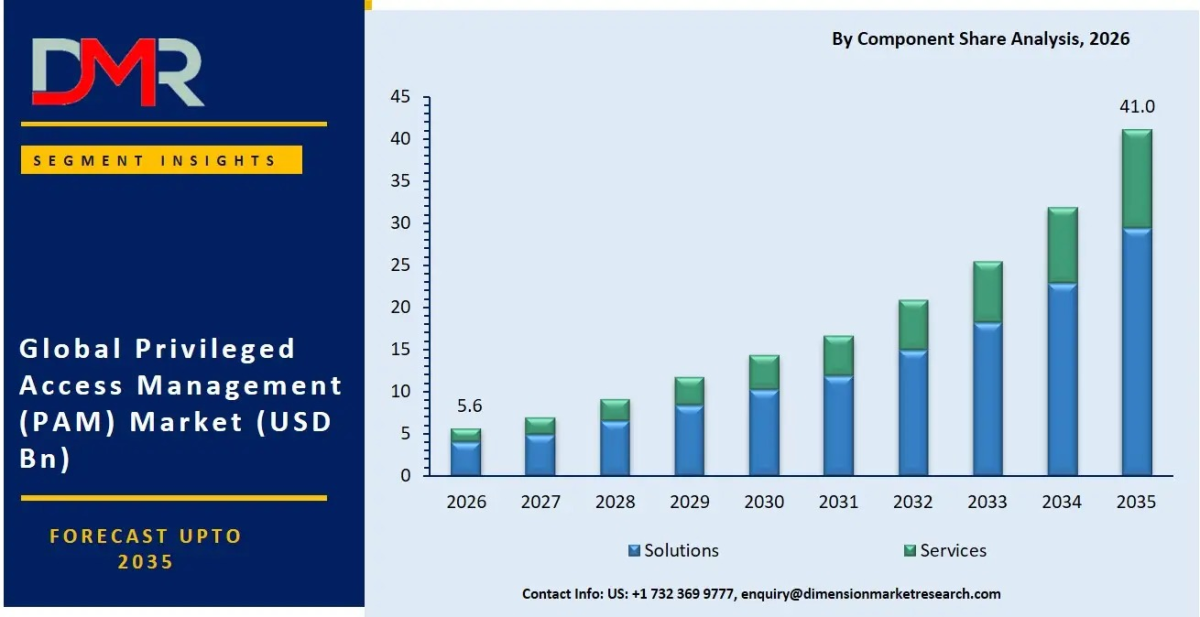
The Privileged Access Management Market is projected to grow from USD 5.6 Bn in 2026 to USD 41.0 Bn by 2035 at a CAGR of 24.7%. Rising ransomware attacks, credential theft, and zero trust adoption are driving market expansion. North America leads with 38.5% share.

Market Overview
According to Dimension Market Research, the Privileged Access Management Market size is expected to be USD 5.6 billion in 2026 and increase at a compound annual growth rate of 24.7% to USD 41.0 billion in 2035 due to increase in the occurrence of ransomware attacks, credential theft, insider threats, and advanced cyber-attacks. The market is witnessing explosive growth as organizations across industries recognize the critical need to secure privileged accounts, credentials, and sessions that provide access to an organization's most sensitive systems and data.
Privileged Access Management (PAM) refers to a comprehensive set of cybersecurity solutions and practices designed to secure, control, monitor, and audit access to privileged accounts, credentials, and sessions within an organization. These solutions protect against unauthorized access, misuse of privileges, and insider threats by enforcing least-privilege principles, just-in-time access, and session monitoring.
The global PAM market is experiencing rapid expansion as enterprises adopt zero trust security frameworks, regulatory compliance requirements tighten, and the frequency and sophistication of cyberattacks continue to escalate. Privileged accounts—including administrator accounts, service accounts, and root credentials—represent some of the most attractive targets for attackers seeking to escalate privileges, move laterally, and exfiltrate data.
The increasing adoption of cloud infrastructure, hybrid work models, and DevOps practices has expanded the attack surface and created new challenges for managing privileged access. PAM solutions are evolving to address these challenges through cloud-native architectures, secrets management, and integration with identity and access management (IAM) platforms.
Definition and Market Significance
Privileged Access Management (PAM) refers to a set of cybersecurity solutions and practices designed to secure, control, monitor, and audit access to privileged accounts, credentials, and sessions. These solutions protect an organization's most critical systems and data from unauthorized access, misuse, and insider threats by enforcing least-privilege principles, just-in-time access, and comprehensive session monitoring.
The importance of PAM lies in its critical role in preventing data breaches, ransomware attacks, and insider threats. Privileged accounts provide elevated access to systems, applications, and data, making them prime targets for cybercriminals seeking to escalate privileges and move laterally across networks.
PAM also supports broader cybersecurity and compliance objectives by enabling organizations to meet regulatory requirements such as SOX, HIPAA, PCI DSS, GDPR, and NIST frameworks, while providing audit trails, access controls, and session monitoring that demonstrate accountability and governance.
Request a Complimentary PDF Sample
https://dimensionmarketresearch.com/request-sample/privileged-access-management-market/
Market Drivers
A major factor driving the Privileged Access Management Market is the increasing occurrence of ransomware attacks, credential theft, and advanced cyber-attacks. Cybercriminals are increasingly targeting privileged accounts to gain unauthorized access to critical systems, deploy ransomware, and exfiltrate sensitive data. This has driven organizations to invest in PAM solutions that can prevent, detect, and respond to privileged access threats.
Growing regulatory compliance requirements are another key driver supporting market expansion. Regulations such as SOX, HIPAA, PCI DSS, GDPR, and NIST frameworks mandate strict controls over privileged access and require organizations to demonstrate accountability through audit trails and access monitoring.
The increasing adoption of zero trust security frameworks is also contributing to market growth. Zero trust principles require continuous verification of users and devices, and PAM solutions are essential for enforcing least-privilege access, just-in-time provisioning, and session monitoring in zero trust architectures.
Market Trends
The shift toward cloud-native PAM solutions is emerging as an important trend in the market. As organizations migrate workloads to the cloud, traditional on-premises PAM solutions are being replaced by cloud-native platforms that offer scalability, flexibility, and integration with cloud infrastructure and DevOps pipelines.
Another significant trend is the integration of PAM with identity and access management (IAM) and identity governance platforms. Organizations are increasingly adopting unified identity security platforms that combine PAM, IAM, and privileged identity management capabilities, providing a holistic approach to managing access across all users, devices, and applications.
The growth of just-in-time (JIT) access and secrets management is also transforming the market. JIT access eliminates standing privileges by granting access only when needed and for a limited time, while secrets management protects API keys, certificates, and other credentials used in DevOps and cloud environments.
Market Restraints
Despite its strong growth potential, the Privileged Access Management Market faces certain limitations. High implementation costs and complexity pose significant challenges, as PAM deployments require substantial investment in software, integration, and training, along with careful planning to avoid disrupting critical business operations.
Resistance to change and user experience concerns are another significant restraint. Privileged users may resist the additional controls and authentication steps introduced by PAM solutions, and poorly designed implementations can create friction that affects productivity.
In addition, the shortage of skilled cybersecurity professionals and the complexity of managing privileged access across hybrid and multi-cloud environments can slow adoption and increase operational overhead.
Market Opportunities
The expansion of PAM into cloud and DevOps environments presents significant growth opportunities. Organizations are increasingly adopting cloud infrastructure and DevOps practices, creating new challenges for managing privileged access to cloud resources, CI/CD pipelines, and containerized workloads.
The growth of identity security platforms that combine PAM with IAM, identity governance, and access management capabilities is another promising opportunity. Vendors that can offer unified identity security platforms are well-positioned to capture a larger share of enterprise security spending.
Furthermore, the increasing adoption of PAM solutions by small and medium-sized enterprises (SMEs) is expected to open new opportunities, driven by the growing availability of cloud-based PAM offerings and the recognition that SMEs face similar privileged access risks as larger organizations.
Segmentation
The Privileged Access Management Market is categorized based on component, deployment mode, organization size, and end-user industry.
By component, solutions are expected to dominate, including privileged account and session management, secrets management, and privileged identity management. Services, including consulting, implementation, and support, are also growing rapidly as organizations seek expert assistance for complex PAM deployments.
By deployment mode, cloud-based PAM solutions are expected to grow fastest, driven by scalability, flexibility, and integration with cloud infrastructure and DevOps workflows. On-premises solutions remain relevant for organizations with strict data sovereignty and security requirements.
By organization size, large enterprises are expected to lead, driven by complex IT environments and regulatory requirements, while SMEs are increasingly adopting cloud-based PAM solutions.
By end-user industry, BFSI, government and defense, healthcare, IT and telecom, and retail are key segments, with BFSI leading due to strict regulatory requirements and high-value targets.
Regional Analysis
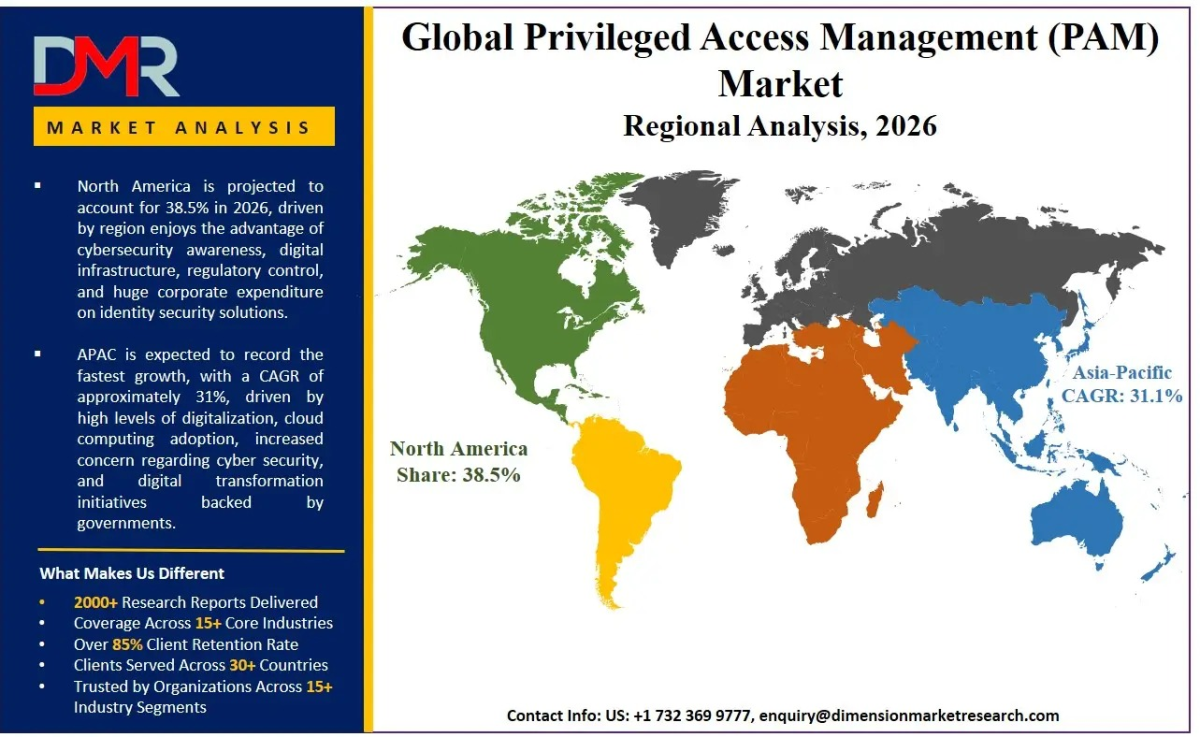
North America is predicted to retain its dominance with the projected market share of 38.5% in 2026. This region enjoys the advantage of cybersecurity awareness, digital infrastructure, regulatory control, and huge corporate expenditure on identity security solutions. Companies belonging to various industries, including financial services, healthcare, governments, and technology, have been focusing on PAM solutions for tackling complex cyberattacks and adhering to cybersecurity regulations. Federal initiatives in cybersecurity, prevalence of zero trust security approach, and the existence of mature cybersecurity environment keep aiding market dominance.
Europe holds a substantial share of the PAM market due to stringent data protection regulations, growing cybersecurity awareness, and increasing adoption of zero trust frameworks. The United Kingdom, Germany, France, and the Nordic countries are key markets, with strong demand for PAM solutions across BFSI, government, and healthcare sectors.
Asia Pacific is projected to be the fastest-growing region, driven by rapid digitalization, expanding cloud adoption, and increasing cybersecurity investments in countries such as China, India, Japan, South Korea, and Southeast Asia. Government initiatives and growing awareness of privileged access risks are further accelerating market growth.
Latin America and the Middle East & Africa are gradually adopting PAM solutions as cybersecurity awareness increases and regulatory requirements evolve, with Brazil, Mexico, the UAE, and Saudi Arabia emerging as key markets.
Competitive Landscape
The Privileged Access Management market is highly competitive, with a mix of established cybersecurity vendors, specialized PAM providers, and cloud security platform companies. Vendors compete on breadth of functionality, cloud capabilities, integration with identity ecosystems, and ease of deployment.
Prominent players include CyberArk, BeyondTrust, Delinea, HashiCorp, Microsoft, IBM, Broadcom, One Identity, Saviynt, and Okta. Recent developments include cloud-native PAM offerings, secrets management integrations, and partnerships with cloud providers and DevOps platforms to address emerging privileged access challenges.
Technological Advancements
Rapid advancements in AI, machine learning, and behavioral analytics are transforming the PAM market. AI-powered solutions can detect anomalous privileged activity, identify potential threats in real time, and automate responses, enhancing security effectiveness while reducing operational burden.
The integration of PAM with cloud infrastructure, DevOps pipelines, and zero trust architectures is also playing a significant role, enabling organizations to secure privileged access across hybrid and multi-cloud environments.
Consumer Adoption Patterns
Organizations across BFSI, government, healthcare, IT and telecom, retail, and manufacturing are increasingly adopting PAM solutions to protect critical systems, meet regulatory requirements, and reduce cyber risk. The growing availability of cloud-based PAM offerings is making these solutions more accessible to organizations of all sizes.
Regulatory Environment
Regulatory frameworks across different regions, including SOX, HIPAA, PCI DSS, GDPR, NIST, and various national cybersecurity mandates, significantly influence the PAM market. Compliance with these regulations drives demand for PAM solutions that provide access controls, audit trails, and session monitoring.
Market Challenges
The PAM market faces challenges related to high implementation costs, complexity, user resistance, skilled workforce shortages, and the need for continuous investment in technology and training. Additionally, managing privileged access across hybrid and multi-cloud environments creates operational complexity for organizations.
Future Outlook
The future of the Privileged Access Management Market remains exceptionally promising as cyber threats continue to escalate and organizations prioritize identity security. Increasing adoption of zero trust frameworks, growth of cloud-native PAM solutions, expansion into SME segments, and integration with identity security platforms are expected to drive strong market growth during the forecast period, with the market projected to reach USD 41.0 billion by 2035 at a CAGR of 24.7%.
FAQs
What is the expected size of the Privileged Access Management Market in 2026?
The market is expected to reach USD 5.6 billion in 2026.
What is the projected market value by 2035?
The market is forecast to reach USD 41.0 billion by 2035.
What is the CAGR of the Privileged Access Management Market?
The market is expected to grow at a CAGR of 24.7% during 2026–2035.
Which component segment dominates the market?
Solutions are expected to dominate, including privileged account and session management, secrets management, and privileged identity management.
Which region leads the global PAM market?
North America is predicted to retain its dominance with 38.5% market share in 2026.
Summary of Key Insights
The global Privileged Access Management Market is expected to grow from USD 5.6 billion in 2026 to USD 41.0 billion by 2035, recording a CAGR of 24.7% during the forecast period. Solutions lead the component segment, while cloud-based deployment is the fastest-growing deployment mode. Large enterprises lead by organization size, and BFSI leads end-user industries. North America holds the largest regional share with 38.5% of global revenue in 2026, while Asia Pacific is projected as the fastest-growing region.
Purchase the Full Report
https://dimensionmarketresearch.com/checkout/privileged-access-management-market/










Comments (0)