

How to Choose the Right Skylift Working Height for Building Maintenance
The budget takes a hit, and the schedule is blown. If you're managing building maintenance in Skylift Selangor projects, accurate height calculation isn't optional - it's the foundation of every aerial work plan.
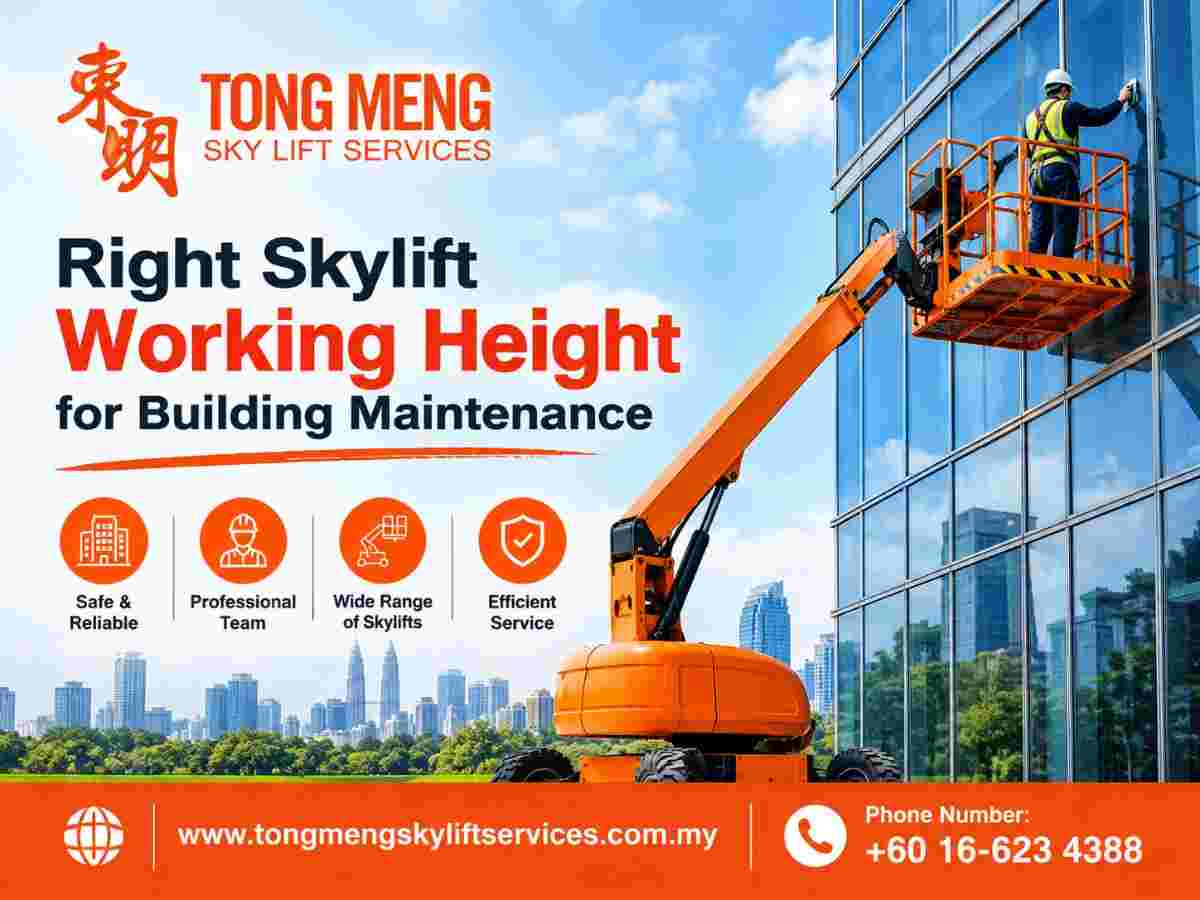
To choose the right skylift working height, measure the actual reach needed — not just the building height. Add the floor-to-floor height, parapet walls, and any equipment offset to calculate true working height. Always select a machine rated at least 1–2 metres above your calculated reach to maintain a safe working margin and avoid under-specifying.
Getting this wrong is one of the most common — and costly — mistakes facility managers make. You book a unit, it arrives on site, and the boom falls short by two metres. The job stalls. A replacement unit is rushed in. The budget takes a hit, and the schedule is blown. If you're managing building maintenance in Skylift Selangor projects, accurate height calculation isn't optional — it's the foundation of every aerial work plan.
Why Working Height Is Not the Same as Building Height
This is the single most misunderstood point among first-time renters. A building's floor count gives you an approximate height, but not the working height your skylift needs to reach.
Working height is measured from the ground to the highest point a worker's hands can comfortably operate. It accounts for the operator standing in the basket, which typically adds around 2 metres above the platform height. So a skylift with a 20m platform height offers roughly a 22m working height — but only under ideal ground conditions.
Key variables that affect your actual required working height:
-
Parapet walls or roof overhangs extending above the building's top floor
-
Facade fixtures like signage, air conditioning ledges, or cladding frames
-
Uneven ground reducing effective boom reach
-
Outrigger positioning that limits horizontal and vertical extension
-
Standoff distance from the building face (the further away the machine parks, the lower the effective vertical reach)
How to Accurately Calculate the Reach You Need
Step 1 — Measure the Target Height
Use a laser distance meter or building floor plans to confirm the height of the work zone. Do not rely on floor estimates. A typical commercial floor in Malaysia is approximately 3.5 to 4 metres, but newer high-rise construction often runs taller. Measure twice.
Step 2 — Add Structural Clearance
Add 1.5 to 2 metres above your target zone. This accounts for the worker's arm reach within the basket and ensures you're not operating at the absolute limit of the machine, which reduces stability and control.
Step 3 — Account for Ground Conditions
If the machine will be parked on a slope, gravel, or uneven pavement, the effective height is reduced. Always communicate the ground surface to your rental provider before confirming the unit. A site inspection is strongly recommended for complex facade access jobs.
Step 4 — Factor in Horizontal Reach Requirements
Some facade sections — recessed areas, canopies, columns — require outreach rather than vertical lift. Boom lifts provide both vertical and horizontal range. Know the horizontal offset you need before selecting a model, as taller units don't always offer more outreach.
Skylift Height Capacity: Which Range Suits Your Job?
Understanding skylift height capacity by job type helps you avoid both under-booking and overspending on a machine that's too large for the task.
|
Working Height |
Typical Application |
Suitable Building Type
|
|---|---|---|
|
Up to 15m |
Low-rise exterior cleaning, signage installation |
2–4 storey shophouses, link houses |
|
18m – 22m |
Mid-rise facade maintenance, window replacement |
5–6 storey office blocks, warehouses |
|
28m – 35m |
High-rise cladding inspection, painting |
8–10 storey commercial buildings |
|
40m – 50m |
Full high-rise facade access, curtain wall work |
12–16 storey towers, hotels |
When a 22m Skylift Rental Makes Sense
A 22m skylift rental is the most commonly requested capacity for mid-rise commercial buildings in the Klang Valley. It's suited to 5–6 storey structures where work zones top out between 18 and 20 metres. The additional margin keeps the crew in a stable working position throughout the shift. For buildings with clean, flat facades and level access roads, this is the default recommendation for most routine maintenance contracts.
When You Should Step Up to a 50m Skylift Rental
A 50m skylift rental is appropriate for buildings above 12 storeys or where facade complexity demands extended outreach. Hotels, mixed-use towers, and corporate headquarters with recessed windows or complex curtain wall systems often require this capacity. The basket load limits are typically higher on these machines, which also supports heavier equipment or two-person operations.
Common Mistakes Facility Managers Make When Selecting Skylift Height
Even experienced maintenance managers get this wrong. Here are the errors worth avoiding:
-
Booking by floor count alone — Five floors in one building might be 17m. In another, it's 22m. Always verify actual measurements.
-
Ignoring overhead obstructions — Power lines, tree canopy, or overhead structures may limit vertical extension. Flag these early.
-
Forgetting load limits — Higher reach doesn't always mean more capacity. Some tall boom units carry lighter maximum payloads. Cross-check before loading tools and personnel.
-
Not confirming access route clearance — The machine needs to get to its operating position. Low gates, narrow driveways, and soft ground are common blockers.
-
Skipping the safety buffer — Operating a skylift at its rated limit reduces stability and is considered unsafe practice. Always book one size up from your minimum requirement.
Local Compliance and Safety Considerations in Malaysia
In Malaysia, aerial work platforms used on construction and maintenance sites fall under the jurisdiction of the Department of Occupational Safety and Health (DOSH). Under the Occupational Safety and Health Act 1994 (OSHA 1994), employers are required to ensure that all machinery used on site is operated safely, maintained in proper working condition, and handled by trained personnel.
For facade and building maintenance work specifically, the type of skylift selected must be appropriate for the site's risk profile. This includes load-bearing capacity, working radius, and outreach distance — all of which relate directly to height selection. Using an undersized unit to cut costs can expose your organisation to both safety liability and regulatory penalties.
Questions to Ask Your Skylift Rental Provider Before Confirming
Before signing any rental agreement, run through these questions with your provider:
-
What is the maximum working height and platform height for this unit?
-
What is the maximum basket load capacity?
-
Is the machine suitable for outdoor use on this surface type?
-
What is the horizontal outreach at maximum height?
-
Does the unit come with a certified operator or is operator training required?
-
What is the minimum access road width and overhead clearance needed for delivery?
A qualified provider will answer all of these without hesitation. If the answers are vague or hurried, treat that as a red flag.
Tong Meng Skylift Services offers a full range of height-rated aerial units across Selangor and the Klang Valley, with on-site assessment available for complex projects. Their team can help you identify the correct capacity before you commit — saving you the cost and disruption of a last-minute swap on site. Visit Tong Meng Skylift Services to explore available units and request a site-specific consultation.
Frequently Asked Questions
Tong Meng Sky Lift Services is a gold standard issuer of skylift rental near me crane offerings in Malaysia, that specialize in turning in reliable and green answers for a extensive variety of production and upkeep projects. With a commitment to safety and patron pride, we provide a diverse fleet of well-maintained skylift crane device operated through experienced specialists.

Comments (0)