

How Malaysia's AI Nation 2030 Strategy Will Change Business Software Development
Discover how Malaysia's AI Nation 2030 strategy will transform business software development through AI integration, intelligent automation, enterprise innovation and scalable AI software solutions.

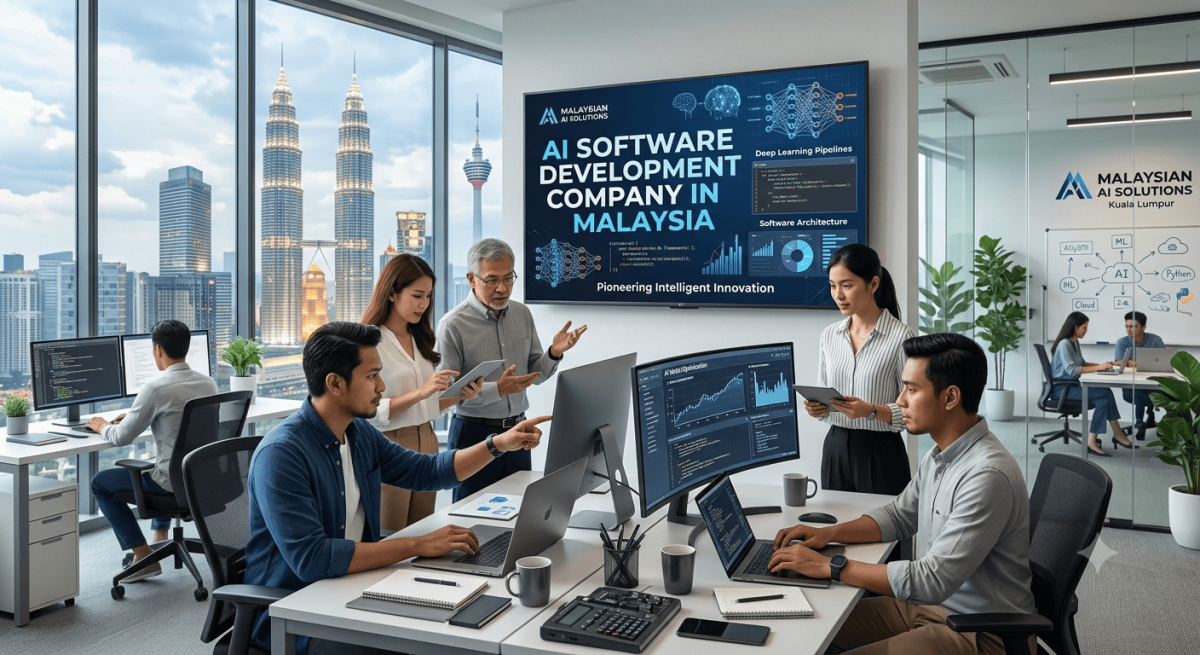
Malaysia is taking a significant step towards becoming a regional artificial intelligence (AI) leader through its National AI Action Plan 2026–2030, also known as AI Nation 2030. The strategy aims to accelerate AI adoption across government, businesses and society while strengthening the country's position in the global digital economy.
For businesses, this initiative represents more than a national technology roadmap. It signals a shift towards intelligent business operations, data-driven decision-making, advanced automation and locally developed AI capabilities. As organisations prepare for this transformation, software development will increasingly focus on building intelligent, scalable and interconnected digital platforms.
The growing demand for enterprise AI adoption will also create opportunities for every AI Software Development Company in Malaysia to contribute to the country's digital transformation journey. From AI-powered enterprise applications to predictive analytics and intelligent automation, businesses will need software solutions that support long-term innovation and competitiveness.
Understanding Malaysia's AI Nation 2030 Strategy
AI Nation 2030 is Malaysia's National AI Action Plan for 2026–2030. It establishes a national direction for developing a responsible, inclusive and sustainable AI ecosystem.
The strategy builds on Malaysia's earlier AI Roadmap 2021–2025, which focused on establishing foundational capabilities such as AI research, digital infrastructure, talent development and governance.
The new action plan shifts attention towards implementation, commercialisation and measurable outcomes. It introduces 28 national initiatives, comprising 14 sector-specific Impact Engines and 14 Foundational Enablers.
Its key ambitions include:
-
Accelerating AI adoption across government, industry and society.
-
Encouraging locally developed and globally competitive AI products.
-
Strengthening AI research, development and commercialisation.
-
Developing advanced AI skills and technical capabilities.
-
Establishing responsible AI governance and security practices.
-
Improving access to data, computing infrastructure and investment.
For businesses, these priorities indicate that AI will become increasingly important in everyday software development, enterprise operations and digital product innovation.
1. Enterprise Software Will Become More Intelligent
Traditional enterprise software primarily relies on predefined workflows, manual inputs and rule-based processes. However, AI is changing how these applications operate by introducing predictive capabilities, intelligent recommendations and automated decision-making.
Under AI Nation 2030, businesses across manufacturing, finance, healthcare, logistics and other industries will have greater opportunities to integrate AI into their existing software environments.
For example, manufacturing companies can use AI-powered applications to monitor equipment performance, predict maintenance requirements and identify production inefficiencies. Financial organisations can implement intelligent fraud detection and automated risk assessment.
Similarly, healthcare platforms can use machine learning to support data analysis and improve administrative workflows.
This transformation will encourage businesses to move beyond conventional applications towards intelligent enterprise platforms that continuously generate operational insights.
2. AI Integration Will Become a Business Software Priority
Many organisations already use ERP, CRM, supply chain management and customer support platforms. However, these systems often operate independently, creating disconnected data environments and operational inefficiencies.
AI Nation 2030 will encourage organisations to make better use of digital infrastructure and data capabilities.
Businesses will increasingly explore AI integration to connect existing applications, automate repetitive activities and improve information accessibility.
For instance, integrating AI into a CRM platform can help sales teams analyse customer behaviour, identify potential leads and generate personalised recommendations. Similarly, AI-powered ERP applications can help organisations forecast inventory requirements and optimise resource allocation.
This creates demand for ai software development services in malaysia that focus on integrating AI capabilities into existing business applications without requiring complete system replacements.
Software development teams will need to prioritise API integration, cloud infrastructure, data interoperability and secure AI architecture to support these requirements.
3. Industry-Specific AI Software Solutions Will Expand
One of the important aspects of Malaysia's AI Nation 2030 strategy is its sector-oriented approach. Instead of treating AI adoption as a single technology initiative, the government aims to accelerate transformation across key economic sectors.
This will create opportunities for industry-specific AI software development.
Some potential applications include:
-
Manufacturing: Predictive maintenance, production monitoring, quality inspection and intelligent automation.
-
Healthcare: AI-assisted diagnostics, patient management, medical data analysis and administrative automation.
-
Finance: Fraud detection, credit risk assessment, financial forecasting and intelligent customer support.
-
Agriculture: Crop monitoring, precision farming, weather prediction and resource optimisation.
-
Logistics: Route optimisation, demand forecasting, warehouse automation and supply chain visibility.
-
Retail: Personalised recommendations, inventory forecasting and customer behaviour analysis.
These applications will require software development approaches that consider industry workflows, regulatory requirements, data availability and business objectives.
Organisations will increasingly invest in ai software development solutions designed around measurable operational outcomes rather than generic AI capabilities.
4. AI Automation Will Reshape Business Operations
Business process automation is moving beyond basic rule-based workflows. Modern AI technologies can understand information, analyse patterns and assist with complex business activities.
AI-powered automation can help organisations reduce manual workloads, improve processing speed and minimise operational errors.
For example, intelligent document processing can extract information from invoices, contracts and business records. AI chatbots and virtual assistants can handle common customer enquiries, while intelligent workflow systems can route requests to the appropriate departments.
Agentic AI can further extend automation by enabling systems to plan and execute multi-step tasks using connected tools, subject to appropriate permissions and human oversight.
As Malaysian businesses adopt these capabilities, software developers will need to build applications that combine automation engines, large language models, APIs and enterprise data sources.
The objective will not simply be to automate individual tasks but to create connected workflows that improve overall business productivity.
5. Data Infrastructure and Cloud Capabilities Will Become Critical
AI applications depend on reliable, accessible and well-structured data. Without appropriate data infrastructure, even advanced AI models may produce inaccurate results or fail to deliver meaningful business value.
Malaysia's AI Nation 2030 strategy identifies data and computing infrastructure as an important foundational enabler for nationwide AI adoption.
This will influence how businesses approach software architecture and infrastructure planning.
Organisations will increasingly evaluate cloud platforms, data warehouses, secure APIs, scalable databases and AI computing environments to support their digital initiatives.
For example, an enterprise implementing an AI-powered customer analytics platform may need to connect information from CRM systems, transaction databases and customer interaction channels.
A well-designed architecture can make this information accessible to AI models while maintaining appropriate security and access controls.
Businesses should therefore consider data readiness, infrastructure scalability and system interoperability before moving AI projects into production.
6. Responsible AI and Software Security Will Gain Importance
As AI adoption expands, organisations must address concerns surrounding data privacy, cybersecurity, transparency, bias and accountability.
Malaysia's AI Nation 2030 strategy places responsible governance and trusted AI adoption among its foundational priorities.
This means businesses cannot evaluate AI software development solely through functionality and performance. They must also consider how applications collect, process, store and use information.
For example, an AI-powered financial application should incorporate appropriate access controls, data protection mechanisms, audit trails and human review processes for important decisions.
Developers must also evaluate model accuracy, monitor AI-generated outputs and establish mechanisms for identifying unexpected behaviour.
Software development companies will need to integrate security and governance considerations throughout the development lifecycle rather than treating them as final implementation steps.
This approach can help organisations build AI applications that are reliable, secure and suitable for enterprise environments.
7. Demand for AI Development Expertise Will Increase
The transition towards an AI-driven economy will increase the need for skilled professionals who can translate business requirements into practical technology solutions.
Businesses will require expertise in machine learning, generative AI, natural language processing, cloud engineering, data science, AI integration and enterprise software architecture.
However, successful AI implementation requires more than access to individual technical specialists. Organisations need development teams that understand business processes, system integration, data governance and application scalability.
Partnering with an experienced AI Software Development Company in Malaysia can help businesses access the technical expertise required to develop, integrate and maintain intelligent applications.
Companies such as Hidden Brains support organisations in exploring AI-driven software development and digital transformation initiatives through technology expertise and customised development approaches.
The emphasis should remain on selecting technologies and development strategies that address actual business challenges rather than adopting AI simply because it is emerging.
How Businesses Can Prepare for AI Nation 2030
Businesses should start preparing for the AI-driven transformation instead of waiting until 2030. A structured implementation approach can help organisations identify opportunities, manage risks and achieve measurable results.
Here are some practical steps:
1. Identify Business Use Cases: Evaluate existing operations and identify processes where AI can improve efficiency, accuracy or customer experience.
2. Assess Data Readiness: Review data quality, accessibility, security and integration requirements before selecting AI technologies.
3. Start with Focused AI Projects: Begin with a practical proof of concept (PoC) that addresses a clearly defined business problem.
4. Modernise Existing Applications: Evaluate legacy systems and identify opportunities for API integration, cloud migration and AI-enabled functionality.
5. Establish AI Governance: Define policies for data privacy, model monitoring, human oversight and responsible AI usage.
6. Work with Experienced Development Teams: Collaborate with technology partners who can support AI strategy, architecture, development, integration and ongoing optimisation.
These steps can help organisations move from experimental AI adoption towards sustainable business transformation.
Conclusion
Malaysia's AI Nation 2030 strategy represents an important shift towards an innovation-driven digital economy. Its focus on sector-specific AI adoption, infrastructure, talent development, responsible governance and commercialisation will influence how businesses build and use software over the coming years.
Enterprise applications will become more intelligent, business workflows will become increasingly automated, and data-driven decision-making will play a greater role in organisational growth.
For companies planning their next phase of digital transformation, investing in scalable AI capabilities will be essential. Working with the right AI Software Development Company in Malaysia can help organisations turn emerging AI opportunities into practical business applications.
With the right technology strategy, businesses can prepare for Malaysia's AI-driven future while strengthening their competitiveness in the global market.







Comments (0)