

Taxi Booking App Development Services: What to Consider
Explore Taxi Booking App Development Services: What to Consider

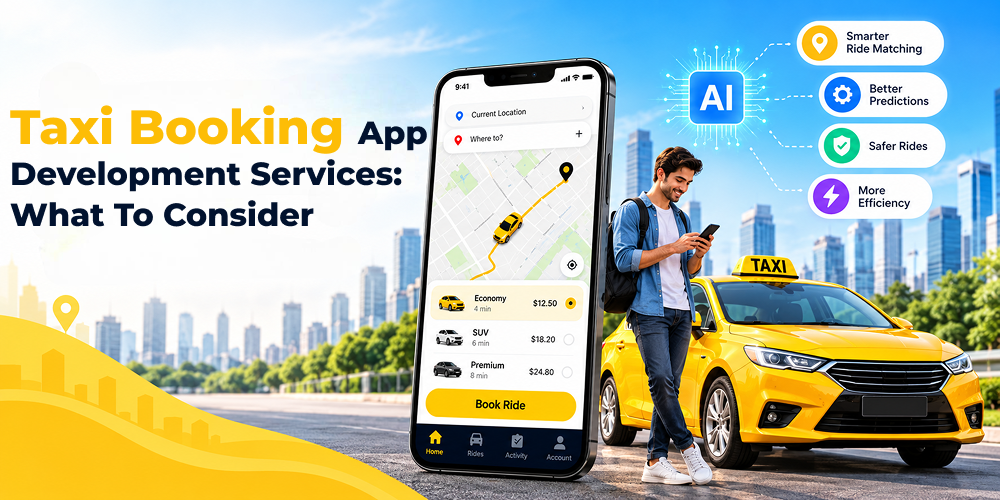
Starting a taxi company is not just about cars and drivers these days. Customers require fast booking, arrival time, secure payments, and reliable service. The right technology is needed to meet these expectations. That's where taxi booking app development services can help. They assist businesses in creating digital platforms for passengers, drivers, and administrators to be brought together in a single system. But the selection of the appropriate method of development demands careful planning.
Choosing features, estimating expenses, each of them can impact your business development. This guide will give you an insight into what to consider before investing in taxi booking app development services.
1. Understand Your Business Requirements
Define your taxi business needs before developing an app. A startup in one city might require a different solution than an established operator with hundreds of drivers. First, you should know who your target customers are, what areas of service you provide, what types of vehicles you have, and how you generate revenue. Choose between local rides, airport transfers, corporate travel, chauffeur service, and ride-sharing. The process of development will be based on your business model. For instance, if you're having an airport transfer service, they might require you to book in advance and provide flight information. An instant booking and real-time driver matching feature can be vital to an urban taxi service. Clear requirements help you avoid unnecessary features and control development costs. They also give your development partner a better understanding of your goals.
2. Choose Between Custom and White-Label Development
The first step is to select between building a custom taxi app or opting for a white label. Custom taxi app development provides you with greater control over features, design, integrations, and business rules. You can build a platform to suit your operations and add new features to it as your business expands. White label taxi app development provides an expedient method to be part of the market. The solution can be rebranded with the company’s name, logo, and preferred design. It could be an option for companies that wish to get started without developing all the pieces themselves. Both are not going to be suitable for all businesses. The difference is that the white label is for businesses who want to launch quickly, whereas custom development might be more appropriate for an existing company with special dispatch requirements. You may use a combination of the two methods. Take your service and build it on a solid basis, and add the elements that set you apart.
3. Identify the Essential App Features
The taxi booking platform should certainly have more than just a booking screen. Every user group needs tools that help them to do their work more easily. The passenger app should enable easy registration, booking of rides, fare estimation, tracking of real-time location, safe payment, history of rides, and rating for the rides. The booking updates should be clear, making customers understand easily. The driver app should contain ride requests, navigation, pickup information, trip status details, and earnings information. Another important aspect of availability management is that drivers should easily be able to accept or decline requests and manage their availability. The admin panel should give a day-to-day view of the operations. Administrators have the tools to manage drivers, keep of trips update the fares, handle complaints, and review business reports. Select features for actual customer and operational requirements. If demand increases, loyalty programs can be added along with scheduled rides, etc as advanced options.
4. Evaluate Dispatch and Fleet Management Capabilities
Among the most crucial components of a taxi booking platform is dispatch. Insufficient driver allocation can cause delays, increase fuel usage, and irritate customers. Search for taxi dispatch software that can match drivers with passengers based on various aspects including location, availability, and estimated arrival time. The system should also allow reassigning rides, canceling rides, and marking periods as busy. The fleet management tools also provide additional control. They are used to track the location of vehicles, review driver activities, schedule maintenance, and track vehicle usage by the operators. The platform needs to be compatible with businesses that have multiple cities, and each city has its own pricing rules. This allows for easier fleet management with no extra manual workload.
5. Check Integration and Customization Options
Your taxi app will have to integrate with a number of external tools. Common integrations are maps, payment gateways, SMS notifications, email services, and analytics. Maps integrate to make routing calculations and estimate arrival times. Payment integrations enable passengers to pay using the accepted modes of payment. Users are notified of bookings, cancellations, and completed rides. Think about integration with your current business systems. Other software that you might require includes corporate billing and accounting software or customer relationship management tools. Other use cases can be aided by AI-powered solutions, such as demand forecasting, estimated arrival time improvements, and fraud detection. But only when they address a real business need, make sure to implement these capabilities. A flexible platform allows the integration of new services in a simpler way without having to replace the whole system.
6. Review Security and Payment Management
Passengers share personal details, location data, and payment information when booking rides. Protecting this information should be a priority from the beginning. Ask your development partner how the platform handles data encryption, account access, authentication, and software updates. Administrative permissions should also limit access to sensitive business information. Payment processing needs equal attention. Choose suitable payment providers and ensure the app handles failed transactions, refunds, and payment confirmations correctly. Your platform should also follow the privacy and payment requirements that apply in your operating markets. For businesses serving customers in multiple countries, these obligations may differ by region. Strong security practices help protect your business and build customer trust.
7. Understand the Development Cost and Timeline
Taxi booking app development costs vary based on the project’s scope. A basic white label solution will generally require less initial work than a custom platform with advanced dispatch and fleet management features. The main cost factors include the number of apps and dashboards, design complexity, backend development, third-party integrations, and testing requirements. Ongoing expenses also matter. Hosting, map usage, payment processing, technical support, and future upgrades can affect your operating budget. Ask for a clear estimate that separates the initial development from recurring costs. Your development partner should also explain the project stages, expected milestones, and factors that could affect the delivery. Planning for future maintenance helps you avoid unexpected expenses after launch.
8. Look for Long-Term Support and Scalability
Launching your app is only the beginning. Once real customers start using it, you may discover issues or opportunities that were not obvious during development. Choose a company that offers reliable technical support, bug fixes, upgrades, and performance monitoring. Regular updates help keep the platform stable as devices, operating systems, and business needs change. Scalability is equally important. Your app should be able to accommodate more users, drivers, bookings, and service locations without requiring a complete rebuild. Ask how the company handles future integrations, new vehicle categories, and additional business models. A clear upgrade path can protect your initial investment and support long-term growth.
9. Assess the Development Company's Experience
The right development partner should understand both technology and taxi operations. Review its portfolio, relevant project experience, development process, and support arrangements before making a decision. Ask how the team approaches driver allocation, fare calculation, payment failures, and peak-hour demand. Their answers can reveal whether they understand the practical challenges of running a taxi business. You should also clarify ownership of the source code, access to project documentation, and responsibility for future updates. A dependable partner will discuss your requirements before recommending a solution. This helps ensure that the final product supports your business goals rather than simply copying another app.
Build a Taxi Booking App That Supports Your Growth
Choosing taxi booking app development services requires more than comparing prices or looking at attractive designs. You need a platform that fits your business model, simplifies daily operations, protects customer data, and adapts to future demand. Partner with Uplogic and start with clear requirements, prioritize essential features, and evaluate the development company's technical capabilities and long-term support. Consider custom development, white-label solutions, integrations, and fleet management tools based on your needs. With the right development strategy, your taxi booking app can become a reliable foundation for delivering better service and expanding your business.













Comments (0)